Last updated: July 14, 2026
- Use keyword-focused, clear titles and meta descriptions: Put your primary keyword near the front of the H1, keep titles under 60 characters, and write meta descriptions (140–160 characters) that state exactly what the page offers.
- Structure content with headings and clean URLs: Break text up with logical H2s and H3s that include relevant keywords, and use short, descriptive, hyphenated URLs that reflect the page topic.
- Optimize images for speed, SEO, and accessibility: Compress images before upload, use keyword-rich filenames, and add descriptive alt text to improve load times, rankings, and accessibility.
- Link internally to support SEO and user flow: Add links to related services, blog posts, and case studies to distribute SEO value, keep visitors engaged, and guide them toward conversions.
- Write for humans first, then fine-tune for search: Answer your audience’s real questions clearly, avoid keyword stuffing, and let readability and usefulness lift both engagement and rankings.
Most marketing managers in B2B manufacturing wear a lot of hats: strategy, execution, content, campaigns, and analytics. Somewhere in the middle of all that, you are also expected to “handle SEO.”
You already know your website needs to rank. You know search visibility drives lead generation. But carving out time to become an SEO expert? Not in the cards.
Here is the good news: you do not need to master every algorithm update to improve your site’s visibility. With a working grasp of on-page SEO, you can make high-impact updates quickly and show measurable results. This guide is built specifically for mid-level marketers like you. Let’s dive in.
What Is On-Page SEO, and Why Does It Matter for Manufacturers?
On-page SEO is the set of elements you control directly on your website that help search engines understand your content and rank it appropriately. It covers everything from your headlines to your image files, and it is the part of SEO you can change today without waiting on a developer or a backlink campaign.
We cover this in more depth in LinkedIn Advertising for Manufacturers: A B2B Marketing Guide.
That includes things like:
- Headlines and metadata
- URL structure
- Internal linking
- Image optimization
- Page structure and readability
In manufacturing, buyers are technical and research-driven, so showing up for the right search terms is critical. A procurement engineer comparing CNC suppliers or a plant manager researching hydraulic components is searching with specific, high-intent language. Strong on-page SEO makes sure your valuable content actually gets found by those buyers — and increasingly, that it gets pulled into AI answer engines like Google AI Overviews and ChatGPT, which lift clear, well-structured answers straight off your pages.
On-Page vs. Technical SEO: What Is the Difference?
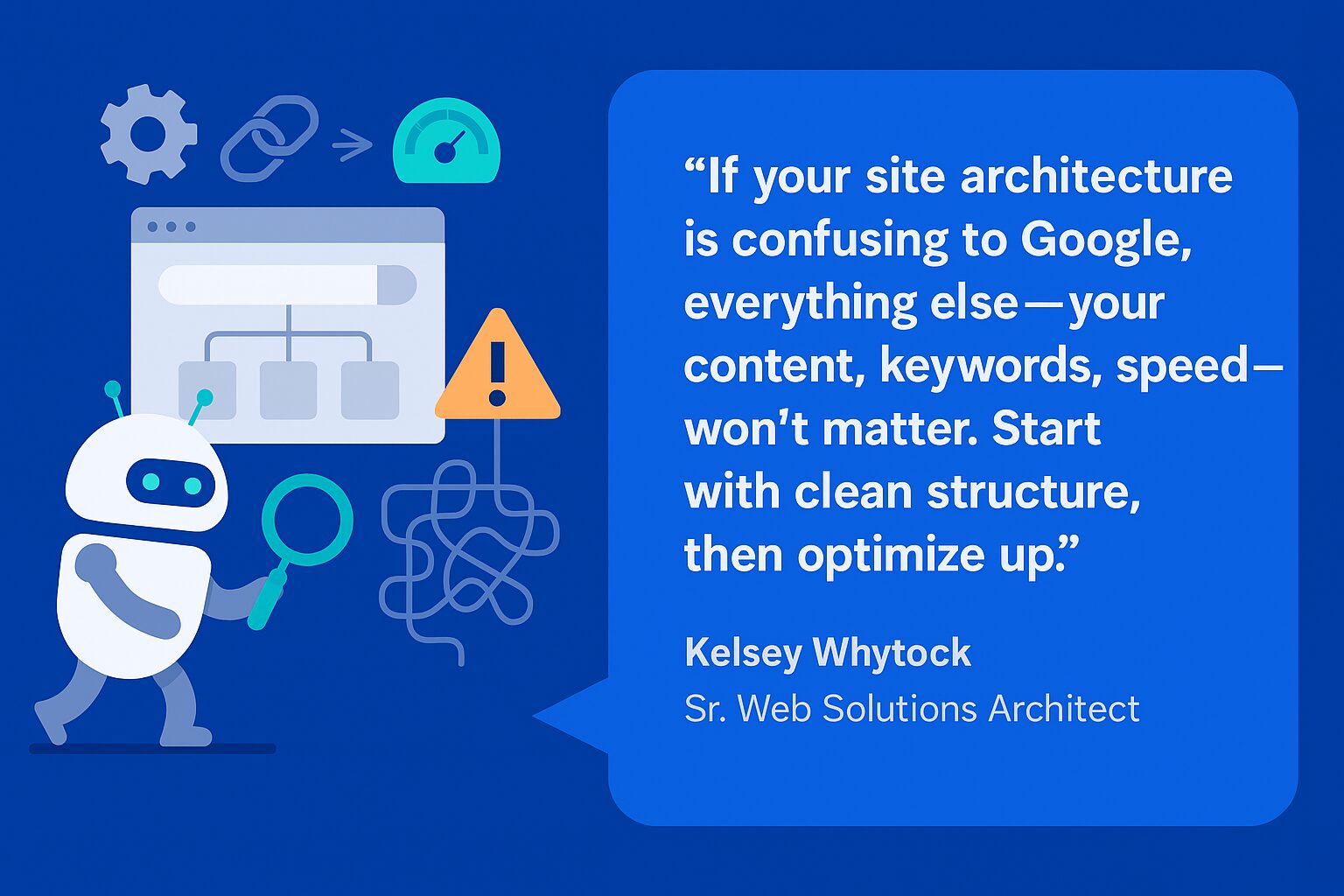
On-page SEO is the content and HTML you edit on an individual page — titles, headings, body copy, internal links, and image alt text. Technical SEO is site-wide plumbing that helps engines crawl and index you at all: site speed, mobile-friendliness, XML sitemaps, and structured data. Most marketing managers can own on-page work directly, while technical fixes usually involve a developer.
The On-Page SEO Essentials You Can Tackle Today
You do not need to overhaul your site to see improvements. Focus on the high-impact basics below for immediate wins. Here is the short version before we break each one down:
| On-page element | What to do | Why it matters |
|---|---|---|
| Page title (H1) | Lead with your target keyword; keep it under 60 characters; make it benefit-driven. | Tells users and search engines what the page is about at a glance. |
| Meta description | Write 140–160 characters that include the keyword and state what the page solves. | Influences click-through from the search results, even though it is not a ranking factor. |
| Headings (H2s, H3s) | Use one H1, then logical H2s and H3s with keywords in one or two of them. | Helps readers skim and helps engines parse the structure of your content. |
| URL structure | Keep URLs short, lowercase, and hyphenated; include the target keyword. | Clean URLs are easier to read, share, and crawl. |
| Internal links | Link to related services, blog posts, and case studies using descriptive anchor text. | Distributes SEO value and guides visitors toward conversion. |
| Images | Compress before upload, use descriptive filenames, and add meaningful alt text. | Speeds up the page, supports accessibility, and adds ranking signals. |
1. Use Keyword-Focused, Clear Page Titles (H1 Tags)
Your primary page title, usually in the H1 tag, tells both users and search engines what your page is about. Make it specific to the product, service, or industry the page serves.
Quick checklist:
- Include your target keyword near the beginning
- Keep it under 60 characters
- Make it clear and benefit-driven, and avoid vague internal jargon
For example, instead of “Solutions for Success,” try “Custom CNC Machining Services for Aerospace Manufacturing.” The second version names the service and the industry, so it matches what a technical buyer actually types into Google.
2. Optimize Meta Descriptions for Click-Throughs
Meta descriptions do not directly affect rankings, but they do influence clicks. Think of the meta description as your page’s sales pitch on the search results page.
Best practices:
- Write 140–160 characters
- Include the primary keyword
- Clearly state what the page offers or solves
These two levers — sharper titles and metadata — are exactly where we start when we optimize a manufacturing site. In our work with EZTube, a manufacturer that already ranked for a large number of keywords but converted poorly, our team rewrote headings around better target keywords and reworked page metadata to lift click-through from search. That on-page-first approach helped drive a 95% year-over-year increase in ecommerce purchases, alongside a 17% jump in total users and an 11% rise in key conversion events — all without a new ad budget.
3. Structure Content with Headings (H2s, H3s)
Search engines scan subheadings to understand the flow and topics of your content, and so do readers. According to Google Search Central, readers appreciate pages organized into clear paragraphs and sections with headings that help them navigate, and the same structure helps its generative AI features surface your content.
Tips:
- Use one H1 per page, followed by logical H2s and H3s
- Break up content every two to three paragraphs
- Include keywords in at least one or two subheadings
4. Make URLs Clean and Descriptive
Avoid URLs like www.example.com/page123?id=57&ref=xyz. Instead, use www.example.com/industrial-pump-repair, which tells both people and search engines exactly what the page covers.
Guidelines:
- Keep URLs short, lowercase, and hyphenated
- Include your target keyword
- Avoid dates unless they are essential
5. Add Internal Links Thoughtfully
Linking to other pages on your site helps distribute SEO value and keeps visitors engaged. This is also the step that turns a blog post into a lead path: a supporting article should point readers toward the SEO strategy service or product page it relates to.
Try linking to:
- Related services or blog posts, such as our guide to how Google actually sees your manufacturing website
- Case studies that support the page’s content
- Product pages tied to the topic
Done well, internal linking also supports better site navigation and conversion rate optimization.
6. Optimize Images for Speed and SEO
Large or unoptimized images slow your site down, and slow sites do not rank well. Image optimization is one of the fastest technical wins available to a non-developer.
You can explore this further in Is SEO Dead? Why It Survives Every Google Shake-Up.
Checklist:
- Compress images before uploading
- Use descriptive filenames, such as hydraulic-valve-installation.jpg
- Add alt text that describes the image and includes keywords naturally
- Ensure images meet accessibility standards
7. Write for Users First, Then Fine-Tune for Search
Google prioritizes helpful, reliable content created to benefit people, not content built to manipulate rankings. According to Google Search Central, its automated ranking systems are designed to reward people-first content. So avoid keyword stuffing and focus on answering your audience’s real questions.
The difference between the two approaches is easy to spot once you know what to look for:
| People-first content | Search-engine-first content |
|---|---|
| Answers a real question your buyers ask | Written mainly to chase a keyword |
| Demonstrates first-hand expertise and specifics | Restates what everyone else already published |
| Leaves the reader satisfied and informed | Sends the reader back to Google for a better source |
| Written naturally for a technical audience | Stuffed with repeated phrases and filler |
Ask yourself:
- Does this page clearly explain the topic?
- Is it tailored to someone in manufacturing, not general business?
- Would I stay on the page, or hit the back button?
If it reads like it was written for a person, not a robot, you are on the right track. If you market in a regulated or highly technical niche, our breakdown of biotech SEO dos and don’ts shows how this people-first principle plays out in practice.
In What Order Should You Fix On-Page SEO?
When everything feels urgent, work in priority order so the fastest, highest-impact fixes come first. A simple sequence we use with manufacturing marketers:
- Titles and meta descriptions on your top revenue pages — quick edits that lift click-through immediately.
- Headings and on-page copy so each page clearly answers one buyer question.
- Internal links from supporting content to the service and product pages you want to rank.
- Images and page speed to remove friction and protect rankings.
Start at the top of that list and you will see movement before you reach the bottom.
When Should You Hire an SEO Agency Instead of Doing It Yourself?
Handle on-page SEO in-house when the fixes are content edits — titles, headings, links, and alt text — and you have time to make them consistently. Consider bringing in an agency when the work turns technical (site migrations, structured data, Core Web Vitals), when results stall despite steady effort, or when you simply do not have the hours. Many teams do the basics themselves and hand off strategy and technical depth.
Advanced Bonus: Schema Markup (Optional)
If you have some developer support, adding schema markup (structured data) helps search engines better interpret your content and can unlock rich results like FAQs or ratings. It is not required, but it is worth exploring down the line alongside your web design and development partner.
What Does On-Page SEO Success Look Like?
You are not aiming to become an SEO wizard overnight. But with consistent on-page updates, here is what you can expect over time:
- Higher visibility for key pages in organic search
- More qualified visitors arriving from relevant terms
- Increased engagement, including more time on page and lower bounce rate
- Clearer conversion paths and more form fills
- Better synergy between paid and organic campaigns
- Stronger support for lead generation
For a deeper look at what the search engines are reading on your site, our companion guide on how Google actually sees your manufacturing website pairs well with this checklist.
How 3 Media Web Can Help
At 3 Media Web, we help manufacturing marketers bring clarity, performance, and results to their SEO strategy without overcomplicating it. Our team handles the technical detail so you can stay focused on the campaigns and results your leadership cares about.
Our on-page SEO services include:
- Full-page audits with actionable recommendations
- Keyword strategy aligned to buyer intent
- Content editing and metadata updates
- Image optimization and page speed improvements
- Ongoing collaboration with your team or web design and development partner
Whether you want a quick win or a long-term roadmap, we will help you turn your website into a search-friendly, results-driven asset that evolves at the pace of your business. Reach out when you are ready to get your site to rank.