Last updated: July 6, 2026
- Most partnerships fail for predictable reasons: unclear goals, poor communication, misaligned values, weak accountability, and no long-term view.
- Evaluate a partner before you sign by agreeing on success metrics, a communication cadence, and named owners on both sides.
- Values misalignment is the hardest pitfall to fix later, so screen for it early.
- The strongest partners act as an extension of your team, not a vendor you have to manage.
- Use the five-point checklist below to spot warning signs before they become deal-breakers.
How do you evaluate a partnership before it fails?
Evaluate a partnership against five criteria: shared goals, communication habits, values fit, accountability, and long-term commitment. A partner who clears all five behaves like an extension of your team. A partner who fails even one is where most of the risk lives, because small gaps in any of these areas tend to widen over the life of an engagement.
Few things are more frustrating than entering a partnership with high hopes, only to watch it unravel. Deadlines slip, expectations get missed, and the trust you once felt fades. Beyond wasted time and budget, a failed partnership carries a quieter cost: damaged credibility with the clients and stakeholders who were counting on you to make the right call. The risk is real, too. According to Harvard Business Review (2007), the failure rate for corporate alliances hovers between 60% and 70%. The good news is that most of these pitfalls are visible in advance when you know the warning signs and build guardrails into how you choose a strategic support partner.
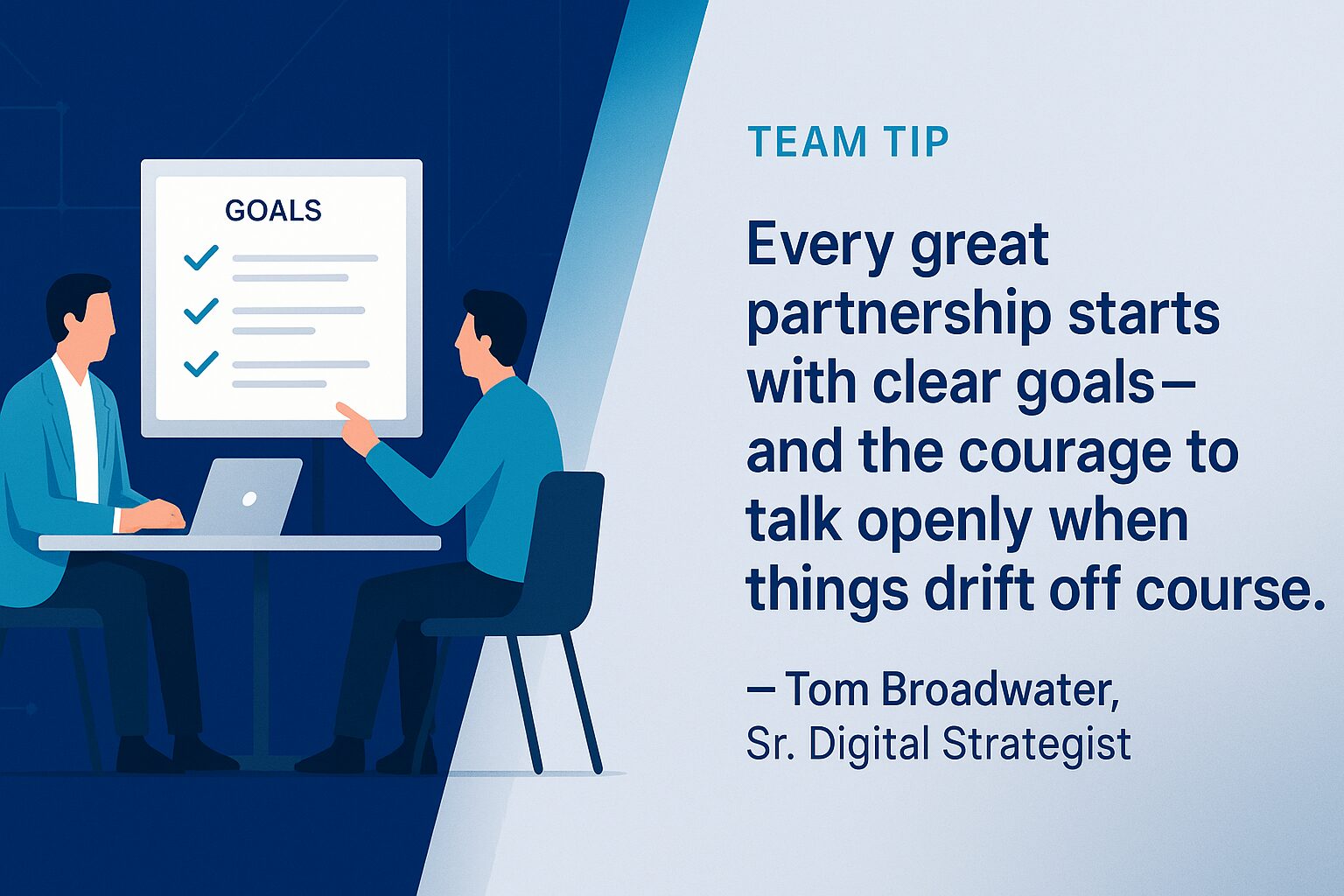
What is the difference between a vendor and a strategic partner?
A vendor delivers a defined task and waits for the next ticket. A strategic partner takes ownership of an outcome, anticipates what you need next, and reports proactively even when you have not asked. The difference shows up under pressure: a vendor protects its own scope, while a partner protects your result. Screening for that behavior early is the whole point of evaluating a partnership before you commit.
Pitfall 1: Unclear goals and expectations
Unclear goals are the most common reason partnerships collapse, because each side quietly defines success differently. One partner measures wins by speed, the other by quality, and neither realizes the mismatch until a deadline arrives. Define what winning looks like together, in writing, before any work begins.
To set shared expectations from day one:
- Define success metrics together before kickoff, not after the first miss.
- Agree on timelines, deliverables, and responsibilities in writing.
- Establish a recurring process for reviewing progress against those metrics.
When everyone agrees on the target, alignment becomes the default rather than a negotiation. This is also where a strong ongoing strategic support partner earns trust early, by tying every deliverable back to a goal you both named. The best partners go a step further and simplify complex needs into a clear plan instead of handing you more complexity to manage.
Pitfall 2: Poor communication
Silence is the fastest way to erode trust in a partnership. When updates stop, one side is left guessing, and a small issue you could have solved in a five-minute message snowballs into a missed milestone. Strong partners over-communicate on purpose, sharing the hard news as readily as the wins.
Healthy communication habits include:
- Scheduled check-ins with a clear agenda and owner.
- Open sharing of both progress and problems, early.
- Transparent reporting on results, not just activity.
Consistent, proactive communication builds confidence and removes unpleasant surprises. In our work with recruiting-software company JazzHR, that steady cadence is what changed the relationship: their senior marketing manager told us we were “the first vendor that actually gets us,” noting that we send reporting and updates “even when we’re not asking.” That trust let a project-based engagement grow into ongoing support that produced measurable outcomes, including a 133% lift in demo conversions and zero website incidents after we took over a site that had been going down roughly once a month. Ongoing website support works the same way: the value is in the steady cadence, not the occasional heroic fix.
Pitfall 3: Misaligned values
Values misalignment derails partnerships even when the technical skill is excellent, and it is the hardest pitfall to repair after the fact. A partner who cuts corners under pressure will keep cutting them, so screen for how they behave when a deadline is tight, not just what they promise in a pitch.
Warning signs to watch for:
- Cutting corners on quality to hit a date.
- Prioritizing their own convenience over the client experience.
- Resistance to collaboration, feedback, or hard conversations.
The strongest partnerships share values around quality, collaboration, and client success. According to Harvard Business Review (2007), the most successful partners focus less on the business plan and more on how the two sides will actually work together, which is exactly what values alignment protects. If the warning signs are already showing in a current vendor, learn to spot the red flags in a web vendor relationship and how to switch smoothly before they cost you.
Pitfall 4: Lack of accountability
A partnership fails when no one clearly owns the outcome. When responsibilities are vague, both sides assume the other is handling a task, and the work falls through the gap. According to a CMO Council study reported by Forbes (2014), only 33% of companies had a formal partnering strategy, and that missing ownership is a leading reason alliances languish. Name a point of contact on each side and document who owns what before the engagement starts.
Build accountability in from the beginning:
- Assign a single, named point of contact on both sides.
- Document responsibilities for every major deliverable.
- Hold regular reviews where ownership is reinforced, not relitigated.
Accountability is the glue that keeps commitments from slipping. It is also what lets results-focused work like SEO, lead generation, and conversion rate optimization stay measurable, because someone is always answerable for the number.
Pitfall 5: No long-term perspective
Partnerships built only for short-term convenience tend to fail when your needs change. A partner focused on the current ticket will not anticipate what comes next, so you end up restarting the search every time your strategy shifts. Choose partners who invest in your growth beyond the project in front of them.
Ask yourself before committing:
- Does this partner proactively bring new ideas to the table?
- Are they invested in the business beyond the current scope of work?
- Do they evolve as your goals and market shift?
Partners who deliver long-term value spare you the constant churn of finding replacements. That continuity is also what makes good habits like accessibility compound over time instead of being treated as a one-off task. For agencies that need to extend their bench without adding headcount, dependable agency partnership support is what turns a one-off subcontractor into a long-term extension of the team.
When should you walk away from a partnership?
Walk away when a warning sign repeats after you have named it directly and nothing changes. One missed deadline is a conversation; a pattern of quiet updates, cut corners, or dodged accountability is a decision. If a prospective partner shows these signs during the sales process, when they are trying hardest to impress you, treat that as your best-case preview and move on before a contract makes leaving expensive.
A 5-point checklist to evaluate any partner
Use this checklist as a fast screen before you commit to a new partner. Compare what a strong partner looks like against the warning sign in each area. If a prospective partner cannot give a confident answer in all five rows, treat the gap as a warning sign worth resolving before you sign.
| Evaluation area | What a strong partner looks like | Warning sign to watch for |
|---|---|---|
| Goals | Success is defined and written down together before kickoff. | Each side describes “winning” differently, or nothing is in writing. |
| Communication | A clear cadence, a named owner, and reporting on results. | Updates go quiet; you find out about problems late. |
| Values | Quality and the client experience are protected under pressure. | Corners get cut to hit a date; feedback meets resistance. |
| Accountability | A single named owner for every deliverable on both sides. | Responsibilities are vague and tasks fall through the gap. |
| Long-term fit | Invested in your growth beyond this one project. | Focused only on the current ticket, with no new ideas. |
The right partner treats this kind of strategic support as the baseline, not a stretch goal.
Frequently asked questions
What is the most common reason partnerships fail?
Unclear goals and expectations are the most common reason. When each side defines success differently and never aligns in writing, the mismatch surfaces at the worst moment, usually a missed deadline. Agreeing on shared success metrics before work begins prevents most of this failure mode.
How do you evaluate a partner before signing a contract?
Screen the partner against five criteria: shared goals, communication habits, values fit, accountability, and long-term commitment. Ask how they handle a tight deadline, who your single point of contact will be, and how progress gets reported. Confident, specific answers signal a partner who behaves like an extension of your team.
Why does values misalignment matter if a partner is skilled?
Technical skill cannot offset a partner who cuts corners or resists feedback under pressure. Values misalignment is the hardest pitfall to fix after an engagement starts, because behavior rarely changes mid-project. Screening for how a partner acts when a deadline is tight protects the client experience and your credibility.
What does accountability look like in a healthy partnership?
Healthy accountability means a named owner for every major deliverable on both sides, documented responsibilities, and regular reviews where ownership is reinforced. When work is measurable and someone is always answerable for the result, small issues get caught early instead of falling through the gaps between teams.
How long should you give a struggling partnership before switching?
Give it one clear, documented conversation and a defined window to correct, usually a single project cycle. Name the specific gap, agree on what “fixed” looks like, and set a date to review. If the same problem returns after that, the issue is behavioral, not situational, and switching is the lower-risk choice.
How 3 Media Web Can Help
The right partnership is about more than ticking boxes. At 3 Media Web, we build trust by acting as a strategic support partner across the areas that move your digital growth, guided by our Human and AI approach so judgment leads and automation supports. That includes:
- Custom web design and development that aligns your site with your business goals.
- Proactive website support that keeps your site performing reliably.
- Results-driven SEO, lead generation, and conversion rate optimization that stay measurable.
- Accessibility best practices that make your site inclusive and compliant.
By consolidating expertise and focusing on outcomes, we help organizations avoid the five pitfalls above and build partnerships that adapt as their needs change.
For the bigger picture, see the full Agency Partnership Playbook.
Ready to work with a partner who evolves at the pace of your business? Reach out to our team to talk through your goals and see how a true partnership should feel.