Last updated: July 6, 2026
- Refer a web partner without risking your reputation by vetting for proven results, clear communication, and shared values, then setting expectations in writing before you make the introduction.
- A referral is read as an endorsement, so the partner’s performance reflects directly back on you, for better or worse.
- The biggest risk is a partner who goes silent after the handoff; screen for communication cadence before you commit.
- Stay involved after the introduction and follow up with your client so the relationship strengthens your standing instead of testing it.
- Use the green-light vs. red-flag checklist below to vet any partner before your name is attached to them.
How do you refer a web partner without risking your reputation?
Refer a web partner without risking your reputation by vetting them against four things before any introduction: proven results, a reliable communication style, shared values, and a documented process. Then set expectations in writing, stay in the loop after the handoff, and follow up with your client. Done in that order, a referral positions you as a trusted advisor rather than gambling the credibility you have spent years building.
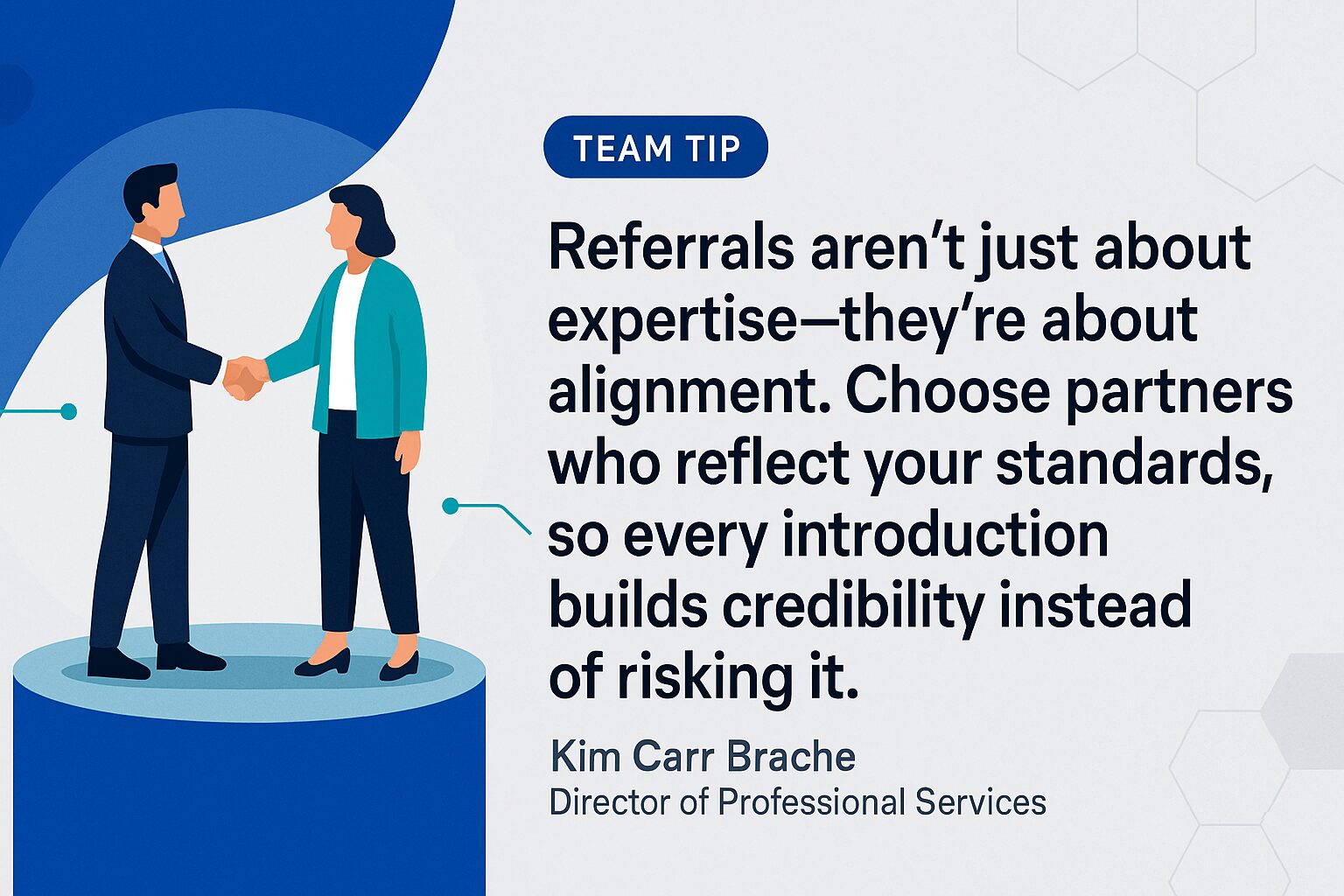
When you refer a partner to your clients, your reputation is on the line. A strong referral can open the door to more opportunities and deepen the trust your clients already place in you. A poor one can damage that confidence, create friction, and cost you business. The stakes are not just a feeling, either. According to Forrester (2025), B2B buyers trust the vendors they currently work with more than almost any other information source, second only to their own colleagues, which is exactly why your endorsement carries so much weight when you pass a client along.
Related reading: How to Streamline Your Partner Program for Easier Handoffs.
What is a web partner referral?
A web partner referral is when you recommend an outside web design, development, or digital marketing firm to a client whose needs fall beyond your own scope. Unlike a casual name-drop, a referral carries your implied endorsement: the client hears it as “this is who I trust.” That is why a referral is best treated as a small extension of your own brand, not a favor you hand off and forget.
Why does referring a partner feel so risky?
Referring a partner feels risky because clients read the referral as a personal endorsement, so any failure on the partner’s side reflects back on you. If the partner underdelivers, the disappointment does not stop with them; it lands on the person who made the introduction. That is why so many leaders hesitate even when a client clearly needs outside help.
Most of that hesitation comes down to a handful of recurring fears:
- A bad past experience with a partner who went silent after the handoff.
- Losing control of a client relationship you worked hard to earn.
- A partner who overpromises in the pitch and underdelivers in the work.
- Any chance of reputational harm with a client who trusts your judgment.
The hesitation is rational, but avoiding referrals altogether has a cost too. According to Texas Tech University research (reported by Haus Advisors), 83% of satisfied customers are willing to refer after a positive experience, yet only 29% actually do. That 54-point gap is the upside you leave on the table when fear wins. The way to close it is not blind trust; it is a repeatable framework for how you choose, vet, and introduce a partner. Much of this overlaps with how you evaluate any partnership before it fails.
What should you look for in a web partner before referring them?
Look for a web partner with proven results, a fast and clear communication style, shared values, a client-first mindset, and a documented process. A partner who demonstrates all five behaves like an extension of your team, which is what protects your reputation. A partner who is missing even one is where the risk concentrates, because small gaps tend to widen once your client is depending on them.
We unpack this further in The Dos and Don’ts of a Healthy Partner Agreement.
Before you make an introduction, weigh each trait against the warning sign that should give you pause:
| What to vet | Green light (refer with confidence) | Red flag (vet further first) |
|---|---|---|
| Proven expertise | A track record of results in areas like web design, development, or SEO, backed by case studies. | Vague claims with no examples, references, or measurable outcomes. |
| Communication style | Responds quickly and clearly, and sets a cadence so your client is never left waiting. | Slow or inconsistent replies, especially before they have even won the work. |
| Shared values | Transparency and accountability that match your own standards under pressure. | Cutting corners to hit a date, or deflecting blame when something slips. |
| Client-first mindset | Focused on making your client feel supported rather than closing a quick sale. | Pushes the biggest package up front, before understanding the real need. |
| Documented process | A clear path from onboarding to follow-up that removes uncertainty for everyone. | Every engagement is improvised, with no repeatable steps to point to. |
If a prospective partner cannot give you a confident, specific answer in every row, treat the gap as a reason to dig deeper before your name is attached to them.
In our work with JazzHR, a recruiting software company, this is exactly how a vendor becomes a partner worth referring. JazzHR came to 3 Media Web looking for a reliable web partner after monthly outages were costing them leads. Because we led with proactive reporting and clear communication, that project grew into ongoing support: their site went from roughly monthly outages to zero incidents, demo conversions rose 133%, and the partner marketplace we built generated 250+ new partner requests and 30+ opportunities. As their senior marketing manager put it, “3 Media Web is the first vendor that actually gets us.” That kind of track record and transparency is precisely what makes a partner safe to put your name behind.
When should you refer a client to a web partner instead of doing the work yourself?
Refer a client to a web partner when the work sits outside your core expertise, when your team lacks the capacity to deliver on time, or when specialized skills like development, SEO, or accessibility are required to do it right. Trying to stretch beyond your lane risks the very relationship a referral is meant to protect. A well-matched partner lets you keep owning the strategy while someone accountable owns the execution.
How do you protect your reputation with every referral?
Protect your reputation by doing your own due diligence, setting expectations up front, staying in the loop after the handoff, following up with your client, and reviewing results together. Protecting your credibility does not mean avoiding referrals; it means building light guardrails into how you make them. Follow these five steps and each recommendation reflects positively on you:
- Do your own due diligence. Ask for case studies, speak with past clients, and confirm the partner’s team has the capabilities you expect.
- Set expectations up front. Clarify what the partner will deliver and communicate that to your client before the introduction, so no one is surprised later.
- Stay in the loop. Even after you make the referral, check in with both sides to confirm communication is smooth.
- Follow up with your client. A quick call or email reinforces that you are invested in their success, not just passing them off.
- Review results together. If the partner delivered, celebrate the win and consider making them a go-to resource.
These steps matter most when a client is stretched thin. If the person you are referring is a small in-house team, the partner’s ability to help prioritize website tasks for a team of one or two can be the difference between relief and one more thing to manage. Agencies and consultants who make referrals regularly often formalize this with dedicated agency partnership support, so the vetting and handoff run the same way every time.
How do referrals build long-term trust?
Referrals build long-term trust by proving you can solve problems beyond your own scope, which is exactly what a trusted advisor does. When you consistently connect clients with the right partners, you become the first call when new challenges arise, and that loyalty compounds over time. Each successful introduction is evidence that your judgment is worth following.
Our post How to Protect Your Reputation When Making Agency Referrals explores this in more detail.
This is where a strong strategic support partner earns its place. The right partner treats your referral as if the client were their own, ties every deliverable back to a goal you both named, and reports on outcomes rather than activity. Over time, those wins turn one-off introductions into a durable network your clients come to rely on, and that reflects well on the person who built it.
Frequently asked questions
How do you refer a web partner without risking your reputation?
Vet the partner before any introduction against proven results, communication style, shared values, and a documented process. Then set expectations in writing, stay involved after the handoff, and follow up with your client. That sequence turns a referral into evidence of good judgment rather than a gamble on someone else’s performance.
Why does referring a partner feel so risky?
Because clients read a referral as your personal endorsement, so the partner’s performance reflects directly back on you. A partner who goes silent or underdelivers can damage a relationship you spent years building. The risk is real, but a clear vetting and follow-up process removes most of it before the introduction is ever made.
What should I look for before referring a web partner?
Look for proven expertise with real case studies, a fast and clear communication cadence, values that match yours under pressure, a client-first mindset, and a documented process from onboarding to follow-up. A partner who demonstrates all five behaves like an extension of your team; a partner missing even one is where reputational risk concentrates.
How do I set expectations before making an introduction?
Clarify exactly what the partner will deliver, in what timeframe, and through which point of contact, then share that with your client before the handoff. Putting scope and cadence in writing prevents the mismatched assumptions that sour partnerships. It also gives you a clear reference point if you ever need to step back in.
How do you write a referral introduction email?
Keep it short and set the frame. Name why you trust the partner, state exactly what they will help with, and hand off a single point of contact so nothing stalls. One or two sentences of context for each side is enough. A clear, confident intro signals that you have vetted the partner and are staying involved, not disappearing after send.
What if a referral goes wrong despite my vetting?
Stay involved early so you catch problems before they escalate. If the partner is underdelivering, address it directly with both sides, document what was promised, and help your client course-correct quickly. Owning the follow-up, rather than disappearing, is what preserves your credibility even when an engagement does not go as planned.
How 3 Media Web Can Help
If you are looking for a partner you can confidently recommend, 3 Media Web is built for long-term, trust-driven collaboration, guided by our Human and AI approach so judgment leads and automation supports. We treat every referral as if they were our own client, with clear communication and proactive guidance at every step. Our expertise spans:
- Custom web design and development that aligns a client’s site with their business goals.
- Proactive website support that keeps sites secure and performing reliably.
- Results-driven SEO, lead generation, and conversion rate optimization that stay measurable.
- Accessibility best practices that keep a client’s site inclusive and compliant.
Your referrals get more than quick fixes; they get measurable results and a partner who protects the relationship you built. Ready to recommend a partner you can stand behind? Reach out to our team to talk through how we support the clients you send our way.
Want the whole framework? Start with the Agency Partnership Playbook.