Last updated: July 6, 2026
TL;DR: A healthy partner agreement starts with shared clarity, not just a signature. The strongest agency partnerships define roles, communication cadence, money, and ownership up front, stay transparent about timelines and assets, and build in flexibility plus a clean exit. Skip that structure and the partnership drifts toward the same confusion that derails most strategic alliances.
- Define roles, decision rights, and accountability before the first shared deliverable.
- Put money, timelines, and asset ownership in writing to prevent later tension.
- Keep the agreement lean and flexible—clarity and collaboration, not control.
- Plan the exit and a twice-a-year review so the partnership can adapt and grow.
What makes a partner agreement “healthy”?
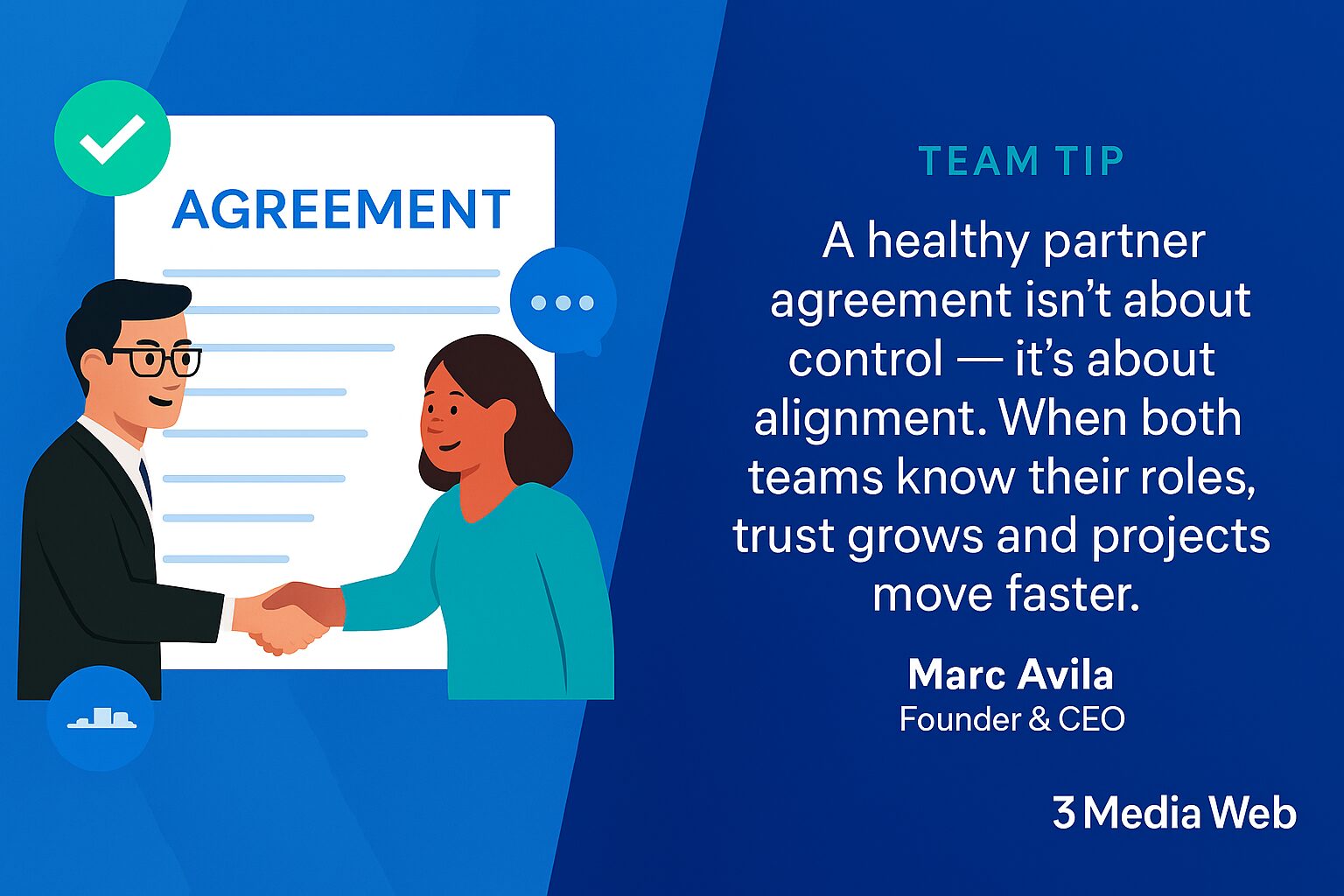
A healthy partner agreement is one that creates shared clarity before work begins—it defines roles, communication, money, and ownership so both teams can move fast without friction. It protects you legally, but its real job is alignment: it builds confidence, speeds up delivery, and sets the conditions for mutual growth. The smartest partners treat a healthy agreement as a positioning tool, not a restriction.
Most agency partnerships start with enthusiasm and trust. You connect with a team that complements your strengths, and both sides see potential. Then reality sets in. Deadlines shift. Scope expands. Payment terms blur. What started as collaboration can quickly become confusion—and the data shows how common that drift is. According to a CMO Council study reported by Forbes (2014), nearly half of companies said their strategic partnerships fail at a rate of 60% or higher, and only 33% had a formal partnership strategy in place. Structure, not goodwill, is what separates partnerships that last from the ones that quietly stall. For a closer look at the failure patterns, see why some partnerships fail and how to avoid the pitfalls.
What should a healthy partner agreement include?
A healthy partner agreement should include four things: clearly defined roles, documented communication and process, transparent money and ownership terms, and room to adapt. Strong partnerships thrive on clarity, so spell each one out before the first shared client engagement.
Define roles and responsibilities up front
Clear roles prevent the “too many cooks” problem and keep both agencies professional in front of shared clients. Each team should know exactly who owns what. Spell out:
- Which team leads client communication.
- Who is responsible for deliverables, QA, and reporting.
- How decision-making and escalation work when priorities collide.
Document timelines, processes, and communication
Written process saves time and removes surprises—it is the governance the CMO Council found most partnerships are missing. Set expectations around:
- Response times for client or partner requests.
- Update frequency and preferred communication channels.
- How change requests and delays will be handled.
Be transparent about money and ownership
Money and ownership are the details most likely to become deal-breakers, so discuss them early. Put in writing:
- How referrals are tracked and compensated.
- Who invoices the client, and when.
- Ownership of creative work, code, or data assets.
Build in flexibility, value, and iteration
Partnerships evolve, so build in the ability to adjust scope, pricing, or collaboration structure as both teams grow. Agreements that adapt to success tend to last longer. A great agreement also documents your mutual value proposition—clarifying how combined strengths like web design and development, marketing strategy, or strategic support deliver a seamless client experience. That shared story reinforces trust and makes joint sales conversations easier.
In our work with JazzHR, a recruiting software company, that shared value proposition became a real revenue engine. We first partnered on a single project—building a partner marketplace microsite to showcase their 250+ technology and service providers—and defined roles and communication so tightly that the launch drove 250+ new partner requests and 30+ qualified opportunities. Clear expectations are also what turned a one-off engagement into ongoing support; as their senior marketing manager put it, “3 Media Web is the first vendor that actually gets us.” The agreement did the quiet work of moving the relationship from vendor to partner.
What is a referral fee versus a white-label arrangement?
A referral fee is a one-time or percentage payment for sending a client to your partner, while a white-label arrangement means your partner does the work under your brand and you own the client relationship. Both belong in the money-and-ownership section of the agreement. Naming which model you are using—and how it is invoiced—removes the single most common source of partner conflict.
When should you put a partner agreement in writing?
Put the agreement in writing before the first shared client deliverable, not after the first disagreement. The trigger is any point where two teams touch the same client, budget, or asset—a referral, a co-sold project, or shared production work. Waiting until money or scope is already in motion means you are negotiating under pressure, which is exactly when goodwill erodes fastest.
The dos and don’ts at a glance
The difference between a healthy agreement and a fragile one usually comes down to the same handful of decisions. This table pairs each “do” with the “don’t” it replaces, so you can pressure-test your own agreement section by section.
| Agreement area | Do | Don’t |
|---|---|---|
| Roles & ownership | Name who owns communication, delivery, QA, and escalation. | Assume good intentions will sort out who does what. |
| Process & communication | Document response times, channels, and change-handling. | Hide behind vague terms like “as needed” or “reasonable effort.” |
| Money & assets | Specify invoicing, referral splits, and asset ownership. | Defer the money conversation until a conflict forces it. |
| Document length | Keep it lean and focused on clarity and collaboration. | Overcomplicate with legal bulk that signals distrust. |
| End of relationship | Define offboarding and a clean exit for both sides. | Forget the exit plan and improvise the breakup later. |
| Review & renewal | Schedule reviews at least twice a year to reassess. | Set it and forget it as clients and goals shift. |
What should you avoid in a partner agreement?
Avoid the five habits that quietly derail otherwise strong partnerships. A healthy agreement is defined as much by what it leaves out as by what it includes.
- Don’t overcomplicate the contract. Lengthy legal documents slow momentum and signal distrust. Keep the agreement straightforward and focused on clarity and collaboration, not control.
- Don’t assume good intentions replace process. Even trusted partners interpret things differently. Document the “how” as carefully as the “what” so process prevents miscommunication.
- Don’t hide behind vague language. Phrases like “as needed,” “reasonable effort,” or “mutual understanding” create friction. Define specific deliverables, timeframes, and responsibilities.
- Don’t forget the exit plan. Healthy agreements plan for every stage, including the end. Clear offboarding terms protect both sides and make transitions smoother.
- Don’t neglect review and renewal. Partnerships shift as clients, technologies, and goals evolve. Schedule reviews twice a year, at minimum, to assess what is working.
How do healthy agreements lead to stronger growth?
Healthy agreements drive growth because clarity frees both teams to focus on results instead of refereeing confusion. When both sides know what is expected, they gain the confidence to share more opportunities, take on larger projects, and explore new service combinations like SEO, conversion rate optimization, or lead generation. Partnerships built this way don’t just win work—they keep winning together. The same clarity helps when scope gets complicated; see how partners can simplify complex client needs without overextending either team.
How 3 Media Web can help
3 Media Web helps agencies and marketing teams build sustainable, scalable partnerships rooted in trust and transparency. From web design and development to long-term website support, our team integrates into your process and helps you deliver exceptional results for your clients without stretching your resources. If you are formalizing a new alliance, our agency partnership support gives you a partner who treats clear expectations as the starting point. We know what makes partnerships thrive—clear expectations, proactive communication, and consistent delivery that protects your reputation and your client’s success.
This topic and more are covered in our complete guide to agency partnerships.