Last updated: July 6, 2026
- Referral relationships that last are built like partnerships, not transactions: trust first, leads second.
- Document a referral framework (criteria, introductions, reciprocity, cadence) so collaboration is predictable instead of ad hoc.
- Keep the relationship active year-round with shared learning and proactive introductions, not just when you need a lead.
- Track referrals like any growth channel: volume, conversion, retention, and revenue influenced.
- The payoff is real: referred customers are at least 16% more valuable and retain longer than non-referred ones.
How do you build referral relationships that last?
You build referral relationships that last by treating them as long-term partnerships: establish trust before exchanging leads, agree on a written framework, stay engaged between referrals, and measure results like any other growth channel. Agencies that run referrals this way turn a one-off favor into a repeatable pipeline. Agencies that treat each referral as a transaction watch the relationship quietly fade.
Many agency partnerships start with enthusiasm, mutual admiration, shared clients, aligned services, and then stall. The usual cause is a short-term mindset that leads to inconsistent follow-up, unclear expectations, and missed opportunities. When trust erodes, even a promising partnership loses momentum.
We unpack this further in The Anatomy of a Profitable Referral Relationship.
The stakes are higher than a single handoff. Word-of-mouth is the most trusted form of marketing there is: according to Nielsen (2013), 84% of global respondents rank recommendations from people they know as the most trustworthy source. And the customers those recommendations bring in are worth more. A Wharton study by Schmitt, Skiera, and Van den Bulte (2011), tracking roughly 10,000 bank customers, found that referred customers are at least 16% more valuable and retain longer than non-referred customers. A referral channel built for the long game compounds; a transactional one resets every quarter.
How is a referral partnership different from a referral program?
A referral partnership is an ongoing, two-way relationship between two firms who send each other well-matched clients and stay engaged between handoffs. A referral program is a one-directional, often transactional incentive to send leads. The difference is durability: a program pays for a lead, while a partnership builds a relationship that keeps producing leads because both sides invest in the other’s success.
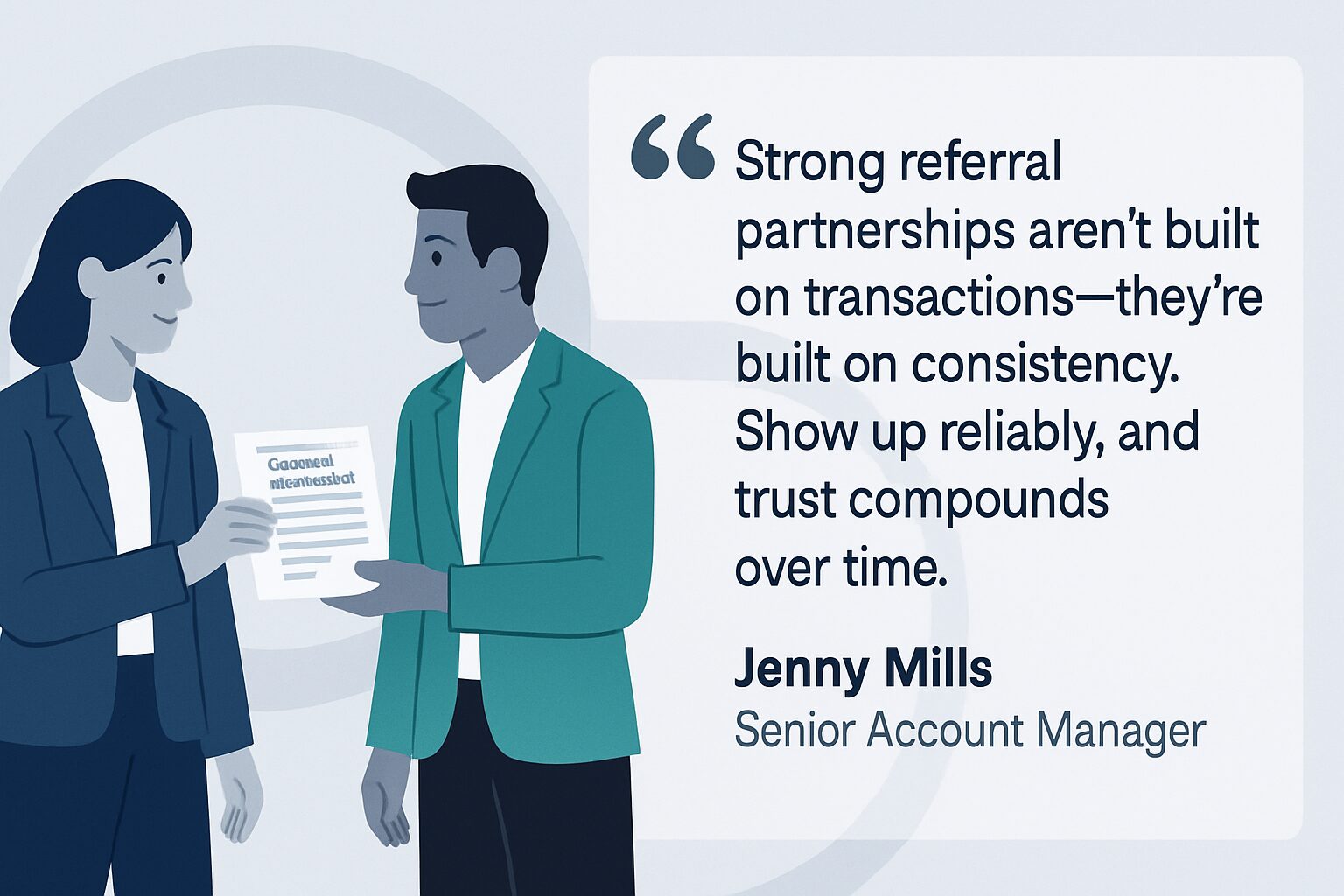
Build trust before you exchange leads
Trust is the foundation of every durable referral partnership, and it has to come before any lead changes hands. Before referrals flow in either direction, both agencies need confidence in how the other communicates, delivers, and treats clients. Sending a client to a partner you have not vetted puts your own reputation on the line.
Trust grows through consistency, not volume. Build it deliberately:
- Collaborate on small opportunities first to learn each other’s process and strengths.
- Watch how feedback gets handled, because a partner who protects your reputation under pressure will keep protecting it.
- Stay transparent about capacity, pricing, and timelines so there are no surprises later.
- Follow through on introductions and client updates promptly, every time.
When a partner sees reliability in action, they refer with confidence, and confident referrals are the ones that turn into repeat work. This is the same trust-building groundwork that drives more referral wins; for a deeper look at the relationship side, see building trust in partnerships.
Define a framework for the partnership
A durable referral partnership runs on a documented framework, not on guesswork. A clear structure makes collaboration easy to repeat and removes the friction that kills momentum. Write it down once and both teams know exactly how a referral moves from introduction to outcome.
Our post How to Build a Referral Engine That Scales With Your Agency explores this in more detail.
A simple referral framework should cover four things:
- Referral criteria: which client types, industries, or budgets are the right fit for each side.
- Introduction process: who connects first, how information is shared, and how the client is positioned.
- Reciprocity: whether referrals are rewarded financially, through mutual opportunity, or both.
- Communication cadence: how often you review outcomes and share updates.
This clarity prevents miscommunication and makes both teams look professional to the client caught in the middle. Pairing it with a results-focused strategic support partner keeps every referred engagement tied back to a goal both sides named.
When should you formalize a referral partnership?
Formalize a referral partnership once you have completed at least one project together successfully, seen how the partner handles client communication and feedback, and identified a repeatable overlap in the clients you each serve. Before that, keep it informal and low-stakes. Formalizing too early, on enthusiasm alone, locks in expectations neither side has yet earned the right to make.
Keep the relationship active, not transactional
Partnerships that last are not driven by referrals alone; they are sustained by collaboration and mutual investment between handoffs. A relationship that only comes alive when someone needs a lead feels like a transaction, and transactions are easy to walk away from. Stay engaged year-round and the referrals follow naturally.
Keep the relationship warm with deliberate touchpoints:
- Share performance insights, such as joint lead generation results or campaign outcomes.
- Host joint workshops, webinars, or co-authored thought leadership.
- Introduce your partner to new opportunities even when there is no direct return.
- Celebrate wins together and acknowledge contributions publicly.
A partnership that is engaged all year feels less like a referral arrangement and more like an alliance.
Transactional vs. long-game referrals
The difference between a referral that fades and one that compounds comes down to a handful of habits. A transactional partner optimizes for the next lead; a long-game partner optimizes for the relationship that produces every future lead. Use the comparison below to see which side your current referral partnerships sit on.
| Dimension | Transactional referral | Long-game partnership |
|---|---|---|
| Trust | Leads exchanged before either side is vetted. | Trust earned on small work before any handoff. |
| Process | Ad hoc, different every time, easy to drop. | Documented criteria, introductions, and cadence. |
| Engagement | Goes quiet until someone needs a lead. | Active year-round with shared learning. |
| Feedback loop | Referred leads vanish with no follow-up. | Outcomes reported back to close the loop. |
| Measurement | Tracked by gut feel, if at all. | Tracked like a channel: volume, conversion, revenue. |
Most struggling referral relationships are not broken; they are simply stuck in the left column and can be moved right with a little structure.
Track, measure, and report referral success
Referral partnerships deserve the same rigor as any marketing channel, which means you measure them. Tracking performance proves the value of the relationship and shows leadership that referrals are a strategy, not luck. Without numbers, a referral channel is invisible the moment a budget conversation starts.
For more on this topic, read B2B Referral Revenue Playbook: Turning Partnerships Into Profit.
Monitor a short, consistent set of metrics:
- Total referrals shared and received.
- Conversion rate and client retention on referred work.
- Revenue influenced by referrals.
- Client satisfaction across referred projects.
In our work with JazzHR, a recruiting-software company, we saw firsthand how a well-run partner ecosystem turns into measurable pipeline: after we built and launched their partner marketplace, it generated 250+ new partner requests and 30+ qualified opportunities, and the engagement itself grew from a single project into ongoing support once both sides had proven the relationship. That is the long game in practice: a structured way to showcase partners, paired with consistent follow-through, compounds into leads instead of resetting after each handoff. Sharing this kind of data regularly builds transparency and reinforces the ROI of the partnership for both sides. If you need to make that case to executives, the metrics that prove partnership value to leadership covers exactly which numbers move the room.
Common mistakes that undermine referral relationships
Even strong referral partnerships stumble when small habits go unchecked, and the failure points are predictable. Most damage comes from neglect rather than conflict, which is good news, because neglect is fixable. Watch for these four pitfalls before they cost you a partner.
- Inconsistent follow-up: failing to close the loop leaves a partner guessing and erodes goodwill.
- No feedback: not reporting what happened with a referred lead breaks trust fast.
- Misaligned expectations: sending clients that do not fit a partner’s strengths wastes everyone’s time.
- One-sided reliance: healthy partnerships balance over time instead of feeling like a one-way street.
Addressing these early keeps the partnership delivering mutual benefit instead of slowly going cold.
Frequently asked questions
How do you start a referral partnership with another agency?
Start small and build trust before exchanging leads. Collaborate on a low-stakes project first to learn the partner’s process, watch how they handle feedback, and confirm they protect client relationships. Once both sides have seen reliability in action, agree on a simple written framework for how referrals will work.
How is a referral partnership different from an affiliate or reseller program?
A referral partnership is a mutual, relationship-driven arrangement where two firms send each other fitting clients and stay engaged over time. An affiliate or reseller program is more transactional: one side is paid a commission or margin to route leads or resell a product. Partnerships prioritize the long-term relationship; affiliate and reseller models prioritize the individual transaction.
What should a referral agreement between partners include?
A referral agreement should cover four things: referral criteria (which clients fit each side), the introduction process (who connects and how clients are positioned), reciprocity (financial, mutual opportunity, or both), and a communication cadence for reviewing outcomes. Documenting these removes friction and keeps both teams looking professional to the client.
Why do most referral relationships fail?
Most referral relationships fail from neglect, not conflict. A short-term, transactional mindset leads to inconsistent follow-up, no feedback on referred leads, and misaligned client handoffs. When the relationship only activates when someone needs a lead, trust erodes and the channel quietly resets instead of compounding over time.
Are referred clients actually more valuable?
Yes. A Wharton study by Schmitt, Skiera, and Van den Bulte (2011), tracking roughly 10,000 customers, found referred customers are at least 16% more valuable and retain longer than non-referred customers. Referrals also carry built-in trust: Nielsen (2013) reports 84% of people rank recommendations from people they know as the most trustworthy source, which shortens the sales cycle.
How do you measure the ROI of a referral partnership?
Track referrals like any growth channel. Monitor total referrals shared and received, conversion rate and retention on referred work, revenue influenced by referrals, and client satisfaction across referred projects. Reporting these numbers regularly proves the partnership’s value and keeps it defensible when leadership reviews where growth comes from.
How 3 Media Web Can Help
The strongest partnerships are built on clarity, consistency, and results, not on one-off favors. At 3 Media Web, we collaborate with other design and marketing firms as a long-term strategic support partner, guided by our Human and AI approach so judgment leads and automation supports. For partners, that includes:
- Custom web design and development that aligns a client’s site with their business goals.
- Proactive website support that keeps sites performing reliably between projects.
- Results-driven SEO, lead generation, and conversion work that stays measurable and reportable.
- Transparent collaboration across the full digital experience, so both agencies share in the success.
When you partner with 3 Media Web, you gain a reliable ally committed to helping your clients succeed as much as your own. Reach out to our team to talk through how a referral partnership built for the long game should feel.
For the full playbook on building agency partnerships that last, start with our pillar guide.