Last updated: July 6, 2026
- A referral only works when your client trusts your judgment, so trust, not your contact list, is what actually drives referral wins.
- A referral partnership is a relationship where two firms send each other qualified clients they cannot fully serve alone, backed by trust on both sides.
- Build trust with partners the same way you build it with clients: communicate openly, deliver on promises, and respect the account.
- Earn client trust by framing the referral as a value-add, tying the partner’s expertise to a real need, and following up on the outcome.
- Screen every partner against five traits before you introduce them, because a bad referral costs you credibility you cannot easily rebuild.
- Recommendations from people we trust are the most credible form of marketing, which is exactly why a careful referral carries so much weight.
Why does trust drive more referral wins than your network does?
Trust drives referral wins because a referral is an endorsement, and clients act on endorsements only from people whose judgment they already trust. When you send a client to a partner, your name goes with it: a strong referral deepens the relationship, and a weak one quietly costs you credibility. That is why the path to more referrals runs through trust, not simply through having the right partners in your contacts.
The numbers back this up. According to Nielsen’s Global Trust in Advertising study (2015), 83% of people trust recommendations from friends and family more than any other form of advertising, the most trusted format Nielsen measured. A referral borrows that same trust. When a client already trusts you, your recommendation inherits the credibility you have earned, which is what makes the introduction land instead of falling flat.
This post is part of our Agency Partnership Playbook — the complete guide to referrals, vetting, and long-term partnership value.
Many agencies and consultants hesitate to refer at all because they fear putting their reputation at risk. The fix is not to refer less. It is to build enough trust, on both sides, that an introduction feels low-risk for everyone involved. A dependable strategic support partner makes that easy, because their reliability becomes an extension of your own.
What is a referral partnership?
A referral partnership is an ongoing relationship in which two firms send each other qualified clients they cannot fully serve alone, backed by mutual trust and clear expectations. It differs from a one-off introduction because both sides commit to protecting each other’s reputation over time. The strongest referral partnerships pair complementary skills, so each firm’s client gets a specialist without leaving the relationship they started with.
For related strategies, check out Referral Mistakes That Cost Agencies Credibility (and How to Fix Them).
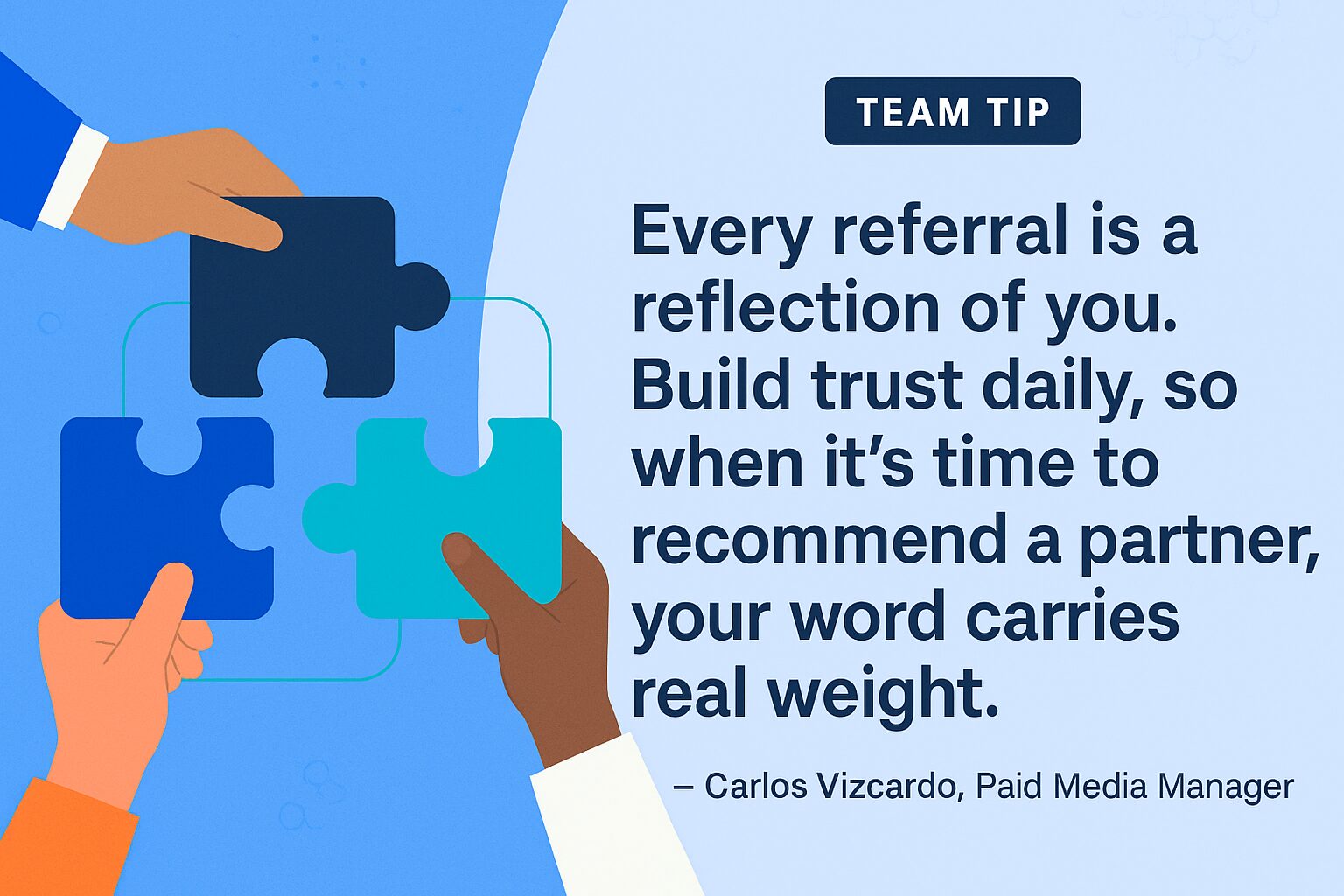
What happens when trust is strong on both sides?
When trust runs in both directions, the entire referral gets easier and three things happen at once. Each one removes friction that would otherwise stall the introduction or sour the result.
- Clients accept the referral with confidence instead of second-guessing the handoff.
- Partners respect the value of your introduction and treat the client with care.
- Everyone benefits from smoother projects and stronger results, which makes the next referral easier to give.
Without that trust, the opposite happens: clients hesitate, partners deprioritize the lead, and you are left wondering whether the introduction was worth the risk. Trust is the currency that keeps a referral relationship paying out over time.
In our work with JazzHR, a recruiting software company, that two-way trust is exactly what turned a single project into an ongoing partnership. We started by building their partner marketplace, which generated more than 250 new partner requests and 30-plus qualified opportunities, then earned the expanded relationship by keeping their marketing site at zero incidents after years of near-monthly outages. As their marketing manager put it, we send reporting and updates “even when we’re not asking.” That is the difference between a vendor and a partner clients trust enough to refer.
How do you build trust with referral partners?
Build trust with partners by showing up for them as consistently as you show up for your clients. Trust between partners is earned through repeated, reliable behavior, not a single signed agreement. The practices below compound over time into a relationship you can confidently put your name behind.
- Communicate openly. Share what your client values most before you make the introduction, so your partner understands the expectations going in.
- Deliver on promises. If you commit to an introduction or a co-marketing initiative, follow through without delay so your word stays reliable.
- Respect the client relationship. A trusted partner understands boundaries and never tries to take over the account you worked to earn.
- Share knowledge. Trade insights on SEO, lead generation, and other strategies so you both grow.
- Celebrate wins together. Recognizing the value a partner brought reinforces mutual respect and keeps the relationship strong for the next opportunity.
These habits are the same ones that sustain a referral relationship for years rather than a single deal. For a deeper look at keeping those relationships healthy over the long term, see our guide to building referral relationships that last. If you want a partner who treats your clients this way, our agency partnership program is built around exactly these habits.
How do you earn client trust when making a referral?
Earn client trust by making the referral about their success, not your convenience. Even the strongest partner network falls flat if your client doubts your judgment, so the introduction has to feel like a benefit rather than a handoff. Use these four moves to keep the client’s confidence intact:
- Frame the referral as a value-add. Make it clear the introduction exists to help them succeed, not to pass them along.
- Explain the partner’s expertise. Tie the partner’s strengths directly to the client’s need, whether that is web design and development or conversion rate optimization.
- Stay connected. Follow up to confirm the partnership is meeting expectations, because clients notice when you care about the outcome.
- Be selective. Referring only when it genuinely fits increases the weight of every recommendation you make.
Selectivity matters more than volume. One well-placed referral that solves a real problem does more for your reputation than ten generic introductions, and it makes leadership on both sides take notice. If you need to show that impact upward, our guide on the metrics that prove partnership value to leadership covers exactly what to track.
When should you refer a client instead of keeping the work in-house?
Refer a client out when the work sits outside your core expertise, when taking it on would stretch your team past the quality you promise, or when a specialist would clearly get a better result. Keeping ill-fitting work in-house to protect revenue is the fastest way to lose the trust you built. A well-timed referral to the right partner signals that you put the client’s outcome first, which is what earns you the next project and the next referral.
How do you spot a trustworthy referral partner?
Spot a trustworthy partner by screening them against five traits before you make any introduction. A confident “yes” across all five signals a partner who will protect your reputation; a gap in even one is a warning sign worth resolving first. Use the checklist below as a fast screen, comparing what a trustworthy partner looks like against the red flag to watch for in each area.
| Trait to check | A trustworthy partner | Red flag to watch for |
|---|---|---|
| Responsiveness | Replies quickly and clearly to questions. | Slow, vague, or inconsistent answers before the work even starts. |
| Proven results | Has a track record of measurable outcomes you can verify. | Talks in promises with no examples or references to back them up. |
| Values fit | Shares your standards for quality and the client experience. | Cuts corners under pressure or prioritizes their own convenience. |
| Respect for boundaries | Honors the client relationship and stays in their lane. | Tries to expand scope or take over the account you own. |
| Smooth process | Makes the referral handoff professional and easy. | Creates friction, confusion, or extra work for your client. |
If you can answer “yes” to all five, you are ready to build a referral that benefits everyone. If you cannot, treat the gap as a reason to pause, not a detail to overlook. The same five-trait screen works whether you are evaluating a design vendor, a marketing partner, or an ongoing website support provider.
Frequently asked questions
Why is trust the foundation of a good referral?
A referral is an endorsement, and clients act on endorsements only from people they already trust. When trust is high, your recommendation inherits your credibility, so the client accepts it with confidence. When trust is low, even a great partner introduction stalls because the client doubts the judgment behind it.
What is the difference between a referral partner and a vendor?
A vendor completes a defined task and moves on; a referral partner protects your client relationship and your reputation over time. The shift happens when a provider communicates proactively, delivers reliable results, and respects the boundaries of the account you own. That earned trust is what makes you comfortable attaching your name to them again and again.
How do I build trust with a referral partner?
Build trust by showing up for partners as reliably as you do for clients. Communicate expectations before the handoff, deliver on every commitment, respect the client relationship, and celebrate shared wins. Trust between partners is earned through repeated, dependable behavior over time, not through a single signed agreement or a one-off introduction.
How do I keep a client’s trust when I refer them out?
Frame the introduction as a value-add that serves the client’s goals, and tie the partner’s specific expertise to the client’s real need. Stay connected afterward to confirm the partnership is working. Following up signals that you care about the outcome, which protects your credibility and strengthens the relationship for future recommendations.
What makes a referral partner trustworthy?
A trustworthy partner is responsive, has a proven record of measurable results, shares your values around quality, respects client boundaries, and makes the referral process smooth. Screen every potential partner against these five traits before introducing them, because a single bad referral can cost you credibility that took years to build.
How often should I make referrals?
Refer selectively rather than frequently. One well-placed referral that solves a genuine problem builds more credibility than many generic introductions. Being selective increases the weight of each recommendation, signals that you respect your client’s time, and keeps your name attached only to partners you would confidently stand behind.
How 3 Media Web Can Help
At 3 Media Web, we treat every referral as an extension of your trust, and we earn it the same way we ask you to vet any partner: with responsive communication, proven results, and respect for the relationships you have built. Guided by our Human and AI approach, judgment leads and automation supports, so the work stays measurable and the experience stays personal. Our team specializes in:
- Website support, maintenance, and hosting that keeps sites reliable and secure.
- Paid media management that ties ad spend to measurable outcomes.
- Website accessibility that makes your client’s site inclusive and compliant.
When you refer us, your clients experience the kind of partnership that reflects well on you, and that is how a referral turns into a lasting strategic support relationship. Explore our agency partnership support or talk to a partner to see how a trusted referral should feel.
We unpack this further in How to Protect Your Reputation When Making Agency Referrals.