Last updated: July 6, 2026
- Prove partnership value with four metrics leaders care about: revenue impact, lead quality and conversion, retention and growth, and saved time.
- Split revenue into direct, co-delivered, and influenced so leaders see the full sales cycle, not just closed referrals.
- Deals with a partner close 53% more often, so partner-sourced lead quality is a number worth showing.
- Pair the four core metrics with backup signals (engagement, pipeline health, reputation) and tie every figure to a business goal.
- Report on a set schedule with shared dashboards so partnership ROI reads as steady return, not a one-time win.
How do you prove the value of a partnership to leadership?
Prove the value of a partnership by turning relationship work into four metrics leaders already track: revenue impact, lead quality and conversion, retention and growth, and saved time. Lead with the revenue partnerships drive. Show that partner-sourced leads close better, then tie both to retention and saved time. That mix reframes partnerships as a growth engine, not a soft, hard-to-measure task.
You already know strong partnerships drive real growth: shared clients, more services, and new deals. But when leaders ask for proof, it is hard to turn relationship work into hard numbers. Leaders want a clear read on how partnerships add to pipeline, profit, and brand, and many partner teams report only surface stats like referral counts or co-marketing buzz without tying them to real results. The data backs the effort. Per Crossbeam’s 2023 State of the Partner Ecosystem Report, deals are 53% more likely to close when a partner is involved. To win buy-in and long-term backing, speak the language leaders use. That starts with a clear web strategy and reports that tie every joint effort back to a business goal.
The four metrics that prove partnership value
Four metrics form the base of any strong partnership report: revenue impact, lead quality and conversion, retention and growth, and saved time. Each one answers a different leadership question, from “what did this earn us?” to “what did this save us?” Use the table below as a quick guide for what each metric proves and what to track, then read the detail in the sections that follow.
| Metric | What it proves to leadership | What to track |
|---|---|---|
| Revenue impact | Partnerships add to the number, both directly and behind the scenes. | Direct referral revenue, co-delivered project revenue, influenced revenue. |
| Lead quality and conversion | Partner leads are better, not just more of them. | Close rate vs. other channels, average deal size, pipeline speed. |
| Retention and expansion | Partnerships build lasting, growing accounts. | Renewal rates, growth in client spend, cross-sell and upsell sourced via partners. |
| Efficiency and enablement | Partnerships save time and money, not only earn revenue. | Delivery timelines, shared marketing spend, added reach from co-branded work. |
1. Revenue impact
Revenue impact is the most direct sign of partnership value, but the strongest reports go past a single total-dollars figure. Instead of one lump sum, show how partnerships lift revenue across the sales cycle. Split the number into three parts:
- Direct referral revenue: deals sourced and closed through partner referrals.
- Co-delivered project revenue: services or client work you run together.
- Influenced revenue: deals where a partner helped through teaching, backing, or sales support.
This split shows leaders not just what partnerships deliver, but how they help at each stage. Influenced revenue is the figure most teams under-report, and it is often where trusted partnerships do their quietest work. The same trust that earns a referral is what turns partnerships into a steady source of referral wins over time.
This topic and more are covered in our complete guide to agency partnerships.
2. Lead quality and conversion
Lead quality matters as much as lead volume, and leaders know the difference. Proving that partner-sourced leads close faster or at a higher rate shows value beyond a referral count. Deals with a partner close 53% more often than deals without one, so a quality gap is usually there to find in your own data. Track things such as:
- Close rate from partner leads versus your usual channels.
- Average deal size from partner-influenced deals.
- Pipeline speed, measured as time from referral to close.
In our work with recruiting-software company JazzHR, building a dedicated partner marketplace turned a single, buried partner page into a real pipeline source: the marketplace generated 250+ new partner requests and 30+ qualified opportunities after launch. That is exactly the kind of partner-sourced number leaders can see and trust. Pairing figures like these with your lead generation data builds a strong story: partnerships do not just bring in leads, they bring in better leads that move through the funnel faster.
3. Retention and expansion
Partnerships often deliver their greatest value after the first deal closes. Retention and growth metrics show leaders that partner work builds long-term, steady growth rather than one-time wins. Measure:
- Renewal rates among co-served or referred clients.
- Growth in client spend when partner services are bundled.
- Cross-sell or upsell deals sourced through partner ties.
When renewals and account growth rise alongside partner activity, leaders see value that builds instead of a single sale. That staying power is the heart of the long game, and it is why referral relationships that last tend to beat one-off intros.
4. Efficiency and enablement
Saved time is the partnership metric teams forget, yet it speaks right to how leaders think about cost. Partnerships do not only bring in revenue; they save time and money across marketing, operations, and delivery. Show how joint work saves effort by tracking:
- Shorter project delivery timelines from working together.
- Lower marketing spend through shared paid media or co-marketing.
- More reach through shared content or co-branded campaigns.
When leaders see saved time next to revenue impact, partnerships read as growth boosters rather than cost centers. Ongoing website support works the same way, where the value lives in the steady pace and saved hours, not the odd fix.
What is partner-influenced revenue?
Partner-influenced revenue is the credit partners earn for deals they help move forward without sourcing them, reported apart from referral and co-delivered revenue. In practice you tag any deal a partner touched through teaching, backing, or co-selling, then track that pipeline in your CRM. This credit matters because influenced revenue is the most under-reported partnership metric, and showing it usually reveals more value than referral counts alone.
The backup metrics that build a stronger story
Backup metrics give leaders a fuller picture around the four core numbers. They rarely stand alone, but they add context that makes the headline figures believable. Layer in:
- Engagement metrics: co-marketing campaign results, event turnout, or content downloads.
- Pipeline health: live deals helped by partnerships or ongoing co-selling deals.
- Reputation signs: partner surveys or client reviews that mention working together.
Pairing hard numbers with softer signs makes the case that partnerships drive both the results and the brand behind them.
How to present partnership results to leadership
Numbers alone do not build trust; context does. Present partnership results so leaders see the story behind the data, using these five habits:
- Aim for clarity, not clutter. Use visual dashboards and short summaries, and show trends over time instead of raw data dumps.
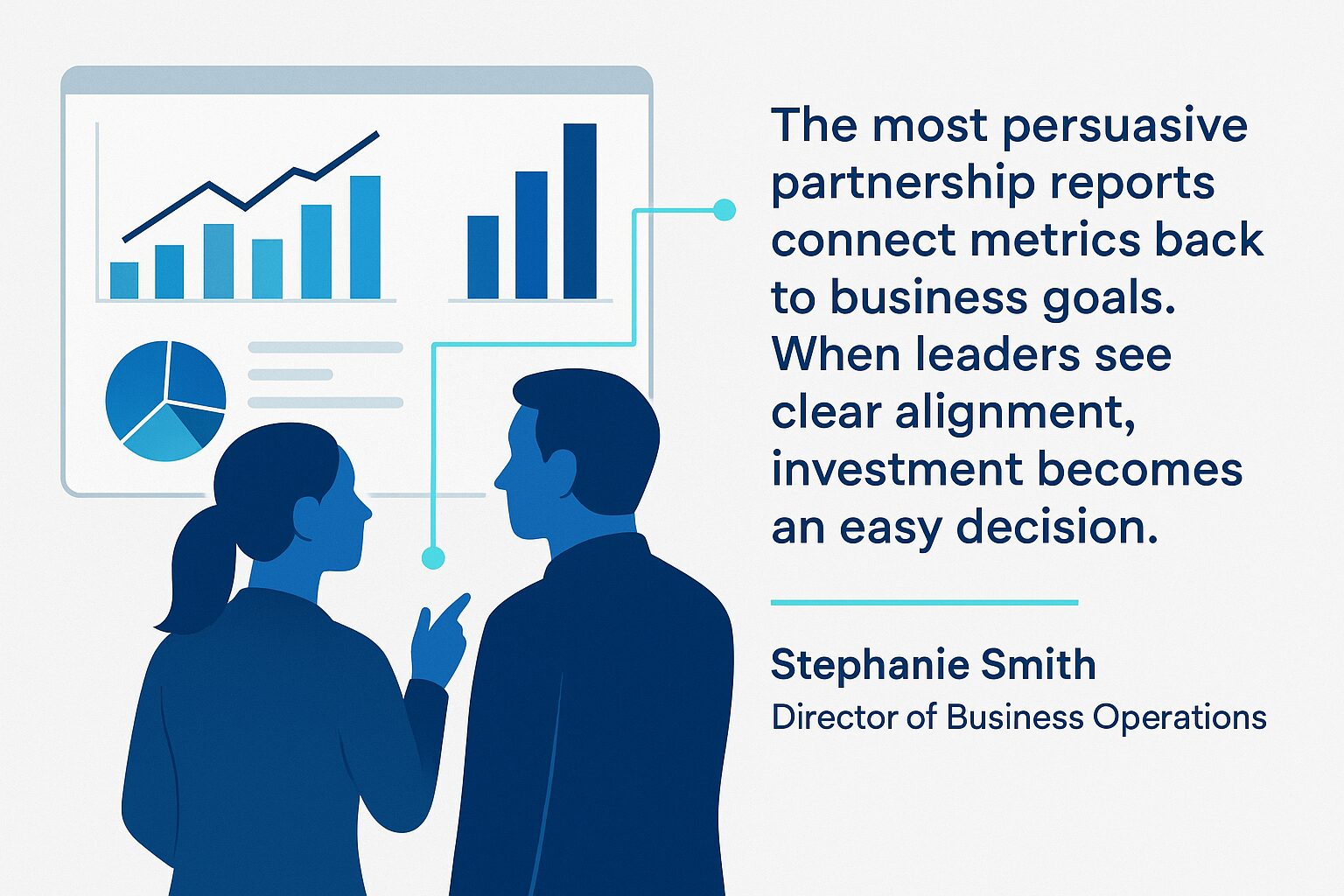
- Tie every metric to a business goal. Frame results in terms of revenue growth, market reach, or saved time.
- Share both wins and lessons. Being open builds trust; if a campaign fell short, explain why and what changes next quarter.
- Credit partner work. Name real cases of partner teamwork to lift morale and back up the partnership’s value.
- Report on a set schedule. Monthly or quarterly reviews keep leaders in the loop and show that partnership ROI is steady return, not a one-time feat.
Frequently asked questions
What metrics best prove partnership value to leadership?
Four metrics carry the most weight: revenue impact, lead quality and conversion, retention and growth, and saved time. Together they show what partnerships earn, how well partner leads close, how accounts grow over time, and what teamwork saves. Tying each one to a business goal turns relationship work into board-ready proof.
What is influenced revenue in a partnership?
Influenced revenue is the value from deals where a partner helped through teaching, backing, or sales support, even if they did not source the lead. It sits next to direct referral revenue and co-delivered project revenue. Most teams under-report it, which hides part of the partnership’s true add to the pipeline.
How do you measure partner lead quality versus other channels?
Measure partner lead quality by weighing close rate, average deal size, and pipeline speed against your other channels. Deals with a partner close 53% more often than deals without one, so a quality gap usually shows up in your own data. Reporting that gap proves partnerships bring in better leads, not just more of them.
How often should you report partnership ROI to leadership?
Report partnership ROI on a set monthly or quarterly beat rather than only when a big win lands. A steady rhythm keeps leaders informed, shows ROI as steady return, and builds the trust that wins ongoing backing. Shared dashboards make each review faster and keep both sides on the same numbers.
When should you build a partner scorecard?
Build a partner scorecard once partner activity drives enough pipeline that one-off updates no longer explain it, usually before your next budget or planning cycle. A scorecard sets the four core metrics into one repeat view, so leaders compare partnership results period over period instead of reacting to stray wins. Start simple with revenue, close rate, retention, and saved time, then add backup signals.
What is the difference between partner-sourced and partner-influenced deals?
Partner-sourced deals are ones a partner started, such as a referral they sent you. Partner-influenced deals are ones your own team found, but a partner helped move forward through backing, tech checks, or co-selling. Reporting both apart stops double-counting and gives leaders an honest view of how partners help at each stage of the pipeline.
How 3 Media Web Can Help
At 3 Media Web, we work with agencies and partners to deliver real results that leaders can see and trust. Our teamwork model runs on openness, results, and shared wins, guided by a Human and AI approach so judgment leads and automation backs it up. That spans web design and development, a clear web strategy that lines your site up with growth goals, and ongoing website support. We provide performance tracking, data insights, and clear reports that help you show partnership impact and build your standing inside the company. If you want a partner who reports the numbers that matter, explore our agency partnership support, then reach out to our team to build relationships that not only work, but win.