Last updated: July 6, 2026
- Co-marketing lets agencies and partners expand reach, share credibility, and lower marketing costs by running campaigns together instead of competing for the same audience.
- The strongest collaborations start with an aligned audience, complementary services, and one clear, shared goal that both teams write down before any content is made.
- Equal promotion and a shared editorial calendar keep both brands visible, so neither partner goes quiet halfway through the campaign.
- Track shared performance metrics, such as new leads and co-branded engagement, to prove ROI and earn the next campaign.
- The right partnership turns one campaign into a repeatable, lead-generating engine that grows revenue for both teams.
What is co-marketing, and how does it drive mutual growth?
Co-marketing is when two businesses with aligned audiences and complementary services run a marketing campaign together, sharing the work, the budget, and the leads. It drives mutual growth because each partner gains exposure to the other’s audience, borrows the other’s credibility, and splits the cost of producing and promoting the campaign. Done well, one joint webinar or guide becomes a lead-generating engine for both teams instead of a one-off project.
Growing an agency or consultancy often comes down to finding the right collaborations. You already share clients with other firms: design agencies work alongside developers, marketers pair with brand strategists, and consultants lean on technology partners. Each one brings a strength you do not have in-house. The real question is how to combine those strengths into campaigns that generate demand for both sides.
That is where co-marketing earns its place in your growth plan. When two trusted brands collaborate, the trust transfers in both directions. According to Nielsen’s Global Trust in Advertising study (2012), 92% of consumers trust recommendations from people they know above any other form of advertising, and a respected partner is the closest a brand gets to that kind of warm endorsement. Successful co-marketing does not happen by accident, though. It takes strategy, transparency, and a shared investment in the results.
What is a co-marketing agreement?
A co-marketing agreement is a short written document that records who does what before a joint campaign launches: the shared goal, each partner’s tasks, the budget split, how leads are shared and routed, and how success will be measured. It does not need to be a formal contract. Even a one-page plan both teams sign off on prevents the confusion and finger-pointing that stall campaigns once they go live.
What are the benefits of co-marketing for growth?
Co-marketing expands your reach, shares credibility between brands, lowers your marketing costs, deepens referral relationships, and opens new lead sources. Each benefit compounds the others, which is why a single joint campaign often outperforms the same effort spent marketing alone.
- Expanded reach. You instantly gain exposure to your partner’s audience. Joint webinars, blog posts, or downloadable guides introduce your expertise to prospects who might never have found you otherwise.
- Shared credibility. When two trusted brands collaborate, each benefits from the other’s reputation. Clients read the pairing as a signal of strength, not competition.
- Lower marketing costs. Co-marketing lets you split the budget for design, content, ads, and promotion while both partners keep the full benefit of the exposure.
- Deeper relationships. Joint campaigns strengthen referral pipelines and build long-term trust. The more you work together, the more confidently you can recommend each other’s services.
- New lead sources. A shared campaign gives both partners a fresh pool of prospects to capture and nurture through coordinated lead generation.
The payoff is real when a partner ecosystem is presented well. In our work with JazzHR, a recruiting software company, we built a dedicated partner marketplace microsite to replace a single, buried partner page. After launch, that marketplace generated 250+ new partner requests and 30+ qualified opportunities, turning an underused network into a working source of demand for both JazzHR and its partners. If your partnerships need that kind of infrastructure to grow, our agency partnership support is built for exactly this.
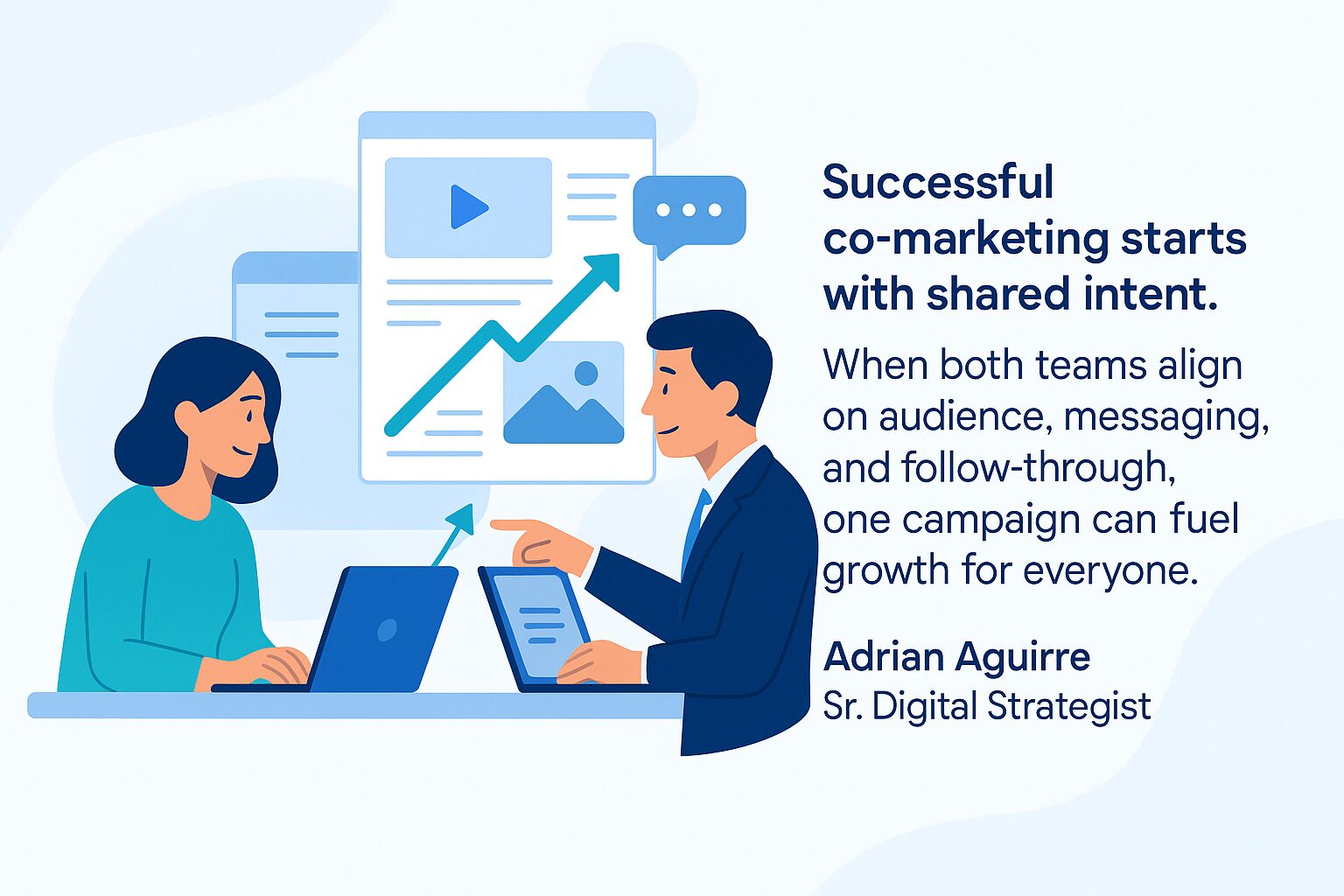
How do you choose the right co-marketing partner?
Choose a partner who serves a similar audience but offers complementary services, shares your standards for client quality, and is equally committed to measuring results. The best collaborator extends your value without competing for the same scope, so the campaign feels seamless to a potential client rather than confusing.
The right co-marketing partner should:
- Serve a similar audience while offering services that complement, not duplicate, your own.
- Share your values around client quality and delivery standards.
- Bring a solid brand reputation and the marketing capability to pull their weight.
- Commit, in writing, to measuring success the same way you do.
For example, a creative agency might team up with a firm that offers web design and development, or a digital marketer might partner with a data analytics company. When audiences align and services complement each other, the combined offer feels like one coordinated team. The flip side matters too: if a prospective partner over-promises or keeps shifting the goalposts, treat it as a warning. The same instincts that help you spot why some partnerships fail will help you choose co-marketing partners who actually follow through.
When should you co-market instead of going solo?
Co-market when a partner can reach an audience you cannot, when the cost or production effort is too high to justify alone, or when a partner’s credibility would make your offer more believable to a shared buyer. Go solo when the topic is core to your positioning, the timeline is too tight to coordinate two teams, or no partner genuinely serves your audience. If a campaign only benefits one side, it is not co-marketing yet.
How do you define shared goals and responsibilities?
Define one primary goal, assign every task an owner, and agree on how leads will be shared before you create anything. Clarity up front prevents the confusion and finger-pointing that derail joint campaigns once they go live.
Before the first asset is made, align on three questions:
- What is the primary goal: awareness, lead generation, or pipeline acceleration?
- Who owns each task: content creation, design, promotion, and reporting?
- How will leads be shared, routed, and followed up on by each team?
Document the answers in a shared plan or simple agreement. When two teams operate as one, a single point of accountability removes friction, which is the same principle that lets strong partners simplify complex client needs instead of adding to them. Write down who decides what, and the campaign stays out of the gray zone where work stalls.
Which co-marketing format should you choose?
Choose the format that fits both audiences and the resources each team can realistically commit. A co-hosted webinar, a co-branded guide, a swapped podcast appearance, a joint social campaign, or a shared case study each build visibility and trust, but they ask for very different levels of effort.
Use the comparison below to match a format to your goal and your bandwidth before you commit.
| Co-marketing format | Effort to produce | Best for | Primary outcome |
|---|---|---|---|
| Co-hosted webinar or virtual event | High | Showcasing both teams’ expertise live | Qualified leads and registrations |
| Co-branded guide, eBook, or infographic | Medium | Educating a shared audience with evergreen value | Gated leads and lasting authority |
| Podcast swap or short series | Low to medium | Borrowing each other’s engaged audience | Reach and brand awareness |
| Joint social media campaign | Low | Coordinating messaging and cross-promotion | Engagement and visibility |
| Shared client case study | Medium | Proving a successful project both teams delivered | Trust and sales enablement |
Start with the format your two teams can sustain, not the most ambitious one. A well-run podcast swap beats a half-finished webinar every time. Co-branded content is often the easiest place to begin, and dependable content marketing gives both partners a steady asset to promote long after launch day.
How do you promote a co-marketing campaign together?
Promote the campaign on a shared editorial calendar where both partners commit to equal effort across every channel. Co-marketing only works when neither side coasts, so align on timelines and tactics before launch and hold each other to them.
Coordinate promotion across:
- Email marketing sequences to each partner’s list.
- Social media announcements, timed and cross-tagged.
- Paid amplification through coordinated paid media.
- Website placement, blog features, or a campaign landing page.
- Direct outreach to shared or overlapping client lists.
A shared calendar keeps both teams aligned and makes it obvious if one side goes quiet. When a small marketing team is stretched thin, it also helps to prioritize the tasks that move the campaign forward first, so promotion never stalls because everything felt urgent at once.
How do you measure co-marketing results?
Measure the campaign against the shared goal you set, using metrics both partners can see, then review the numbers together. Accountability is the step most teams skip, and it is the one that turns a single campaign into a lasting partnership.
Review these metrics together after the campaign:
- Website visits and engagement spikes tied to co-branded content.
- New leads or inquiries sourced from the shared campaign.
- Conversion rate on the specific landing pages you built.
- Social engagement and total content reach across both audiences.
- ROI of any joint advertising or event spend.
Share the results transparently and talk through what worked, what fell flat, and how to improve next time. Celebrating a win, even a small one, strengthens the relationship and makes the second campaign easier to greenlight than the first.
Frequently asked questions
What is co-marketing?
Co-marketing is a partnership where two businesses with aligned audiences and complementary services run a marketing campaign together, sharing the work, budget, and resulting leads. Common formats include co-hosted webinars, co-branded guides, and joint social campaigns. The goal is mutual growth: each partner reaches the other’s audience and splits the cost while keeping the full benefit.
How is co-marketing different from co-selling or a referral?
Co-marketing creates demand together through shared content and campaigns, while co-selling works a specific deal together and a referral simply passes a lead from one partner to another. Many strong partnerships use all three. Co-marketing usually comes first because it builds the shared audience and credibility that make later referrals and co-selling far easier.
How do you choose the right co-marketing partner?
Look for a partner who serves a similar audience but offers complementary rather than competing services, shares your standards for client quality, and will commit to measuring results the same way you do. A solid brand reputation and real marketing capability matter too, because co-marketing only works when both sides can pull their weight and promote the campaign equally.
How do you measure the ROI of a co-marketing campaign?
Measure against the single goal you set at the start, using metrics both partners can see: new leads and inquiries, conversion rate on shared landing pages, co-branded content engagement and reach, and the ROI of any joint ad or event spend. Reviewing those numbers together keeps both teams accountable and informs the next campaign.
What co-marketing format is best for a small team?
Start with the lowest-effort format your two teams can sustain, usually a joint social campaign, a podcast swap, or a single co-branded guide. A well-run, modest campaign beats an ambitious one that stalls halfway. Prove the model with one win, then scale up to webinars or a content series once both partners trust the process and the results.
How long does a co-marketing campaign take to show results?
Engagement and reach show up during the campaign itself, but lead and pipeline results usually take one to three months as shared prospects move through follow-up. Set expectations early: judge awareness formats on reach within weeks, and judge lead-generation formats on qualified inquiries over a full quarter before deciding whether to run the next one.
How 3 Media Web Can Help
At 3 Media Web, we help agencies and marketing partners build and optimize the digital ecosystems that make mutual growth possible, guided by our Human and AI approach so strategy leads and automation supports. From web strategy and web design and development to ongoing website support and results-driven strategic support across SEO, content, and lead generation, we build the infrastructure that keeps co-marketing campaigns running smoothly.
For the bigger picture, see the full Agency Partnership Playbook.
We act as an extension of your team, providing the strategy, execution, and analytics that help both sides deliver measurable results. When the landing pages convert, the content ships on time, and the reporting is clear, your partnerships have room to grow.
Ready to turn a promising partnership into a repeatable growth engine? Find a growth partner and let’s build the campaigns that grow both brands.