Last updated: July 14, 2026
- AI has moved from a bonus to a baseline expectation: buyers now expect agencies to use AI for faster, smarter outcomes, not just prettier dashboards.
- Marketing leaders want business results, so the right agency uses AI to move conversions, pipeline, and ROI, not to automate busywork.
- Human plus AI is the winning model: pair AI’s speed and data-crunching with human strategy, creativity, and oversight for higher-quality work.
- Real AI adoption requires structure: the agencies that succeed have clear processes, quality control, and a knowledge engine behind consistent output.
- Five focused questions about how an agency uses AI, how it benefits your account, and what outcomes it has delivered will separate the real partners from the pretenders.
Should your next agency be taking AI seriously?
Yes, your next agency should be taking AI seriously, because AI is no longer a differentiator but a baseline expectation for B2B marketing partners. AI is changing how marketing gets done and how buyers buy, and an agency that only dabbles in it now risks falling behind the ones that have built it into daily delivery. Nearly the entire industry has already moved. According to Forrester research reported by The Current (2024), nine out of 10 ad agencies claim to be using AI, with about two-thirds tapping generative AI tools.
Talking about AI is not the same as delivering with it, though. Marketers and business leaders need partners who live and breathe AI to produce results, not vendors who name-drop it to look current. B2B buyers and CEOs alike now expect their agency to leverage AI for smarter, faster outcomes rather than fancy reports or cookie-cutter campaigns. The sections below unpack how those expectations are shifting and what a genuinely AI-forward partnership looks like, so you can find an agency that delivers on the right strategic support.
What do buyers want now: outcomes, not dashboards?
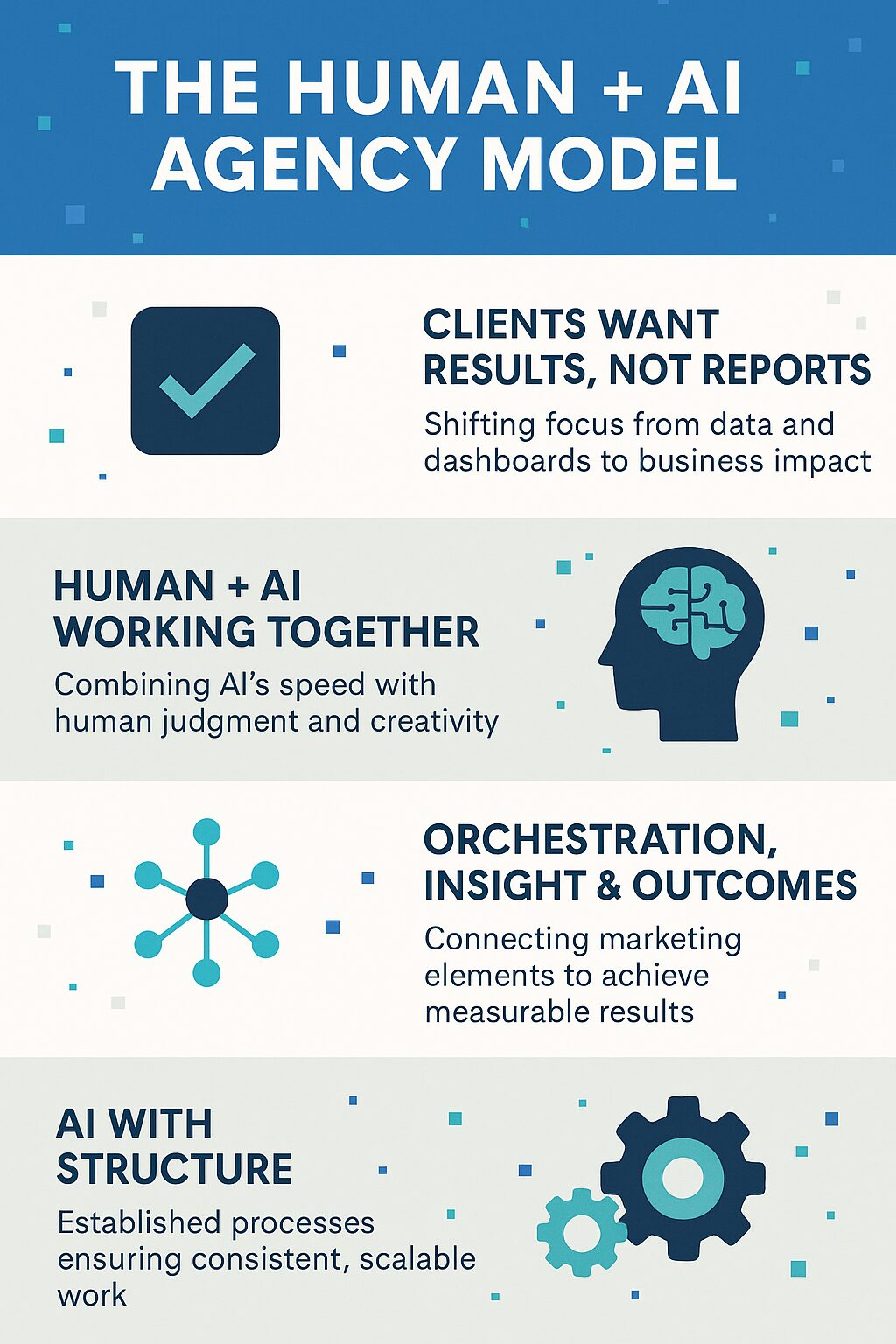
Buyers want tangible business outcomes delivered proactively, not another analytics portal to interpret on their own. A slick dashboard full of charts is the old way; today’s business leaders are not impressed by the latest reporting tool when it leaves them wondering what to do next. The value of marketing technology now lives in what it does, not what it looks like.
Martech is increasingly run by AI “agents” under the hood, which means integration and execution matter more than the interface. We are moving toward agentic outcomes, where AI tools act on your behalf and drive value without a human clicking every button. B2B buyers do not care whether an agency uses GPT-5, a CDP, or a magic 8-ball, as long as the work delivers meaningful, measurable value.
That expectation shows up as three concrete demands:
- Orchestration: connecting channels, content, and data into one coordinated strategy instead of handing you siloed pieces to assemble yourself.
- Insight: strategic guidance on what to do next, not just another pile of data points to decipher.
- Outcomes: more leads, higher conversion rates, faster sales cycles, and better ROI that the agency reports back to you.
In practice, that might mean using AI to personalize website content for higher conversion rather than handing you a personalization dashboard, or analyzing your CRM to flag the best opportunities rather than emailing a lead-scoring report. At 3 Media Web, we have been testing proprietary AI tools that ingest large volumes of data to surface trends, anomalies, and actionable insights from Google Analytics 4, Google Search Console, and Semrush, and then make sharper information-architecture and UX decisions. The question every marketing leader should ask is simple: what are you doing with AI that moves the needle for us? If the answer is “we have a cool dashboard,” that agency probably will not make the cut.
What is a Human plus AI operating model?
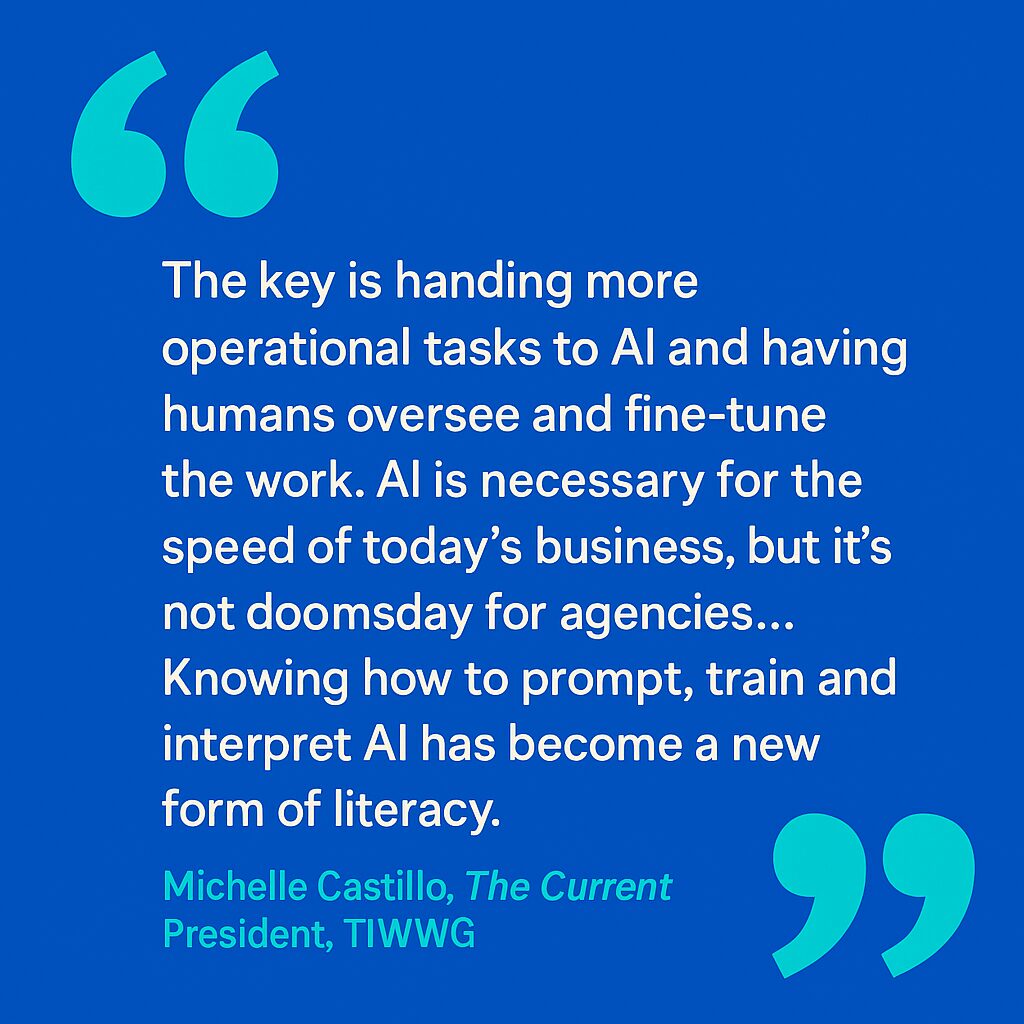
A Human plus AI operating model pairs the speed and processing power of AI with the seasoned judgment and creativity of people, so delivery is AI-accelerated but human-led. We built our work this way because the best results happen when AI and people collaborate rather than compete. An industry analysis of agencies and AI framed it well: the key is handing more operational tasks to AI while humans oversee and fine-tune the work, because knowing how to prompt, train, and interpret AI has become a new form of literacy.
In this model, AI does what it does best (crunching data, automating routine steps, generating first drafts) and the team does what it does best (adding strategic insight, creative polish, and quality assurance). It is not AI versus talent; it is AI with talent. That distinction is the difference between an agency that ships faster and one that ships faster and better.
The payoff is different depending on where you sit:
- For CMOs: an agency team that is far more productive, hits deadlines and growth goals sooner, and stays aligned to your strategy because humans steer the ship.
- For mid-level marketers: a responsive, proactive partner whose AI assistants watch campaigns around the clock so issues surface early, while a human account manager makes sure nothing ships off-brand.
AI is a tool, not a crutch. As 3 Media Web’s founder, Marc Avila, often puts it, “AI extends our capabilities, but our accountability to the client remains 100% human.” That accountability is what turns AI speed into trustworthy web strategy rather than unsupervised output.
We cover the whole decision — need, vetting, and switching — in our Choosing a Web Partner guide.
Orchestration, insight, and outcomes: what do they really mean?
Orchestration, insight, and outcomes are the three needs driving the AI push, and each one maps to a specific failure of the old agency model. Understanding them helps you judge whether an agency is actually delivering value or just adding tools.
Orchestration
Orchestration means coordinating every moving part of modern marketing into one harmonious strategy. Marketing keeps getting more complex, with multiple channels, multiple tools, and multiple customer touchpoints. Buyers want an “orchestra conductor” agency that integrates all of it, for example using an AI agent to pull data from Google Analytics, HubSpot, and LinkedIn Ads into one unified report without an analyst spending days in spreadsheets. If your current agency hands you a dashboard here and a report there and leaves you to connect the dots, that is a problem a Human plus AI agency solves automatically.
Insight
Insight is data explained, contextualized, and applied, which is far more valuable than raw data. Business leaders are drowning in data and craving clarity. A good agency uses AI to separate signal from noise (analyzing thousands of feedback comments to surface the top three market pain points, or monitoring SEO rankings daily and flagging why competitors gained), then relies on human strategists to translate that analysis into recommendations. Strong content marketing depends on exactly that distillation. Data does not equal insight; if your agency cannot explain the “so what,” that is a red flag.
Outcomes
Outcomes are the business results marketing exists to drive: revenue, pipeline, customer lifetime value, and brand equity. In the age of AI, the expectation is that agencies become even more outcome-aligned because the busywork is automated. Instead of spending 10 hours building a slide deck, the team spends those hours optimizing campaigns. More agencies are even structuring contracts around performance rather than deliverables, precisely because AI should enable greater accountability for results. It is no longer enough to say “we built you a website”; the real question is what that website achieved, which is why our SEO and SEO strategy work continuously tunes sites for faster loads, higher engagement, and more conversions.
What is agentic AI in marketing?
Agentic AI in marketing refers to AI systems that do not just answer prompts but take goal-directed action on your behalf, such as adjusting ad bids, routing leads, or assembling a cross-channel report without a person clicking through each step. The practical shift for buyers is that value moves from the interface to the integration: when AI agents run the work behind the scenes, connected data and reliable execution matter more than another dashboard to interpret.
When should you switch agencies over AI?
Consider switching agencies when your current partner cannot explain how AI benefits your account, shows no quality-control step for AI output, or keeps handing you raw data instead of decisions. A simple decision framework: if the agency fails on substance (no concrete use cases), structure (no governance or training), or proof (no measurable outcomes), that is a signal to look elsewhere. If they clear all three, the relationship is usually worth keeping and deepening.
How does an AI-ready knowledge engine make an agency better?
An AI-ready knowledge engine makes an agency faster, smarter, and more consistent because it gives every team member instant access to the agency’s collective experience. To deliver on the promise of AI, an agency needs intelligence at its core, not just a scattering of tools. That is why we built EmberIQ, 3 Media Web’s proprietary platform that serves as the brain of our operations.
EmberIQ is our consolidated, AI-ready knowledge center: standard operating procedures, checklists, past proposals, case studies, code snippets, and creative assets, all in one place our team and AI assistants can query in seconds. When a project starts in a new industry, EmberIQ surfaces relevant insights such as what messaging resonated or which UX design patterns worked well for that sector. Importantly, we never upload client data or client specifics to any AI tool, including EmberIQ. Here is why a knowledge engine matters to you as a client:
- Faster onboarding: the team queries learnings going back to the sales process instead of spending weeks chasing tribal knowledge, so much of your intake is prefilled and you simply refine it.
- Smarter strategy: proven tactics from across industries (a headline formula that lifted conversions, a journey that shortened sales cycles) are ready to be reused and tailored to your business.
- Consistent quality: AI outputs are generated against our vetted processes and brand guidelines, so you get the collective knowledge of the whole agency, not just the individuals on your team.
This is what AI with structure looks like: a coordinated system rather than each employee running their own experiments. It is the difference between an agency that uses AI strategically and one that uses it randomly, and it is core to delivering work that is AI-accelerated and human-led.
What does Human plus AI delivery look like in practice?
Human plus AI delivery looks like real client work where smart people and smart tech together produce outcomes neither could reach alone. The clearest example is our SEO and UX strategy analysis system, which integrates Google Analytics, Google Search Console, and Semrush to analyze 12-plus months of historical data, a task that previously took our team days to compile and cross-reference manually.
Human expertise leads the process. Before the AI begins, our strategists feed it rich context about each client (ideal customer profiles, target keywords, competitive landscape, industry nuances) so the analysis is grounded in real business objectives rather than processing data in a vacuum. The AI then runs multi-dimensional analysis, spotting patterns, anomalies, and opportunities that are easy to miss across separate data sources, and applies our proprietary frameworks to generate initial UI/UX and SEO/AEO/GEO recommendations. Those are intelligent starting points, not final deliverables: our experts review, validate, and enhance them with their judgment.
Work that previously required five to 10 hours of manual extraction and analysis now takes minutes, which lets us deliver comprehensive audits roughly 80% faster while surfacing far more actionable insights. More importantly, the team catches opportunities it might have missed before, such as subtle correlations between user behavior and search performance or emerging content gaps. AI is never used for gimmicks; it is used to get results that the human team directs toward each client’s strategic goals. For a closer look at how this plays out on the website itself, see how AI-ready websites make tech teams smarter.
That outcome-first, partner-not-vendor posture is exactly what turns an agency relationship into real business results. In our work with JazzHR, the recruiting-software company, we combined automated monitoring and proactive QA with human-led strategy to eliminate their recurring downtime (from roughly monthly outages to zero incidents), lift demo conversions by 133% through a self-scheduling flow, and build a partner marketplace that generated 250-plus new partner requests and 30-plus qualified opportunities. Their marketing manager put the shift plainly: 3 Media Web was “the first vendor that actually gets us,” sending reporting and updates “even when we’re not asking.” That is the difference between an agency that hands you a dashboard and one that owns the outcome and communicates proactively, which is the heart of the agency partnership support we build around every engagement.
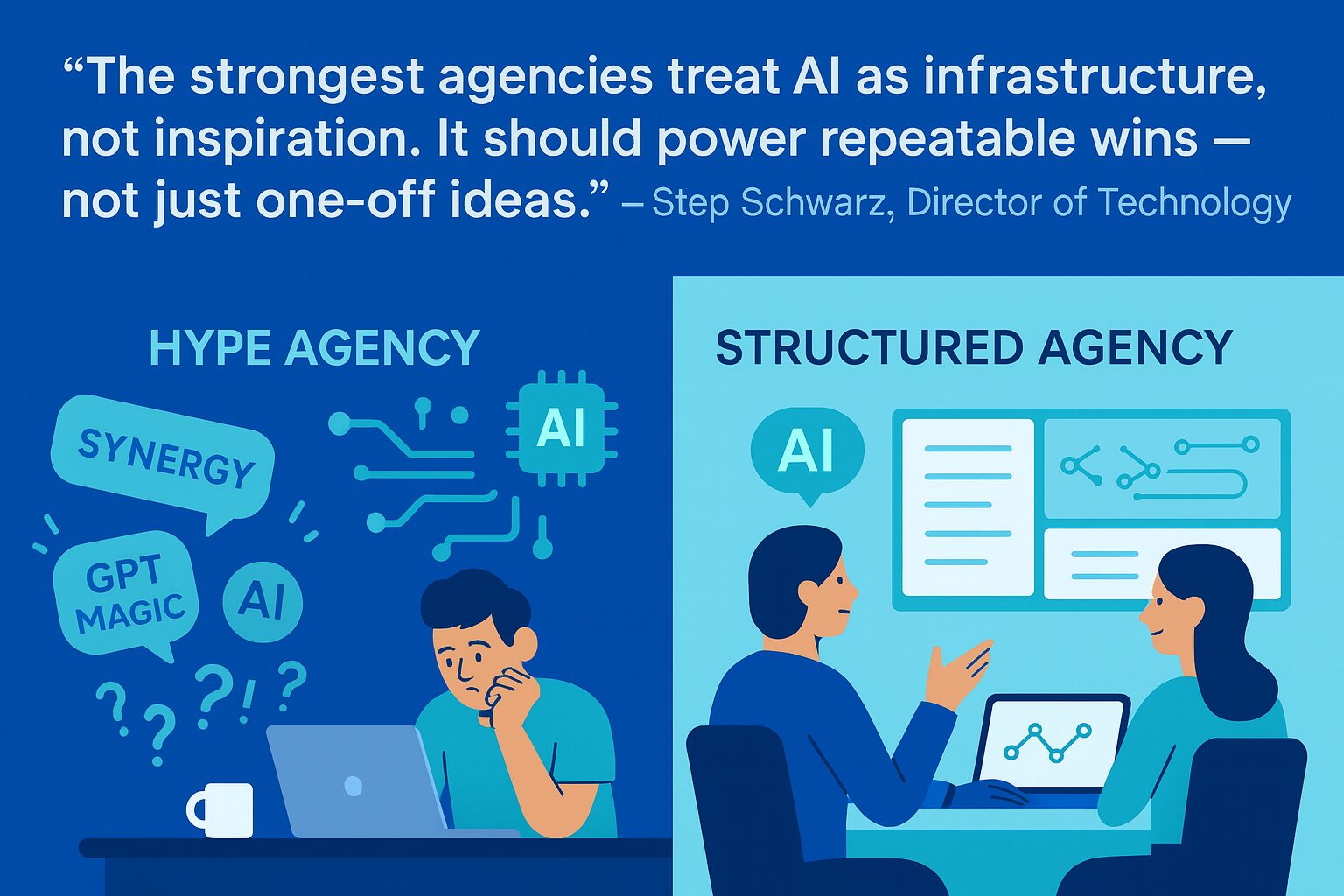
Hype vs. help: what are the red flags when an agency talks AI?
The biggest red flag is an agency that talks about AI in buzzwords but cannot connect it to a concrete benefit, outcome, or quality-control process. Not every agency claiming to “do AI” is doing it effectively, so the goal is to separate the true innovators from the imposters. Use the table below to weigh what a serious AI-forward agency sounds like against the warning sign in each area.
| What to probe | A serious AI-forward agency | Red flag to watch for |
|---|---|---|
| Substance behind the buzzwords | Explains exactly what AI automates, what insights it yields, and what outcomes it drives. | Pitches a “proprietary AI-driven growth engine” but changes the subject when you ask how it helps you. |
| Strategy and governance | Has a defined AI model, regular staff training, and a governance policy that protects your data. | Says “our folks use AI here and there” with no structure, ownership, or point of view. |
| Quality control on AI output | Describes a human-in-the-loop process that fact-checks and edits everything before it ships. | Brags about writing blog posts “in minutes” with no mention of human review. |
| Proof and case studies | Points to specific projects and numbers, such as an AI audit that raised organic traffic. | Offers only vague claims like “our clients have benefited across the board.” |
| Realistic expectations | Is optimistic about AI but honest about its current limits and the strategy it still requires. | Implies AI will run your marketing on autopilot if you “just sign and watch the magic.” |
Before we rolled out any AI tools, proprietary or not, we created a company-wide AI Governance Policy to safeguard responsible use without exposing client or internal data to public AI tools. An agency that cannot articulate how it integrates AI, or how it governs that use for quality and ethics, likely is not walking the walk. Look for clarity, not smoke and mirrors: the agencies worth hiring treat AI as a means to better insight, faster execution, and higher ROI, and they stay transparent about how they use it.
What are the 5 questions to ask an agency about AI?
The five questions below quickly reveal whether an agency has real AI expertise or surface-level knowledge. Ask each one and listen for concrete, account-specific answers rather than generalities.
- How exactly are you using AI in your workflows, and how will it benefit our account specifically? Push past general answers. A strong reply names concrete use cases relevant to you, like monitoring ad campaigns hourly to adjust bids, or drafting social posts that the team then polishes for more content at no extra cost.
- What processes do you have in place for quality control when AI is used? The agency should describe a human-in-the-loop step, such as a creative director refining AI-generated design variations or an editor fact-checking AI copy before it goes live. No clear QA step is a red flag.
- Can you share a case study of AI making a measurable impact for a client? Put them on the spot to prove it. Specific outcomes (AI-driven email personalization lifting open rates, an AI audit filling content gaps that boosted organic traffic) signal real wins; a struggle to answer signals there may not be one.
- How do you keep your team and your AI tools up to date? The field moves fast. Look for continuous learning, such as quarterly AI training, dedicated R&D time, and pilots with new tools, rather than one tool learned in 2023 and never revisited.
- Will we have visibility and input into how AI is applied to our projects? A savvy agency is open and consultative: it shows you when AI is doing something significant, shares the rationale, and lets you opt in or out. Cageyness here (“don’t worry about it, trust us”) is not a good sign.
For CMOs, these questions confirm the agency can align AI with your strategic goals and deliver ROI. For mid-level marketers, they reveal whether the partner will make your life easier and stay transparent about what is human versus machine. The agencies worth hiring will welcome the questions; the ones that bristle or give you fluff just told you what you needed to know.
Where are human creativity and AI converging in the next-generation agency?
The next-generation agency is a fluid, adaptive team where human creativity and strategic thinking are amplified by AI at every turn, neither old-school nor a robot factory. Picture your agency partner as an extension of your team with superpowers: people still brainstorm big ideas and craft the stories that make your brand shine, while an AI “brain” gives them instant knowledge and crunches data at superhuman speed. Repetitive tasks get handled, analysis happens overnight, and personalization scales in a flash, which frees humans to focus on strategy, creativity, and relationships.
In this model, AI is treated as a teammate that needs onboarding, training, management, and a clear role, and every team member becomes part problem-solver and part “AI pilot.” New titles like AI Operations Manager signal an agency that is serious about evolving rather than delegating AI to whoever is “good with computers.” The result is what marketing leaders have always wanted from a partner: proactive strategy and tangible growth impact, delivered by a results-obsessed team that sets KPIs that matter and uses every tool, human or AI, to hit them.
The gap is already widening between agencies that embraced AI and those that hesitated, and the same is true for the marketing teams that hire them. As you weigh your next agency, ask whether they have the Human plus AI chops to orchestrate your marketing, deliver genuine insight, and drive real outcomes. If yes, you have likely found a keeper. The takeaway is simple: do not settle for agencies that only talk about AI; hire the ones that deliver with it.
How 3 Media Web Can Help
At 3 Media Web, our Human plus AI model is built to orchestrate your marketing, surface insight faster, and drive the outcomes that matter, with human judgment leading and AI accelerating the work. We pair proprietary tools like EmberIQ with seasoned strategists, and we govern every use of AI so the work stays measurable, on-brand, and accountable to you. Our team specializes in:
- Web strategy and UX that turns AI-driven analysis into a clear, conversion-focused plan.
- SEO, AEO, and GEO strategy that uses 12-plus months of data to win search and AI answer engines.
- Content marketing where AI handles the heavy lifting and humans add the judgment that earns trust.
If you are weighing AI-forward partners, our guide to AI-powered website features that drive growth shows what this looks like on the site itself. When you are ready, talk to our Human plus AI team to see how we put an AI-accelerated, human-led approach to work for your organization.