Last updated: July 7, 2026
- Spot a reliable agency partner by how they engage before the contract: a real partner asks about your business goals, not just your deliverables.
- Transparency is the first test — reliable agencies explain pricing, scope, timelines, and process plainly instead of hiding behind vague proposals.
- Watch the red flags: copy-paste proposals, overpromising on price or speed, no references or case studies, and slow or unclear communication.
- Strong partners take initiative — they recommend, own outcomes, and are willing to say no when something would hurt your results.
- The best partnerships are strategic and long-term: they tie your website and marketing back to growth, then keep improving it over time.
How do you spot a reliable agency partner?
Spot a reliable agency partner by watching how they behave before you sign: a dependable partner asks why you need a project and ties it to your business goals, is transparent about pricing and process, and can prove past results with references or case studies. Everyone in a crowded market promises responsiveness and expertise, so confidence is easy to fake — credibility shows up in the questions an agency asks, the clarity of its proposal, and the proof it can put on the table. The signals below give you a repeatable way to tell a true collaborator from a vendor who disappears after the kickoff call.
This matters because the decision is rarely yours alone, and it rarely rides on the sales pitch. According to TrustRadius’s 2022 B2B Buying Disconnect report, a survey of 2,185 technology buyers, B2B buyers do not rely solely on vendor-provided content before they commit — they weigh reviews, case studies, and references first. An agency that makes that proof easy to find is already showing you how it will work once the contract is signed.
What is an agency partner versus a vendor?
An agency partner is an outside team that takes shared ownership of your outcomes and ties its work to your business goals, while a vendor simply executes a defined scope and stops there. The practical difference shows up in behavior: a partner asks why before what, recommends instead of waiting for direction, and stays accountable after launch. A vendor delivers the brief and moves on. Naming which one you actually need is the first step to choosing well.
Look for alignment beyond the proposal
Look for an agency that is curious about why you need a project, not just what you need delivered, because alignment on goals is what separates a partner from an order-taker. During the early conversations, pay attention to how they engage with your business rather than your task list. Partners who dig deeper from the start demonstrate that they are invested in a relationship, not just a contract.
For a deeper look at this, see How Do Digital Marketing Agency Partnerships Work?
Ask yourself three questions while you evaluate them:
- Do they ask strategic questions about your audience, business objectives, or success metrics?
- Are they focused only on deliverables, or do they connect those deliverables to business outcomes?
- Do they show real understanding of your brand’s tone, workflow, and decision-making structure?
This is also where good agencies lean on a clear web strategy from day one, so the work maps to your goals before a single deliverable is scoped.
Why is transparency the first test of reliability?
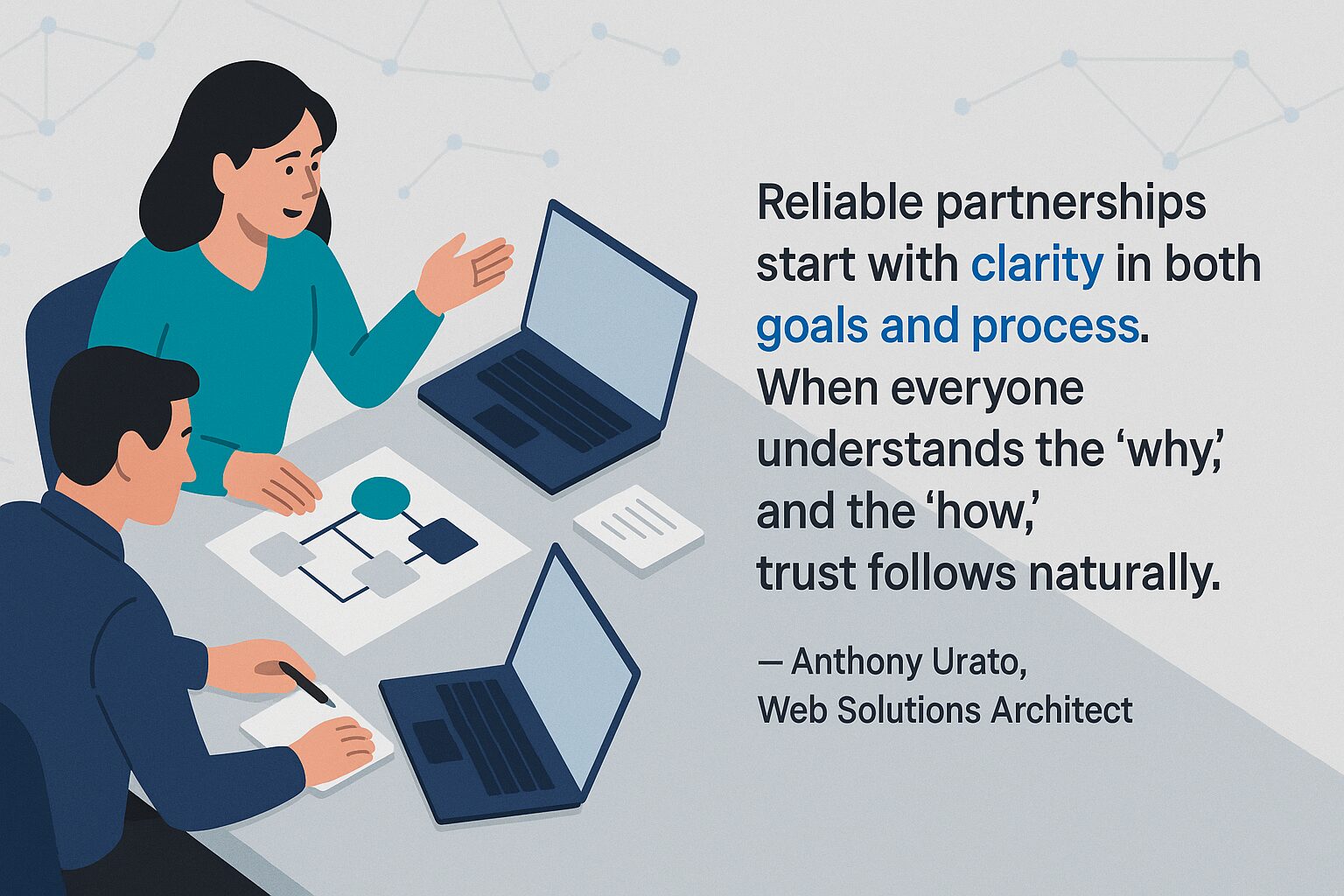
Transparency is the first test of reliability because how an agency handles the sales process previews what working together will feel like long-term. An agency that is open about costs and candid about timelines before you pay anything tends to stay open once the project is underway. If a partner cannot articulate how it works — or hesitates to show you its process — treat that as a warning sign, not a quirk.
Look for transparency at every step of the conversation:
- Pricing and scope: reliable agencies explain where costs come from and what is included.
- Timelines: they give realistic estimates instead of overly optimistic promises.
- Communication: they are proactive about setting expectations and responsive to your questions.
- Process: they can clearly outline their approach to web design and development, SEO, or any other core service they provide.
Watch for the signs of a true partnership
Watch for an agency that shows up like an extension of your own team, because the best partnerships are defined by behavior during the work, not promises made before it. A reliable partner communicates without being chased, recommends instead of waiting for direction, and owns outcomes rather than tasks. Strong partners also care as much about your long-term results as you do, which is why they will occasionally tell you no.
For a deeper look at this, see The Dos and Don’ts of a Healthy Partner Agreement.
The markers of a genuine partner are consistent:
- They communicate frequently and clearly, without needing to be chased.
- They offer recommendations instead of waiting for direction.
- They own outcomes, not just the tasks on a checklist.
- They are comfortable saying no when something is not the right fit or might hurt performance.
In our work with JazzHR, a recruiting-software company, this is exactly how the relationship evolved. We were first brought on for a single partner-marketplace microsite, then expanded into ongoing support because the working relationship earned it — resolving a site that had been going down roughly once a month down to zero incidents, and, in the client’s words, sending “reporting and any updates about the site, even when we’re not asking on a regular basis.” A partner who behaves that way before you have to chase them is the one worth keeping.
That instinct to push back in your interest is a feature, not friction. We unpack the same dynamic in why some partnerships fail and how to avoid the pitfalls, where the absence of these behaviors is usually the first crack.
Which red flags should you watch for before you sign?
Watch for red flags that surface during the sales process, because the warning signs you ignore early almost always get worse after the contract is signed. Even polished agencies leak clues about how reliable they will be, and a buyer who knows what to look for can spot them before money changes hands. Use the table below to match each red flag to the reliability problem it signals.
| Red flag during the pitch | What it usually signals | What a reliable partner does instead |
|---|---|---|
| Generic, copy-paste proposal | Little real interest in your specific goals | Tailors the proposal to your audience and outcomes |
| Overpromising on price or speed | Unrealistic estimates that lead to stress and rework | Gives honest timelines and explains the trade-offs |
| Blames clients for past failures | A lack of ownership that will repeat on your project | Owns its share of outcomes and what it learned |
| Slow or vague communication | Response times and clarity that only get worse later | Replies promptly and sets clear expectations up front |
| No references or case studies | Thin proof of results or happy clients | Shows concrete outcomes and connects you to clients |
When an agency operates without accountability, your projects will too. If you are already living with several of these signals, our guide to how partners can simplify complex client needs covers what a healthier engagement should look like instead.
When should you switch agency partners?
Consider switching agency partners when the reliability problems are pattern, not accident: repeated missed deadlines, communication you have to chase, scope that keeps drifting, or a refusal to own results. Before you move, name the specific behaviors that are failing and raise them once, clearly — a real partner course-corrects. If nothing changes after that, the relationship is costing you more than a transition would, and it is time to find agency partnership support that treats your outcomes as its own.
Prioritize strategy over execution
Prioritize a partner who guides strategy over one who only executes tasks, because a reliable agency connects your website, marketing, and digital performance back to your broader business goals. That means thinking past a single design or campaign and into continuous improvement — the kind of ongoing work that compounds over months instead of resetting with every project. A partner who plans this way helps you stay ahead of change rather than react to it.
For a deeper look at this, see The Three Traits of Agency Partners Who Always Deliver.
Strategic partners build improvement into the relationship through:
- Regular website support and optimization
- Ongoing conversion rate optimization
- Data-driven lead generation strategies
- Thoughtful reporting that ties digital metrics to growth outcomes
This is the heart of 3MW’s strategic support work: keeping a site evolving at the pace of your business instead of letting it drift between redesigns.
Frequently asked questions
How do I find a reliable agency partner?
Find a reliable agency partner by judging behavior over promises. Look for one that asks about your business goals, is transparent about pricing and process, communicates proactively, and can prove results with references or case studies. The way an agency acts during the sales process is the clearest preview of how it will act once you are a client.
What are the biggest red flags when choosing an agency?
The biggest red flags are copy-paste proposals, overpromising on price or speed, no references or case studies, slow or vague communication, and blaming clients for past failures. Each one signals a reliability problem that tends to worsen after the contract is signed, so treat warning signs in the pitch as a preview, not an exception.
Why does transparency matter so much in an agency relationship?
Transparency matters because how an agency handles pricing, scope, and timelines before you pay previews how it will communicate during the work. Reliable agencies explain where costs come from and give honest estimates. An unwillingness to show their process or pricing early almost always points to friction and surprises later in the engagement.
How can I tell a true partner from just a vendor?
A true partner takes initiative — they recommend instead of waiting for direction, own outcomes rather than tasks, and are willing to say no when something would hurt your performance. A vendor executes the brief and little more. The difference shows up in whether the agency treats your long-term results as its own responsibility.
Should an agency be able to show references or case studies?
Yes. Reliable partners can demonstrate proof of results and satisfied clients, and most B2B buyers weigh that third-party evidence before they commit. An agency that cannot share references, case studies, or measurable outcomes is asking you to take its expertise on faith, which is a meaningful risk for any growing team.
How long should an agency partnership last?
The strongest agency partnerships are ongoing rather than one-and-done, because a website and marketing program improve through continuous iteration, not a single project. Expect an initial engagement to prove fit, then a longer strategic-support relationship if results and communication hold up. Judge longevity by whether the partner keeps tying its work to your growth, not by a fixed contract length.
How 3 Media Web Can Help
3 Media Web builds long-term partnerships with agencies and in-house marketing teams that value trust, clarity, and consistent results, guided by our Human and AI approach so judgment leads the strategy and automation handles the repeatable work. We specialize in strategic web design and development, ongoing website support, and digital optimization that evolves with your business. That includes:
- A clear web strategy that ties every recommendation to your business goals before work begins.
- Proactive strategic support across hosting, optimization, and reporting so your site keeps improving.
- Dedicated agency partnership support for teams that need a reliable white-label or overflow collaborator.
- Transparent communication from defining goals to every phase of collaboration, with no surprises on scope or timeline.
We believe strong partnerships are built on shared wins, not short-term projects. Ready to work with a partner who treats your success like their own? Let’s talk partnership and what reliable collaboration should look like for your team.
For every stage of the decision, our guide to choosing a web partner has you covered.