Last updated: July 7, 2026
- The best vendor relationships start with alignment, not capability, so the first question you ask should test how a partner thinks, not just what they sell.
- Lead with one question: “How do you ensure our goals stay aligned over time?” It separates transactional vendors from true partners faster than any capabilities deck.
- A strategic partner answers with a process for staying aligned: regular check-ins, metrics tied to your revenue goals, and a track record of adapting when priorities shift.
- Alignment matters more than raw execution, because a fast vendor pointed at the wrong goal just wastes your budget faster.
- Screen every vendor against the same five signals before you sign, then keep testing for alignment as your roadmap evolves.
When you step into a new marketing leadership role at a technology company, every decision feels like a test. You are under pressure to prove impact quickly: streamline processes, hit lead targets, and build a foundation for scalable growth. That means you will be evaluating vendors fast — web developers, agencies, analytics partners — and every one of them claims to be “strategic,” “data-driven,” and “results-focused.” As you already know, the reality often does not match the pitch.
The challenge is not finding a vendor who can deliver. It is finding one who will stay aligned with your evolving business goals as priorities shift, products grow, and leadership changes. That is where one powerful question separates a transactional vendor from a true partner.
What is the first question a new tech CMO should ask a vendor?
Ask this first: “How do you ensure our goals stay aligned over time?” It is the single most revealing question because it tests how a vendor thinks about partnership, not just what they can build. Most marketing leaders open vendor conversations with questions about capabilities, case studies, and pricing. Those matter, but they only describe what a vendor does — not how they will work with you a year from now.
If this challenge sounds familiar, Cutting the Fat: How CMOs Decide Which Vendors Stay or Go is worth a read.
The alignment question changes the conversation. A vendor focused on deliverables will answer with timelines and a feature list. A strategic partner will answer with how they learn your business model, track your growth targets, and tie their work to measurable outcomes. That difference is the whole game, and it shows up in the first five minutes if you know to listen for it.
In our work with JazzHR, a recruiting-software company, that alignment is what turned a single project into an ongoing partnership. 3 Media Web was first hired to build their partner marketplace, then took over full web support — and the results tracked directly to their revenue goals: a 133% improvement in demo conversions, 250+ new partner requests and 30+ opportunities from the marketplace, and a move from near-monthly website outages to zero incidents. Their senior marketing manager put the alignment test plainly: “I feel 3 Media Web is the first vendor that actually gets us… even when we’re not asking, they send us reporting and updates.” That is what a partner who protects your goals over time actually sounds like.
What to Offload to a Web Partner vs What to Keep In-House digs into the practical side of this.
This is also why alignment belongs at the center of your web strategy from day one, long before anyone scopes a redesign or a campaign.
What is vendor-goal alignment?
Vendor-goal alignment is the degree to which a vendor’s day-to-day work stays tied to your business outcomes — pipeline, revenue, and retention — rather than to a fixed task list. An aligned vendor measures success the way you do, adjusts as your roadmap changes, and can explain how each deliverable moves a metric you care about. It is the difference between a partner who advances your strategy and one who simply closes tickets.
What should you listen for in a vendor’s answer?
A good partner has a process for adapting to your goals, not just executing on day one. The fastest way to read an answer is to compare what a strategic partner says against what a transactional vendor says to the same question. Use the table below as a real-time scorecard while a vendor is talking.
| Signal to listen for | A strategic partner says | A transactional vendor says |
|---|---|---|
| Proactive collaboration | Describes regular check-ins, quarterly strategy reviews, and joint planning. | Talks only about delivery dates and a ticketing queue. |
| Transparent reporting | Measures success with metrics tied to your goals, such as qualified lead generation, conversion rate, and pipeline impact. | Reports vanity numbers like raw traffic and impressions. |
| Adaptability | Gives a concrete example of pivoting for a client when priorities changed. | Treats the original scope as fixed and resists mid-course change. |
| Ownership and accountability | Talks in terms of “we” and behaves like an extension of your team. | Draws a hard line between “your” work and “our” work. |
| Strategic curiosity | Asks sharp questions about your market, sales process, and audience. | Waits for a spec and asks little about the business behind it. |
A confident answer across all five signals points to a partner who will protect your goals as they evolve. A gap in even one is worth resolving before you sign. The same five-signal read works whether you are evaluating a design vendor, an analytics partner, or an ongoing website support provider.
Why does alignment matter more than execution?
Alignment matters more than execution because a fast vendor pointed at the wrong goal just wastes your budget faster. In technology marketing, speed is essential — but speed without alignment leads to wasted spend and siloed work. The payoff for getting it right is measurable, not theoretical. According to The Strategy Institute, marketing goals connected to business objectives have been shown to fuel revenue growth by 24% and boost profits by 27%. Those results come from spending the same resources on work that points in the same direction, which is exactly what an aligned partner makes possible.
A well-aligned partner does three things a purely capable one often will not:
- Understands how your business defines success — pipeline and revenue, not just traffic or clicks.
- Connects digital initiatives like SEO, conversion rate optimization, and paid media to revenue outcomes instead of treating them as standalone tasks.
- Brings ideas that move your strategy forward proactively, rather than waiting for a list of boxes to check.
Without alignment, even the most technically capable vendors become liabilities. With it, they become an accelerator. Proving that impact upward matters too, and our guide to the metrics that prove partnership value to leadership covers exactly what to track when you report results to your CEO or board.
When should you replace a vendor instead of realigning?
Replace a vendor when the misalignment is about will, not skill. If a capable vendor still reports vanity metrics after you have shared your revenue goals, resists changes to a fixed scope, and treats strategy reviews as optional, the gap will not close — and every month you wait compounds the wasted spend. Realign first with a direct conversation and a shared scorecard; if nothing moves after one full reporting cycle, start looking. Switching costs are real, but an unaligned vendor quietly costs you more.
What questions should you ask next?
Once you have identified a partner who values alignment, dig deeper. These follow-up questions test for the two hallmarks of a partner who can scale with your growth — consistency and flexibility:
- “How do you stay informed about changes in our strategy or product roadmap?”
- “What is your communication cadence, and who is involved in those conversations?”
- “How do you measure success and report results back to us?”
- “Can you describe a time you helped a client pivot strategy mid-project?”
Alignment is not a one-time check at signing; it is the foundation of a relationship you keep testing as your roadmap changes. That trust compounds over time, and it is the same trust that turns a good vendor into a long-term partner — the dynamic we explore in building trust in partnerships.
Frequently asked questions
What is the single best question to ask a new vendor?
Ask “How do you ensure our goals stay aligned over time?” It reveals how a vendor thinks about partnership, communication, and accountability — not just what they can build. A deliverables-focused vendor answers with timelines and features, while a strategic partner answers with a process for learning your business and tying their work to your measurable outcomes.
Why ask about alignment instead of capabilities or price first?
Capabilities, case studies, and pricing describe what a vendor does today, but they say nothing about how the relationship holds up as your priorities shift. Alignment is the variable that determines whether a capable vendor stays valuable a year from now, so testing for it first saves you from a costly switch later.
What are the signs of a vendor who will stay aligned?
Listen for five signals: proactive collaboration through regular reviews, transparent reporting tied to your goals, adaptability backed by a real example, ownership expressed as “we” rather than “you,” and genuine curiosity about your market and sales process. A confident answer across all five points to a partner who will protect your goals over time.
What is a red flag that a vendor will not stay aligned?
The clearest red flag is a vendor who reports activity instead of outcomes — leading with traffic, impressions, or hours logged rather than pipeline and revenue. Pair that with resistance to changing a fixed scope and few questions about your business, and you are looking at a transactional vendor who will drift from your goals the moment priorities shift.
How is a strategic partner different from a transactional vendor?
A transactional vendor executes a fixed scope and reports activity metrics like traffic and impressions. A strategic partner treats your goals as their own, ties initiatives like SEO and conversion rate optimization to revenue, adapts when your roadmap changes, and brings proactive ideas instead of waiting for a list of tasks to complete.
How often should I revisit alignment with a partner?
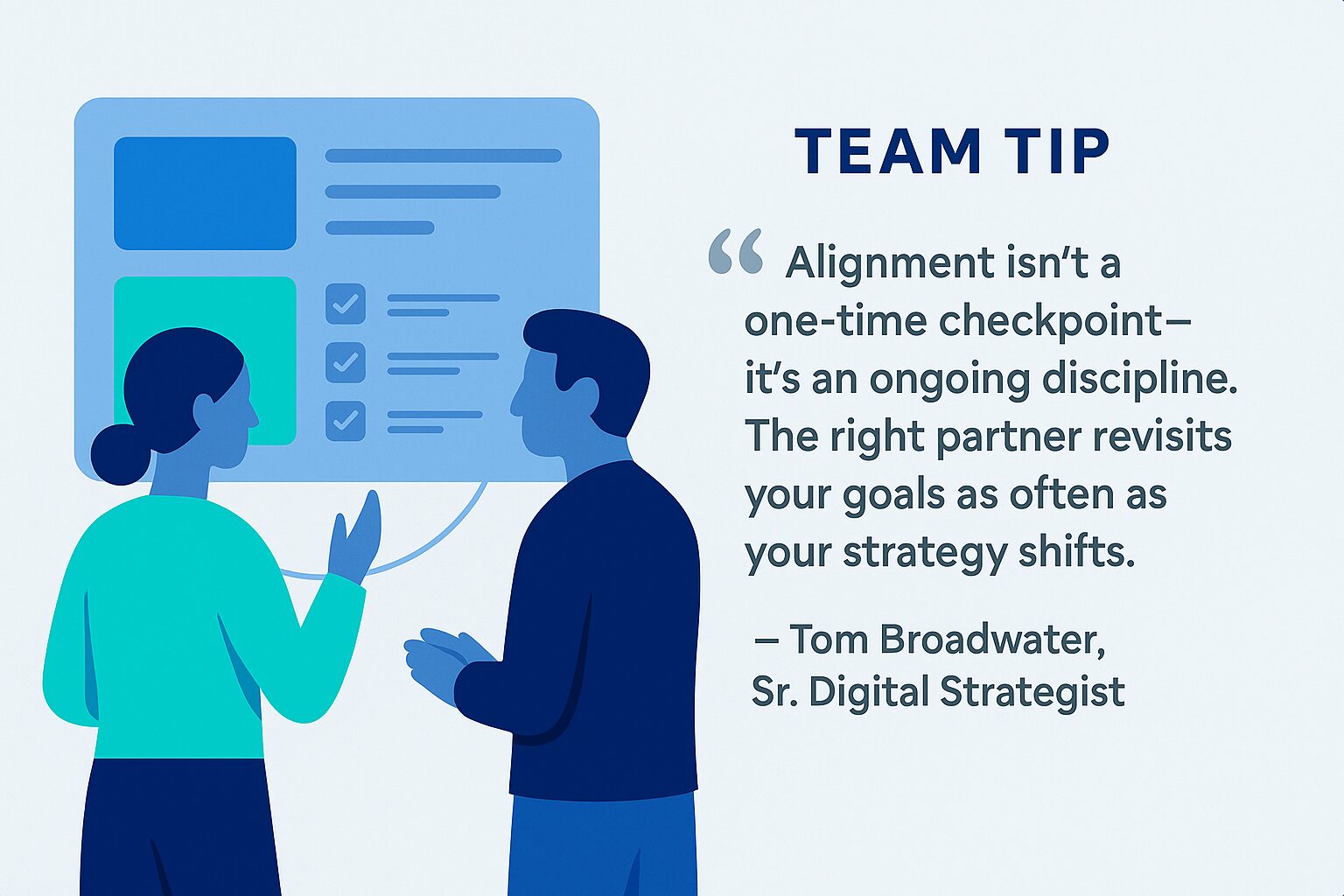
Revisit alignment at least quarterly, and any time your strategy, product roadmap, or leadership changes. Alignment is not a one-time check at signing; it is an ongoing discipline. Regular strategy reviews keep a partner’s work pointed at your current goals rather than the ones you set when the engagement began.
How 3 Media Web Can Help
At 3 Media Web, we build long-term partnerships with technology companies by aligning every project to measurable business goals. Guided by our Human and AI approach, judgment leads and automation supports, so the work stays measurable and the relationship stays personal. Our process begins with understanding where you are headed — then we make sure your digital presence evolves alongside your business through:
- Web strategy that ties your website to revenue goals from the start.
- Custom web design and development built for marketing performance, not bloated templates.
- Lead generation tied to conversion rates and pipeline impact, not vanity metrics.
If you are an agency evaluating a white-label build or ongoing support team on behalf of a client, our agency partnership support applies the same alignment discipline to the work we do alongside you. We do not just execute tasks; we help you connect every digital initiative to the growth metrics that matter. Talk to a partner to see what real alignment feels like.
For the full picture, see our complete guide to choosing a web partner.