Last updated: July 14, 2026
TL;DR: New CMOs in professional services have little runway to prove value, so the fastest ROI comes from clarity, not volume. Tie your website, data, and a few high-leverage campaigns directly to revenue and retention, ship visible early wins in your first 90 days, and report outcomes in language partners care about. Doing the right few things well beats doing everything at once.
- New CMOs in professional services face immediate pressure to show measurable results.
- Early wins come from clarity—aligning your website, data, and campaigns to real business goals.
- Fast ROI isn’t about doing everything; it’s about doing the right few things well.
- Data-driven website and marketing performance tracking are essential for credibility.
- The fastest way to earn trust is to tie marketing outcomes directly to revenue and retention.
How Do New CMOs Prove ROI Fast in Professional Services?
New CMOs prove ROI fast by defining what ROI means for their firm, building a website that converts, making data-backed decisions, shipping early wins in the first 90 days, and reporting results in revenue terms. The pressure is real: according to Spencer Stuart’s CMO Tenure 2026 analysis, the average tenure among CMOs in the S&P 500 is just 4.1 years, compared to 5.0 years for all C-suite roles, so the window to establish credibility is short. In professional services, where relationships and reputation drive sales, proving ROI fast requires balance—visible wins without sacrificing strategic depth. Focus your energy on clarity, measurement, and momentum.
Stepping into a CMO role in a professional services firm means walking into a spotlight. The partners want to see numbers. The team expects direction. The CEO wants results yesterday. You know marketing’s value runs deeper than quick wins—but proving that value early determines whether your strategy earns the long-term trust it deserves. A clear website strategy gives you a measurable foundation to build that proof on.
For a deeper look at this, see The CMO’s First 100 Days: Website Decisions That Make or Break You.
What Counts as a Good Marketing ROI in Professional Services?
In professional services, a “good” marketing ROI is less about a single ratio and more about proving influence on the metrics leadership already tracks: qualified consultation requests, pipeline contribution, client retention, and cost per acquired engagement trending down over time. Because sales cycles are long and relationship-driven, tie marketing to leading indicators—booked meetings and marketing-influenced deals—rather than waiting on a single closed-revenue figure to justify the investment.
Step 1: Define What ROI Really Means for Your Firm
Start by defining ROI in a way that reflects your firm’s unique buyer journey, because professional services results rarely come from direct sales. Your website’s “conversion” might be a consultation request, not a purchase, so a single revenue figure won’t tell the whole story. Align marketing metrics across four layers—awareness, engagement, conversion, and revenue—so leadership can see how early-funnel activity connects to closed business.
| Metric layer | What it measures | Example signals |
|---|---|---|
| Awareness | Reach and visibility at the top of the funnel | Website traffic growth, brand visibility, content reach |
| Engagement | Depth of interest from qualified visitors | Average session duration, case study downloads, webinar attendance |
| Conversion | Intent that becomes a tracked lead | Form fills, demo requests, meeting bookings from qualified leads |
| Revenue | Marketing’s influence on closed business | Deals influenced by marketing touchpoints, pipeline contribution |
By clearly connecting these layers, you turn marketing into a measurable system instead of a collection of campaigns—and you give partners a clear line from a website visit to a signed engagement.
Step 2: Build a Website That Converts
Make your website the first place a skeptical partner finds evidence of marketing ROI, because it is. If your site doesn’t align with your brand promise and lead pipeline, your credibility suffers before a single campaign launches. A conversion-focused website isn’t just attractive—it’s functional and fast, and it should:
- Reflect your brand’s authority through professional web design and development
- Include clear calls to action and service pathways designed for lead generation
- Be optimized for mobile, speed, and accessibility
- Feature social proof like client logos, testimonials, or industry recognition
A strong digital foundation lets you measure engagement, test ideas, and capture leads efficiently—all critical for showing early ROI. This is where a deliberate build and design approach pays off, turning your site from a brochure into a working revenue asset.
When Should a New CMO Redesign the Website vs. Optimize the Existing One?
Choose optimization when the current site converts but underperforms on speed, messaging, or a few key pages—these are fast, low-risk early wins you can ship in weeks. Choose a redesign when the platform blocks your team from making updates, integrations, or measurement, because that friction quietly caps every future campaign. A practical rule: fix what limits proof now, and rebuild what limits growth for the next two years.
Step 3: Focus on Data-Backed Decisions
When you’re under pressure to prove impact, make data your first move, not your last. Implement analytics that connect marketing actions to business outcomes, then track how content, advertising, and outreach influence each stage of the funnel. For example:
- Use SEO to attract qualified visitors actively searching for your services
- Employ targeted paid media management to reach decision-makers quickly
- Apply conversion rate optimization to test headlines, CTAs, and landing pages that drive action
Data doesn’t just measure progress—it shapes it. It gives you proof to show the partners and insight to improve your next campaign. For a deeper look at the numbers leadership actually values, see the metrics that prove partnership value to leadership.
Step 4: Prioritize Early Wins That Build Momentum
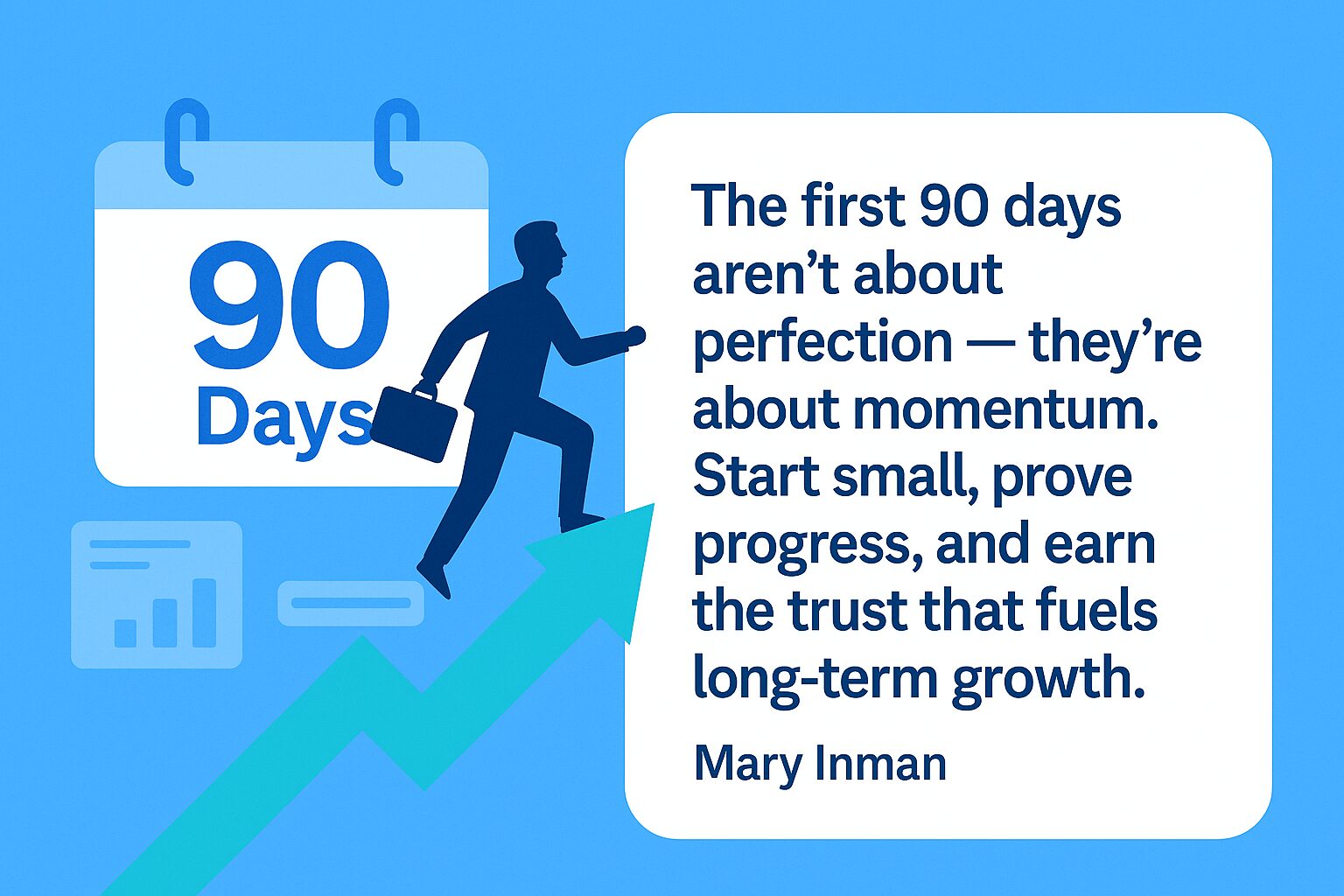
In your first 90 days, prioritize initiatives that show visible progress while supporting long-term goals. Small wins compound: when leadership sees marketing generating measurable leads or engagement, it buys you the time and budget to execute bigger strategic initiatives. Some examples include:
- Revamping your homepage messaging to align with client needs
- Launching a high-performing PPC campaign for a key service line
- Improving conversion tracking and lead quality reporting
- Refreshing top-performing blog content to generate immediate SEO gains
In our work with Lando & Anastasi, a Boston intellectual property law firm, this is exactly how momentum took hold: replacing a hard-to-manage platform freed the marketing team to move on their own, saving 40+ hours a month and driving a 20% year-over-year gain in SEO visibility—the kind of visible, measurable result that turns a vendor relationship into a strategic partnership. Those early wins are also a trust-building exercise. The same principle that wins referral business—consistent, visible value—applies internally, as we cover in building trust in partnerships.
Step 5: Communicate ROI Effectively
Translate every metric into a business outcome partners care about, because proving ROI is as much storytelling as it is data. Stakeholders need to understand what the numbers mean: revenue, client growth, reputation, and retention. Structure your updates around four points:
- The goal you set
- The action you took
- The result achieved (with data)
- The opportunity moving forward
When you connect metrics to impact, you shift the conversation from “marketing cost” to “marketing investment.”
How 3 Media Web Can Help
At 3 Media Web, we help professional services CMOs accelerate impact through strategic digital foundations. From web strategy to continuous website support and performance optimization, we create websites that attract, convert, and evolve alongside your firm’s goals.
From Chaos to Control: A CMO’s Guide to Aligning Digital digs into the practical side of this.
Our team specializes in building measurable marketing systems—integrating SEO, lead generation, and analytics into one cohesive growth strategy. We help new marketing leaders establish credibility fast, with results they can confidently present to any leadership team.
You can explore this further in 90 Days to Impact: How New CMOs Prove Value Fast.
For the bigger picture, see our professional services web design overview — how we build sites for firms where credibility is the product.