Last updated: July 7, 2026
- Get a scattered digital setup on the same page by auditing your platforms, partners, and data, then rebuilding around one website hub that ties everything together.
- Being out of sync is common and costly: Gartner found marketing teams actively use only 49% of their martech, and just 15% of organizations are high performers.
- Follow five steps: find the mess, rebuild the base, line up strategy and data, tighten how you run campaigns, then guard your progress with steady support.
- One clear digital strategy drives stronger ROI, a steady brand experience, and faster work, turning marketing from a patchwork into a growth engine.
- The right digital partner keeps systems tied together through proactive website support, so your progress holds as your firm grows.
How do professional services CMOs fix a scattered digital ecosystem?
Professional services CMOs fix a scattered digital ecosystem by auditing platforms, partners, and data to expose waste, then rebuilding around one website hub that unites brand, content, and analytics. The work moves in five steps: find the mess, rebuild the base, line up strategy and data, tighten how you run campaigns, and guard your progress with steady support. Getting everyone on the same page, not another campaign, is what turns scattered tools into a growth engine.
Most professional services CMOs inherit tangled digital setups built over years of growth: many websites, disconnected CRMs, mixed messaging, and agency partners chasing their own goals. Everyone is trying to help, but the result is the opposite — waste, wasted spend, and frustration. You are asked to prove ROI, drive leads, and refresh how the brand is seen, yet half your energy goes into managing vendors or fixing systems that do not talk to each other. The data shows the drag: according to the 2025 Gartner Marketing Technology Survey, martech use has dropped to 49%, meaning marketers actively use barely half the tools they pay for. The fix is getting everyone on the same page, and it starts with a clear web strategy that ties every system back to a business goal.
What does a mismatched digital setup actually cost?
A mismatched digital setup costs professional services firms in wasted spend, slower work, and blind spots in the sales pipeline. When platforms, teams, and partners work in silos, marketing pays twice: once for tools no one fully uses, and again in the hours spent lining up systems that should share data. The table below shows how a scattered setup and a unified one split across the measures a CMO is judged on.
| Measure | Scattered setup | Unified setup |
|---|---|---|
| Tech stack | Overlapping tools, low use, hand-copied data between systems. | Connected platforms with a website hub feeding analytics and automation. |
| Reporting | Channel data lives in separate dashboards; ROI is hard to prove. | One shared view of leads for both marketing and sales. |
| Brand experience | Mixed messaging across sites, campaigns, and vendors. | A steady brand and service story everywhere a prospect lands. |
| Partners | Agencies chase their own goals with little teamwork. | Partners work openly under your priorities and goals. |
| Speed | Every change is a project; insights arrive weeks late. | Faster changes and choices made on current, pooled data. |
According to the same Gartner (2025) research, organizations struggle most with broken processes and siloed data, the exact conditions this kind of work is built to fix.
What is a martech stack audit?
A martech stack audit is a careful list of every marketing platform, connection, and data source you own, scored for use, overlap, and how well each tool links to the others. For a professional services CMO it answers one question: which tools earn their cost and which ones create the silos that stall reporting and campaigns.
Step 1: Find the root of the digital mess
Start by auditing where your digital setup breaks down, because you cannot fix what you have not named. A tight audit surfaces the gaps holding your team back and gives you the proof to rank fixes. Ask four questions:
- Are your website, marketing automation, and CRM platforms properly connected?
- Can you see performance across every campaign and channel?
- Are agencies and partners working under the same goals and metrics?
- Does your website reflect your current services and thought leadership?
In many professional services firms, digital chaos creeps in over time as teams grow and priorities shift. The good news is that naming the problem is the first real step toward control.
When should a CMO merge multiple websites?
Merge when separate sites split your traffic, water down SEO authority, or force your team to keep the same content in several places. If prospects land on mixed brand experiences or you cannot report on the full funnel in one view, the cost of a scattered setup now outweighs the cost of merging. One strong hub almost always wins.
Step 2: Rebuild around one digital base
Rebuild your setup on the website, because it is the hub every other digital effort leans on. When your site fits your brand, messaging, and analytics, campaigns, automation, and reporting all work better. A strong base includes:
- A custom web design and development approach built to grow and connect.
- Clean content structure that makes your services easy to understand.
- Accessibility that meets current industry standards.
- Fast performance and steady tech to support SEO, analytics, and automation.
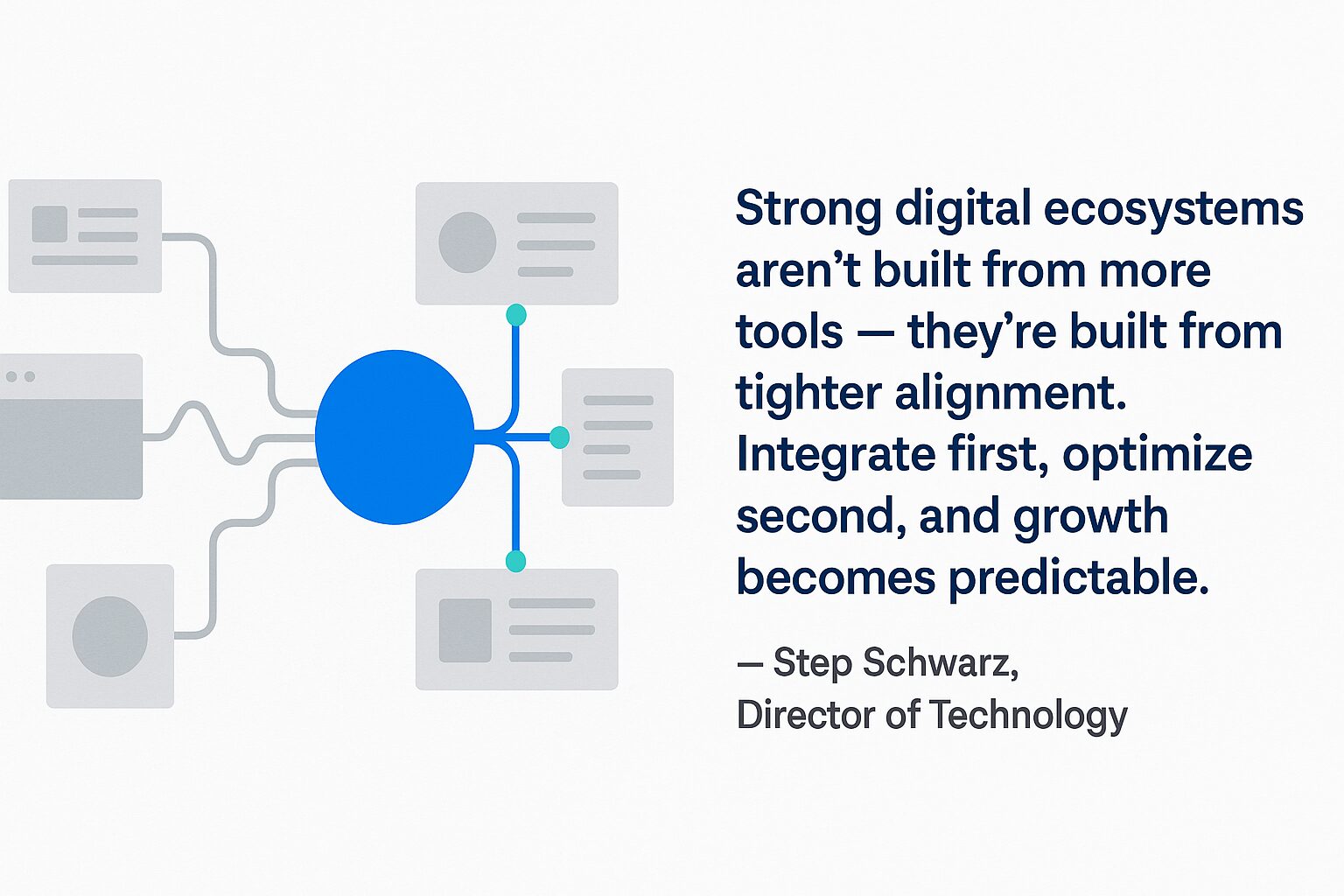
A well-built website gives you control, a steady experience, and confidence no matter how tangled your marketing stack becomes.
In our work with NeighborHealth, Massachusetts’ largest community-focused health center, a digital presence spread across four separate domains was the source of the mess. We merged those four domains into one WordPress platform, and within three months of launch organic search traffic rose 35% while the site-wide conversion rate improved 28%. The lesson holds broadly: when you rebuild around one hub instead of many, the systems that lean on it start working better almost right away.
Step 3: Line up strategy, data, and teams
With the base in place, line up strategy, work, and measurement so every stakeholder works from the same playbook. Real teamwork ties together the people and systems that usually work apart:
- Marketing and sales share one view of leads and conversions through connected tracking and reporting.
- Content, design, and analytics teams work under shared brand standards and performance goals.
- Partner agencies work openly, guided by your priorities rather than their own goals.
This level of teamwork takes planning on purpose, but it produces clear gains in campaign efficiency and conversion results. It also rests on trust, which is why building trust in partnerships is what keeps in-house teams and outside vendors pulling in the same direction.
Step 4: Tighten how you run and improve campaigns
Keep everything in sync by treating campaign work as a steady habit, not a launch-day milestone. The strongest CMOs build momentum through steady tune-ups. Use these tactics to keep your setup nimble:
- Run quarterly digital audits to sharpen messaging, structure, and performance.
- Use conversion rate optimization to improve landing page results and engagement.
- Watch keyword performance and content trends to guide your SEO roadmap.
- Line up paid and organic strategies through one paid media plan.
- Pool campaign data so you act on insights quickly instead of reacting weeks later.
When every part of your digital strategy moves in sync, marketing work becomes faster, more exact, and far easier to scale.
Step 5: Guard your progress with an ongoing partnership
Guard your progress with proactive upkeep, because even the best-built systems drift apart without it. This is where steady website support becomes essential: ongoing updates, testing, and performance checks keep your platforms growing with your business rather than against it. A digital partner who knows your setup helps you:
- Keep a steady brand across every channel.
- Watch analytics and performance for new growth openings.
- Fix tech or connection issues before they grow.
- Grow your website alongside shifting market and service priorities.
The goal is not just stability but staying flexible over time, and the best results come from treating the relationship as a long game rather than a one-off project.
Frequently asked questions
What is digital alignment for a professional services firm?
Digital alignment is when your website, martech, data, teams, and agency partners all work toward the same goals. It swaps siloed tools and clashing priorities for one connected setup, anchored by your website, so marketing delivers steady ROI, clear reporting, and one brand experience for prospects.
Why is the website the center of digital alignment?
The website is the hub every other digital effort leans on. It feeds analytics, supports automation, hosts your content, and shapes how the brand is seen. When the site is fast, connected, and well built, campaigns and reporting work better. When it is scattered, every linked system inherits that mess, which is why this work starts there.
How do you start fixing a scattered digital ecosystem?
Start with an audit. List every platform, partner, and data source, then check whether your website, CRM, and marketing automation are connected and whether partners share your goals. The audit reveals extra tools and broken handoffs, giving you a ranked roadmap before you invest in rebuilding the base.
How much of their marketing technology do teams actually use?
Not enough. The 2025 Gartner Marketing Technology Survey found martech use has dropped to 49%, so marketers actively use barely half the tools they buy. Only about 15% of organizations qualify as high performers. That gap is the clearest sign that getting in sync, not more software, is the real opportunity.
How do you keep digital systems in sync over time?
Keep systems in sync through proactive, ongoing support. Set quarterly audits, watch performance, run updates and testing, and pool campaign data so insights stay current. A digital partner who knows your setup can fix connection issues early and grow your site as services change, so your progress holds instead of quietly drifting apart.
What is the difference between digital alignment and digital transformation?
Digital transformation is the broad, often multi-year push to modernize how an organization works and serves customers. Digital alignment is narrower and quicker: it makes your current website, martech, data, teams, and agency partners work toward the same goals. You can line up a scattered setup in weeks, and that is usually the fastest ROI inside any larger change.
How 3 Media Web Can Help
At 3 Media Web, we help professional services marketing leaders regain control of tangled digital presences. Our team unites strategy, technology, and creativity, guided by a Human and AI approach so judgment leads and automation supports. That spans a clear web strategy, custom web design and development, data-driven SEO, and ongoing website support that keep your systems connected, measurable, and in step with your firm’s growth goals. We act as an extension of your marketing team, building bases that perform today and grow for tomorrow. Reach out to our team to reset your digital strategy and turn chaos into control.
For the bigger picture, see our professional services web design overview — how we build sites for firms where credibility is the product.