Last updated: July 14, 2026
- A new CMO’s first 100 days set how the board, sales, and staff judge marketing, and the website is the most visible proof that the new leader is delivering.
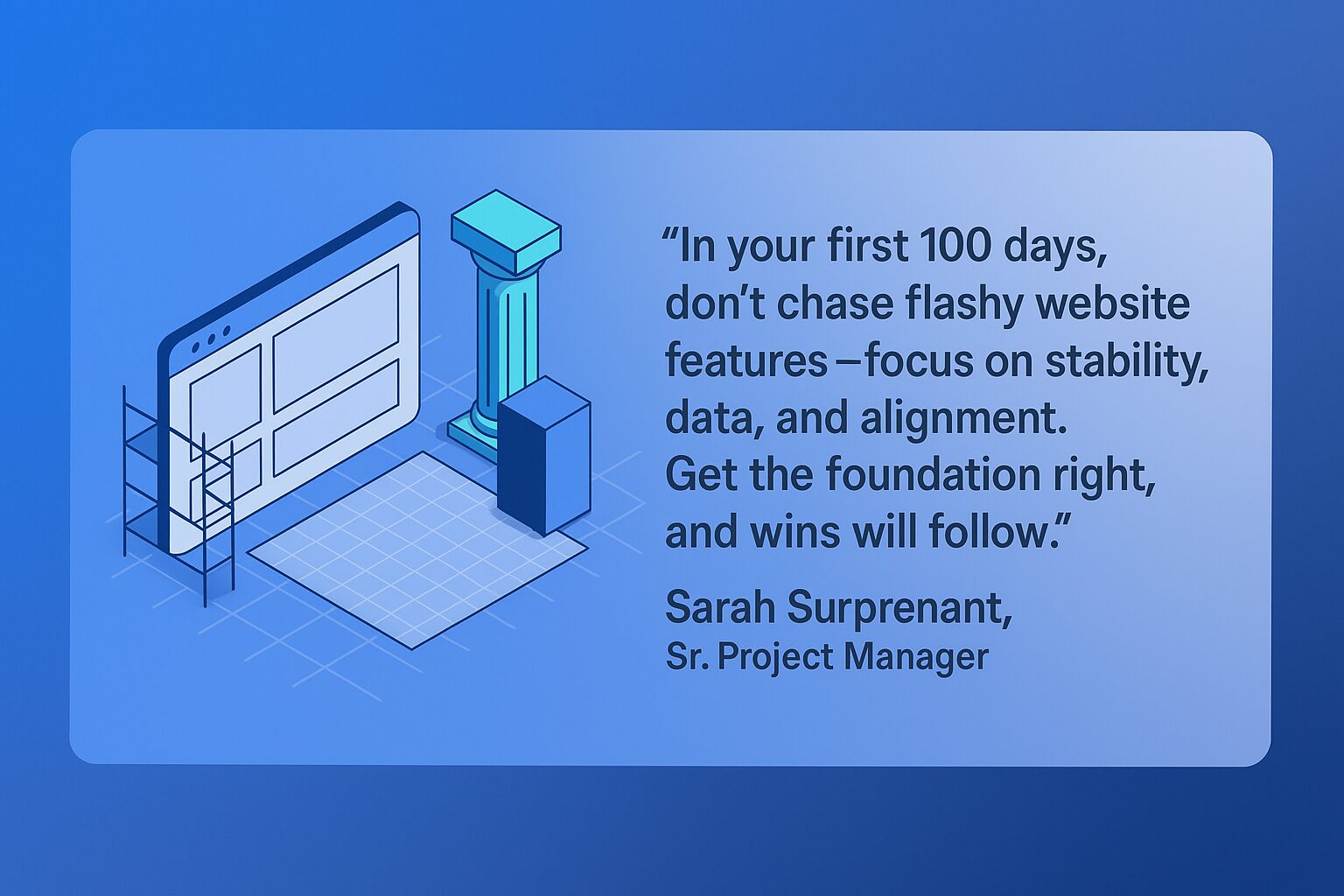
- Lead with the foundation: confirm technical stability, brand consistency, and a clean user experience before chasing campaigns, because a shaky site undercuts every later win.
- Make data the compass: install analytics correctly and benchmark traffic, conversions, and engagement so you can prove ROI from week one.
- Prioritize visibility and lead flow early, because a site that ranks and converts earns trust across the organization faster than any internal pitch.
- Treat accessibility and conversion optimization as first-100-days work, not later cleanup, so credibility gaps never have a chance to open.
Why are a CMO’s first 100 days so high-stakes in pro services?
A new CMO’s first 100 days feel high-stakes because the role carries the shortest runway in the C-suite, so early credibility is everything. The sales team wants proof that marketing will deliver real opportunities, the board expects a clear path to ROI, and internal teams look for leadership that brings alignment and momentum. In a professional services firm, the website is where all three audiences watch those expectations either come together or fall apart.
The pressure is not imagined. According to Spencer Stuart’s 2026 CMO tenure analysis, the average tenure among S&P 500 CMOs is just 4.1 years, compared to 5.0 years for all C-suite roles. A shorter runway raises the cost of a slow start, which is exactly why the website decisions you make in the first 100 days carry so much weight.
Without clear direction, a site that looks dated, loads slowly, or fails to generate leads undermines your credibility before you have built any momentum. With a deliberate website strategy, the same 100 days become the period where you prove value and set marketing up to compound.
What should a new CMO fix first on the website?
Fix the foundation first: technical stability, brand consistency, and user experience, in that order. The website is often the first impression for prospects, partners, and even potential hires, so foundational gaps cost you credibility before a single campaign runs. Anchor your early work to a clear web strategy so each fix ladders up to a business goal rather than a one-off task.
- Technical stability: confirm hosting, security, and website support processes are in place and documented.
- Brand consistency: audit design, messaging, and tone for alignment with the vision you were hired to deliver.
- User experience: test navigation, calls-to-action, and mobile performance the way a busy prospect actually uses the site.
These foundational elements protect your reputation and build internal confidence in your leadership before you ask anyone to fund a bigger initiative.
In our work with Baker Newman Noyes, a top-100 U.S. accounting and advisory firm, the foundation that mattered most was operational: their marketing team could not update advisor bios or thought-leadership content without a developer, which slowed everything downstream. We rebuilt their WordPress site on flexible, standardized content blocks so the marketing team could publish independently across more than 148 static pages and 4,000-plus blog and profile pages, then reconnected the tools a CMO reports on, including Google Analytics, HubSpot, and Google Tag Manager. The lesson for a first-100-days plan is that credibility often starts with removing the friction that keeps your own team from executing.
How do you make data your compass in the first 100 days?
Make data your compass by getting measurement right before you optimize anything, so every later decision rests on evidence instead of opinion. Professional services firms thrive on relationships, but the board funds what it can see, and clean numbers are how you make marketing’s contribution visible. Establish your baseline in three moves:
- Ensure analytics are properly installed and configured, including conversion tracking for consultations, proposals, and form fills.
- Benchmark current performance for traffic, conversions, and engagement so you have a starting line to measure progress against.
- Identify gaps in reporting that would otherwise prevent you from proving ROI when leadership asks.
Strong data practices make it far easier to align with sales and show progress early. When you can connect a website change to pipeline, you turn a subjective debate into a measurable result, which is the same discipline covered in our guide to the metrics that prove partnership value to leadership.
How do you prioritize visibility and lead flow early?
Prioritize visibility and lead flow by making the site findable and conversion-ready, because even the best design means little if no one finds it or acts on it. Early wins come from a tight loop between qualified traffic and clear next steps, so the people searching for your services actually reach a path to talk to you. Focus the first 100 days on three levers:
- SEO to capture relevant searches and attract qualified visitors who are already looking for your expertise.
- Lead generation systems that turn interest into real opportunities your sales team can work.
- Clear pathways that guide visitors to book a consultation or request a proposal without friction.
When your site starts delivering leads quickly, you earn trust across the organization, and that trust is what buys you room for the longer-term plays. Paid channels such as paid media management can accelerate that pipeline while your organic visibility builds.
Which first-100-days priorities make or break your credibility?
Five website priorities most often make or break a new CMO’s credibility, and each one carries a real cost when neglected. The table below pairs the priority to act on with the consequence of skipping it, so you can see at a glance where attention pays off and where a gap quietly erodes trust. Treat any row you cannot confidently check as a first-100-days task, not a someday item.
| First-100-days priority | What acting on it earns you | The cost of neglecting it |
|---|---|---|
| Technical stability | A fast, secure, reliable site that protects the brand at every visit. | Downtime, slow pages, and security scares that embarrass you in front of leadership. |
| Analytics and reporting | Clean baselines and conversion tracking that let you prove ROI on demand. | No way to show progress, so marketing’s value stays invisible to the board. |
| SEO and lead flow | Qualified traffic and a clear path to consultations and proposals. | A site nobody finds and visitors who leave without ever raising a hand. |
| Accessibility | An inclusive, compliant site usable by every prospect and partner. | Legal exposure and a polish gap that undercuts a professional reputation. |
| Conversion optimization | A steadily rising share of visitors who take a meaningful action. | Wasted traffic and stalled pipeline that no campaign budget can rescue. |
Two of these, accessibility and conversion rate optimization, are the ones leaders most often defer, and deferring them is where credibility gaps open later. Addressing them early prevents those gaps and creates measurable improvements over time.
Website audit or redesign: which do your first 100 days need?
A website audit is a structured review of technical health, analytics, SEO, accessibility, and conversion paths that tells you what is working and what is quietly costing you. Run the audit first, in the first few weeks, because it is fast, cheap, and gives you the evidence to decide what comes next. Choose optimization when the foundation is sound and the site mostly needs SEO, tracking, and conversion fixes. Choose a redesign only when the platform blocks your team from executing or the brand no longer reflects the firm.
What belongs in a CMO’s 30-60-90 day website plan?
A 30-60-90 day website plan sequences the first 100 days into three focused phases. In days 1 to 30, audit the site and fix technical stability, then confirm analytics and conversion tracking are accurate. In days 31 to 60, align brand and messaging and start SEO and lead-generation improvements. In days 61 to 90, layer on accessibility and conversion optimization and report early wins against your baseline. Sequencing this way protects credibility while still showing measurable progress to leadership.
Frequently asked questions
What are the most important website decisions in a CMO’s first 100 days?
The most important decisions are securing technical stability, installing accurate analytics, and building a clear path from qualified traffic to leads. Get the foundation and measurement right first, then layer on SEO, accessibility, and conversion optimization. This order protects your credibility early and gives you the data to prove marketing’s ROI to leadership quickly.
Why does a CMO’s first 100 days matter so much in professional services?
The first 100 days set how the board, sales, and staff judge a new marketing leader, and the website is the most visible proof of progress. With average CMO tenure shorter than most C-suite roles, the runway is tight, so early, visible wins on the site build the trust and momentum that make later initiatives possible.
How do you prove marketing ROI early as a new CMO?
Prove ROI early by configuring conversion tracking, benchmarking traffic and engagement, and tying website changes to pipeline outcomes such as consultations and proposals. Report against your baseline from week one so leadership can see movement. Connecting a specific change to a measurable result turns subjective debate into evidence the board trusts.
Should accessibility be a first-100-days priority?
Yes. Accessibility belongs in the first 100 days because it reduces legal exposure and signals the polish professional services clients expect. Deferring it creates a credibility gap that is harder to close later. Building an accessible, compliant site early makes the experience usable for every prospect and partner and protects the brand from the start.
What is the biggest first-100-days mistake new CMOs make?
The biggest mistake is chasing visible campaigns before the foundation and measurement are solid. A flashy launch on a slow, untracked site cannot prove value and often backfires. Stabilize the site, install analytics, and confirm lead pathways first, then invest in growth, so every later result is both real and measurable.
When should a new CMO redesign the website instead of optimizing it?
Redesign only when the current platform actively blocks your team, when the brand no longer reflects the firm, or when core pages cannot be made stable, accessible, and conversion-ready. If the site simply needs better SEO, tracking, and messaging, optimization is faster and lower-risk. Let a first-100-days audit make the call so the decision rests on evidence, not instinct.
How 3 Media Web Can Help
At 3 Media Web, we help professional services marketing leaders turn the first 100 days into proof of value, not a scramble. Guided by our Human and AI approach, judgment leads and automation supports, so your site stays measurable and the experience stays personal. We focus on the work that builds credibility fast:
- Custom web design and development grounded in a clear web strategy that aligns the site to your brand and goals.
- Analytics, SEO, and conversion rate optimization that connect website changes to pipeline you can report upward.
- Ongoing support that lets the site evolve at the pace of your business, so momentum from the first 100 days keeps compounding.
Strong early decisions are the start of a longer relationship between marketing and growth, the kind explored in our guide to building referral relationships that last. Let’s talk web strategy and turn your first 100 days into a foundation the whole organization trusts.