Last updated: July 6, 2026
- A sales-enabled website actively supports the buying journey, while a brochure website only describes what you do, which is why static sites quietly underperform as a revenue tool.
- Most sites fall out of sync between redesigns: case studies age, product pages stay too high-level, and CTAs stop matching how sales actually works.
- Tight sales and marketing alignment correlates with measurably faster growth, so a site built around it becomes shared revenue infrastructure, not just a marketing asset.
- Sales-forward design, self-qualifying paths, and credible social proof turn your website into a silent seller buyers trust enough to share with stakeholders.
- Ongoing website support keeps messaging, proof, and journeys aligned with evolving sales goals between full redesigns.
What does it mean for your website to be a sales ally?
Your website is a sales ally when it actively moves buyers toward a decision, not just when it explains what you sell. A brochure site states your services and waits; a sales-enabled site guides a prospect from first question to qualified conversation. That difference is what leadership is really asking about when they want to know how marketing moves deals forward.
The pressure on that question keeps rising. Building brand awareness and generating leads is no longer enough on its own, because executives now expect the website to carry weight in the sales process itself. When your site cannot do that, it is underperforming as a revenue tool, even if the design looks current.
You are likely already fielding the internal version of this:
- “Can we send prospects here?”
- “Why doesn’t this explain the value clearly?”
- “Do we have something that compares us to competitors?”
Those questions expose the gap. Many websites were never designed to support the way buyers actually evaluate, engage, and decide, and that gap is a missed revenue opportunity hiding in plain sight. Closing it starts with a deliberate web strategy that treats the site as part of the sales motion.
What is website sales enablement?
Website sales enablement is the practice of designing and maintaining your site so it does the work a sales rep would: qualifying visitors, answering objections, surfacing proof, and pointing each buyer to the right next step. Unlike a one-time redesign, it is an ongoing discipline that keeps messaging, content, and calls to action matched to how your team actually sells.
Why do websites often underserve sales teams?
Websites underserve sales teams because they go static between redesigns while everything around them keeps moving. Most marketing teams invest in a redesign every few years, but in the months between, the site stays frozen as the sales pitch evolves, buyers ask new questions, and the product offering shifts. Without consistent updates, the site drifts away from what actually helps move deals forward.
Here is what that drift looks like in practice:
- Missing or outdated case studies that no longer speak to key industries.
- Product or service content that stays too high-level for decision-makers.
- CTAs that don’t match real sales motions like demos or discovery calls.
- No easy way for buyers to self-educate or share relevant content with stakeholders.
When the site falls out of sync, the burden lands back on your reps. They recreate assets, hunt for the right PDF, and send follow-up explanations the website should have handled on its own. That is slower for buyers and more expensive for you, and it is exactly the friction a strategic support partner is meant to remove.
What does a sales-aligned website look like?
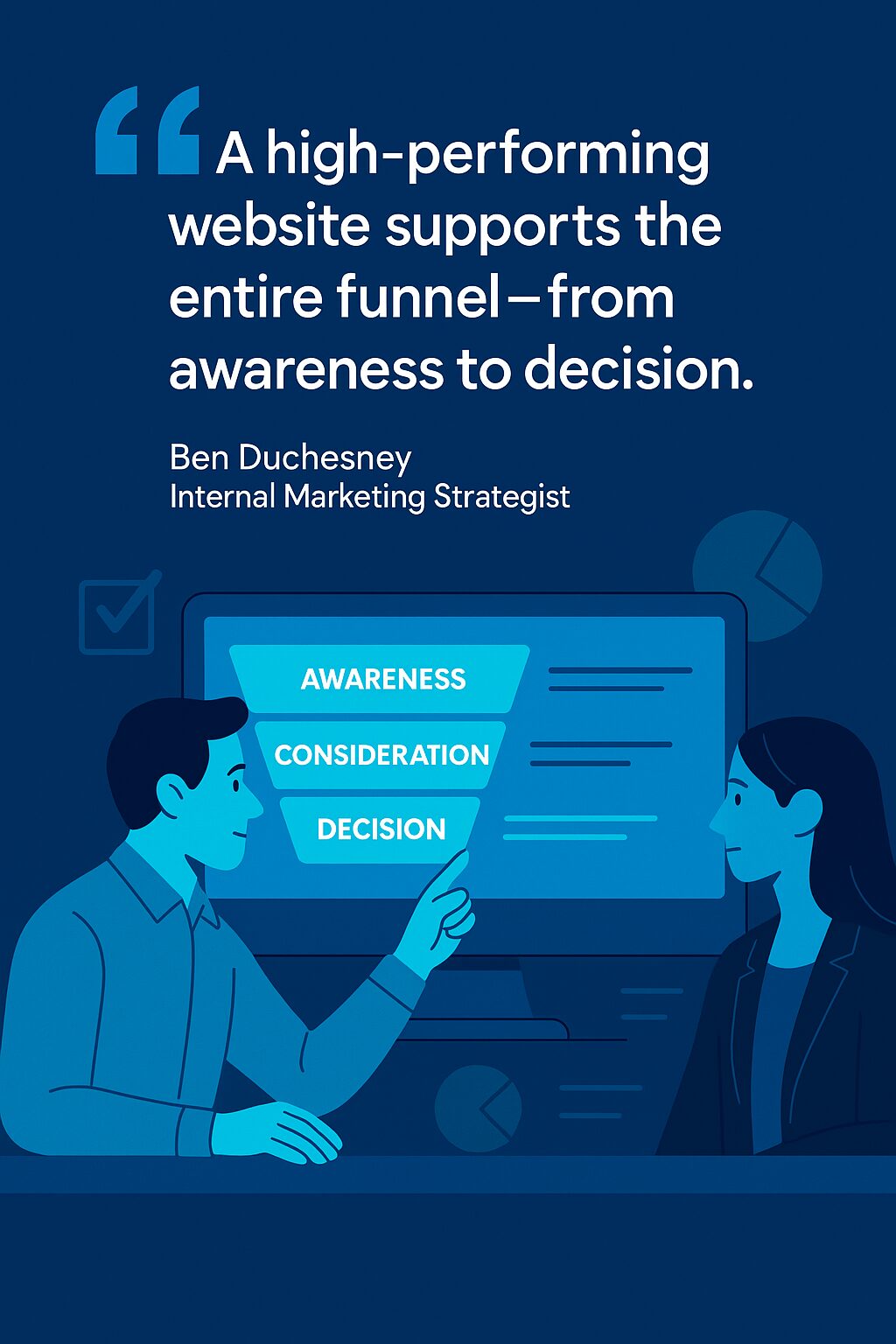
A sales-aligned website guides prospects through every stage of the funnel with clarity, confidence, and relevance. The defining trait is that it is designed for intent, not just information, so each page anticipates where a buyer is and what they need next. The contrast with a typical brochure site is sharp once you put the two side by side.
| What buyers need | Brochure website | Sales-enabled website |
|---|---|---|
| Positioning | Lists services without making the difference clear. | Quickly shows what you do, who you serve, and why you’re different. |
| Navigation by need | One generic path for every visitor. | Self-qualifying paths, industry pages, and solution overviews buyers explore on their own. |
| Proof | Old or generic testimonials with no clear relevance. | Recent, credible case studies that mirror the ideal customer’s journey. |
| Calls to action | “Learn more” on every page, regardless of intent. | Sales-forward CTAs like “book a strategy call” or “compare plans” matched to the stage. |
| Content updates | Frozen until the next full redesign. | Flexible modules that support quarterly campaigns, launches, and new GTM motions. |
In our work with Sisense, the embedded-analytics software company, this principle drove the entire project: instead of one generic path, we built persona-aligned navigation for its three distinct buyer types — developers, product managers, and enterprise executives — so each audience could self-qualify and reach the content that mattered to them. The redesign was aimed squarely at increasing demo requests and streamlining enterprise lead flow, and we migrated more than 3,600 pages while preserving their SEO equity. That is what designing for intent looks like in practice, not theory.
When these traits are built into your web design and development process, the site stops merely attracting leads and starts nurturing them into qualified conversations. The shift from the left column to the right is what turns a static page into a silent seller working for you around the clock.
How does sales and marketing alignment help the website perform?
Sales and marketing alignment turns the website into shared revenue infrastructure that reduces friction between teams. When both departments treat the site as a common resource rather than a marketing artifact, each side gets something it could not produce alone, and the business compounds the benefit.
The payoff is not just anecdotal. According to sales-and-marketing alignment research compiled by ZoomInfo (originally from SiriusDecisions), B2B organizations with tightly aligned sales and marketing operations achieve 24% faster three-year revenue growth and 27% faster three-year profit growth. A website built around that alignment is one of the most durable places to operationalize it.
Marketing gains:
- Clear direction on which assets and stories to highlight.
- Higher-quality leads who have already engaged with sales-relevant content.
- Metrics that go beyond pageviews to show pipeline influence.
Sales gains:
- A trusted destination to send prospects mid-deal.
- Content that handles common objections and validates the pitch.
- A faster path to trust through thought leadership and proof.
This alignment is also a strong signal to leadership, because it shows marketing is not just filling the funnel but building infrastructure that accelerates revenue. Proving that impact upward is its own discipline; our guide to the metrics that prove partnership value to leadership covers exactly what to track. The same trust that makes internal alignment work also drives external growth, a theme we explore in building trust in partnerships.
How do you keep a website aligned with sales over time?
Keep a website aligned with sales by treating it as a living asset that updates on the cadence of your sales strategy, not on the timeline of your next redesign. Alignment is not a one-time project; it erodes the moment the site stops reflecting current messaging, proof, and buyer questions. A proactive support model keeps it current without waiting years for a rebuild.
That ongoing work usually covers a few specific moves:
- Keep messaging, case studies, and pages aligned with the current sales strategy.
- Build frictionless user journeys based on actual buyer behavior, supported by conversion rate optimization.
- Launch new sales-driven content fast, without waiting for a full redesign.
- Make confident updates backed by performance data and user insights.
Done consistently, these updates keep the site in step with how your buyers actually evaluate you, so it stays a sales ally instead of slowly reverting to a brochure.
When should you redesign your website versus update it for sales?
Redesign when the foundation itself blocks selling — dated branding, a rigid CMS your team cannot update, poor performance, or an information architecture buyers cannot navigate. Choose ongoing updates when the structure is sound but the content has drifted: aging case studies, off-target CTAs, or messaging that no longer matches the pitch. As a rule, if the problem is the container, redesign; if the problem is what is inside it, keep improving on your sales team’s cadence.
Frequently asked questions
What is a sales-enabled website?
A sales-enabled website is one designed to support the buying journey, not just describe your services. It uses clear positioning, self-qualifying paths, credible proof, and stage-matched CTAs to move prospects toward a decision. The goal is a site your sales team can confidently send buyers to, knowing it will advance the conversation rather than stall it.
How is a sales-enabled website different from a brochure site?
A brochure site states what you offer and waits for visitors to act, while a sales-enabled site actively guides them. The brochure site uses one generic path and “learn more” links; the sales-enabled site offers tailored journeys, recent case studies, and sales-forward CTAs matched to buyer intent. The difference is design for action versus design for information.
Why does sales and marketing alignment matter for my website?
Alignment matters because the website performs best when both teams treat it as shared revenue infrastructure. Research compiled by ZoomInfo (originally from SiriusDecisions) links tightly aligned sales and marketing operations to 24% faster three-year revenue growth. A site built around that alignment gives marketing pipeline-level metrics and gives sales a trusted destination that handles objections and validates the pitch.
How often should I update my website for sales?
Update continuously rather than only at redesign time. Messaging, case studies, and CTAs should track your current sales strategy, and new sales-driven content should launch as needs arise. Proactive website support makes this possible without a full rebuild, keeping the site aligned with how buyers evaluate you instead of letting it drift between projects.
How do you measure whether your website supports sales?
Look past pageviews to pipeline signals: demo and discovery-call requests, conversion rate on sales-forward CTAs, engagement with case studies and comparison pages, and how often reps actually send prospects to the site. A quick qualitative test helps too — if sales hesitates to link buyers to a page, that page is not yet pulling its weight in the deal.
What signs show my website is underperforming as a sales tool?
Watch for reps recreating assets the site should provide, outdated case studies, product pages too high-level for decision-makers, and CTAs that don’t match real sales motions. If your team hesitates to send prospects to the site, or buyers cannot easily share content with stakeholders, the website is underperforming as a revenue tool.
How 3 Media Web Can Help
At 3 Media Web, we help marketing leaders turn static websites into performance tools that enable both sales and marketing. Guided by our Human and AI approach, strategy and judgment lead while automation supports, so every change ties back to your revenue goals instead of vanity metrics. From web strategy through conversion rate optimization and lead-gen landing pages, we design with business outcomes in mind. Our team helps you:
- Keep messaging, case studies, and pages aligned with your sales strategy through proactive website support.
- Build frictionless buyer journeys grounded in real behavior, not guesswork.
- Launch new sales-driven content fast, without waiting for a full redesign.
Whether you need to enhance your current site or start fresh, we partner with you to make your website your most reliable sales rep. Book a strategy call to see what that could look like for your team.
For related strategies, check out 5 Signs Your Website Is Holding Back Your Marketing Strategy.