Last updated: July 14, 2026
- CMOs judge marketing on revenue, not activity. Use a tool like HubSpot or GA4 to attribute form fills, downloads, and demo requests to specific campaigns so your website shows pipeline, not just traffic.
- Build campaign-ready landing pages that launch fast and are easy to test, so marketing can match messaging to the moment without waiting on a dev queue.
- Report on strategic progress, not vanity metrics. Show growth in organic traffic, form submissions, and conversion rate over time to make the case that marketing compounds.
- Treat the website as a sales-enablement tool by tracking content downloads, time on key pages, and how sales-qualified leads engage across the funnel.
- Tie every channel back to the site as the hub, connecting paid media, email, webinars, and events to traffic, conversions, and sales activity in one ROI narrative.
How can your website help you prove marketing ROI to your CMO?
Your website proves marketing ROI when it attributes leads to campaigns, reports conversions and pipeline over time, and connects every channel to a measurable action. Set up form tracking and analytics so each form fill, download, and demo request maps to a source, then report on revenue-tied outcomes instead of traffic. Done well, the site stops being a digital brochure and becomes the system of record that ties marketing activity to business results.
Most marketing managers in B2B manufacturing spend their days building campaigns, managing content, and trying to hit performance goals with limited resources. The effort is real, yet proving how that work moves the needle is hard, especially in front of an executive who owns the budget. You are expected to drive demand, fill the pipeline, and support sales, and when quarterly reporting arrives, the question still lingers: what was the return? The pressure is not in your head. According to a 2024 Gartner survey, only 52% of senior marketing leaders said they could prove marketing’s value and get credit for it. The good news is that a well-built website, grounded in a clear web strategy, gives you the data and flexibility to land on the right side of that statistic.
What CMOs really want to see
CMOs care about outcomes, not activity, so they want proof that marketing contributes to revenue and supports the wider business. They are evaluating where budget goes and whether it works, what you are testing and optimizing, how marketing fuels sales, and whether the digital experience reflects the brand’s credibility. That focus is why vanity metrics like raw traffic and impressions fall flat in an executive review. The table below maps the metrics that tend to stall a conversation against the ones that move it forward.
| Vanity metric (limited context) | Strategic metric a CMO acts on | What it proves |
|---|---|---|
| Total sessions and pageviews | Marketing-sourced and influenced pipeline | The site generates revenue opportunities, not just visits. |
| Impressions and reach | Form fills, downloads, and demo requests by campaign | Specific campaigns and channels drive measurable demand. |
| Bounce rate in isolation | Conversion rate on core pages over time | UX and messaging changes are improving outcomes. |
| Raw email open count | Engaged sessions from sales-qualified leads | The website actively supports the sales process. |
What is marketing-sourced pipeline?
Marketing-sourced pipeline is the dollar value of sales opportunities where marketing generated the very first touch, such as an organic search visit, a gated download, or a demo request. It answers the question a CMO always asks: how much of the deal flow would not exist without marketing? Marketing-influenced pipeline is the related, broader figure that counts any deal marketing touched at any stage. Reporting both separates demand you created from demand you accelerated.
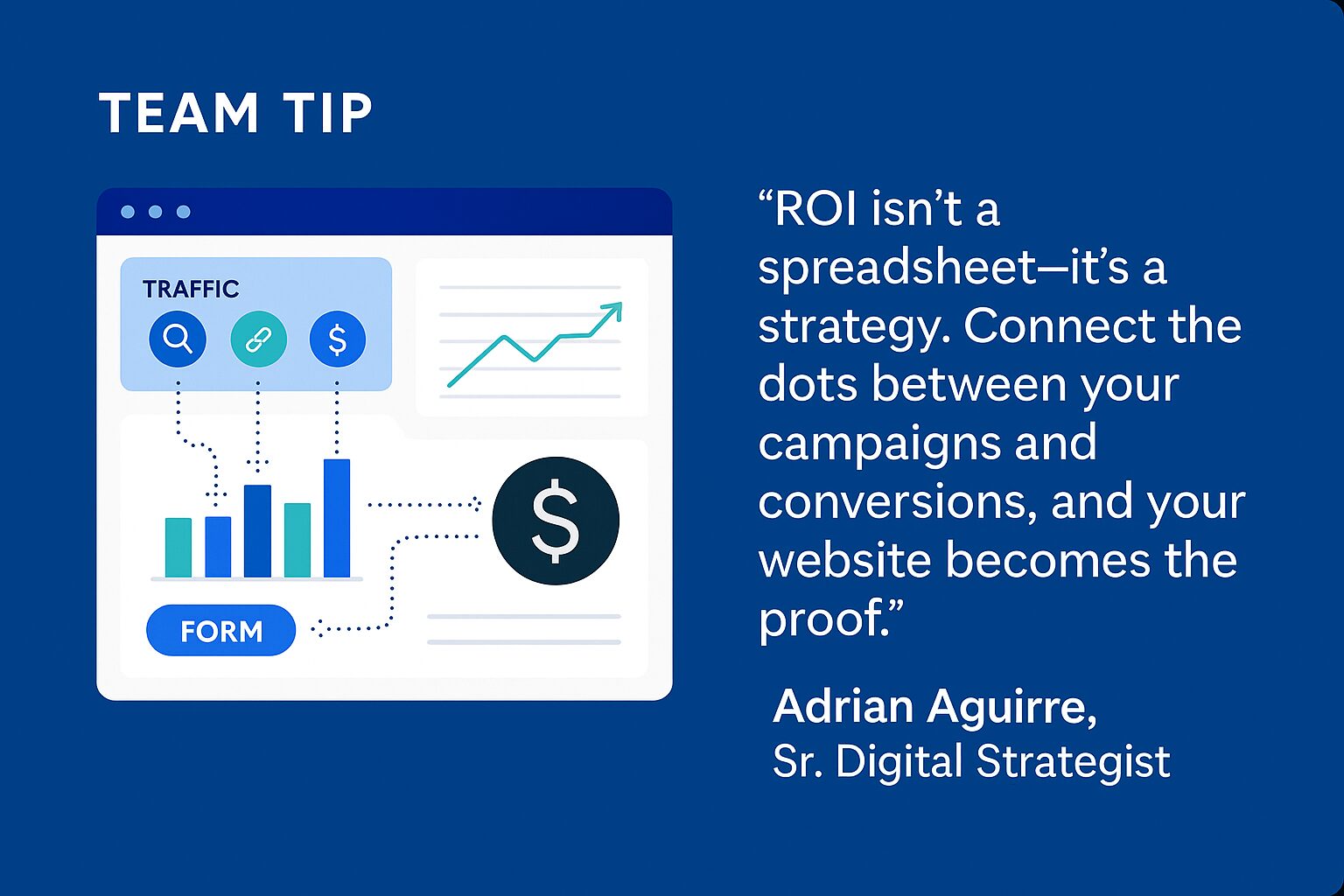
Your website is the bridge between marketing and ROI
A well-structured website gives marketing teams the data, flexibility, and tools they need to show results across the funnel. The five capabilities below turn a static site into a measurable growth engine, and each one maps to a question your CMO is already asking. In our work with Maxdao, a global telecommunications component manufacturer, restructuring 50+ product categories and layering in a real keyword and metadata strategy drove a 48% increase in organic traffic within the first 90 days, and turned a product-heavy catalog into a lead-generation tool the marketing team could actually report on.
1. Trackable lead generation
Trackable lead generation is the foundation of website ROI, because you cannot prove value you cannot measure. Your site should show clearly how many leads your efforts produce and which actions drove them. Make sure you can:
- Attribute leads to specific campaigns and channels.
- Identify which landing pages, assets, and CTAs are converting.
- Measure form submissions, downloads, and demo requests.
- Segment leads by quality or readiness.
When set up correctly, a tool like HubSpot or Google Analytics paired with form tracking connects website activity directly to revenue opportunities. That connection is the heart of effective lead generation, and it is the first thing to fix when reporting feels thin.
2. Campaign-ready landing pages
Campaign-ready landing pages let marketing move at the speed of the market instead of the speed of a dev queue. If launching a single page takes a week and a developer, you will miss the moments that matter. Your site should be built for agility, so CMOs can see:
- How quickly your team turns an idea into a live campaign.
- Whether each page aligns with messaging and value props.
- The conversion rate of each offer or page.
With flexible web design and development and smart, reusable templates, marketing teams launch, test, and iterate without waiting on IT. This is what it means to run a website that evolves at the pace of your business.
3. Performance metrics that show progress
Performance metrics prove progress when they connect effort to compounding outcomes rather than one-off spikes. A dashboard that shows traffic is one thing; a dashboard that ties SEO gains, form submissions, and funnel velocity together tells an executive story. Report on:
- Increases in organic traffic from SEO strategy.
- Growth in form submissions over time.
- Improvement in engagement on core pages.
- Wins from conversion rate optimization.
This lets your CMO see marketing as a compounding investment, which is exactly the long-term, holistic view Gartner found is the most successful way to prove marketing’s value. Leadership already tracks these trends elsewhere, so meeting them with the same framing builds instant credibility.
4. Sales enablement support
Sales enablement is where the website quietly earns its keep, because most of the buying journey now happens before a rep is ever contacted. According to Gartner, 75% of B2B buyers prefer a rep-free buying experience, which means your site is doing real selling on its own. Make it easy to show how the site supports sales by tracking:
- Views and downloads of case studies, spec sheets, and whitepapers.
- Page visits from email nurture or outbound campaigns.
- Time on site and engaged sessions from sales-qualified leads.
When sales reps rely on your site to move deals forward, that reliance is concrete proof of marketing value. It also reframes the website as shared revenue infrastructure, not a marketing-only expense.
5. Integrated campaign performance
Integrated campaign performance treats the website as the central hub that connects every other channel. Your site is not working alone; it ties together your paid media management, email, social, and content efforts. Track how campaigns perform across:
- Ad traffic to landing pages.
- Email clicks to gated offers.
- Webinar registrations and follow-up workflows.
- Event-specific microsites or CTAs.
Reporting each channel through the site as the hub builds one cohesive ROI narrative around your whole strategy, instead of a pile of disconnected channel stats.
When should you rebuild your website instead of optimizing it?
Optimize when the foundation is sound but underused: if your site loads well, has clean analytics, and simply needs better tracking, CTAs, or content, targeted fixes will lift ROI faster and cheaper than a rebuild. Rebuild when the platform itself blocks the outcome, when you cannot launch a landing page without a developer, attribution is impossible, or a fragmented product taxonomy buries what buyers came for. A useful test: if proving ROI would require fighting the website, it is time to rebuild.
What to avoid when reporting to the CMO
The fastest way to lose an executive room is to bury the outcome under data, so report on impact and leave the rest in the appendix. Skip the habits that read as activity for its own sake, and lead with the numbers tied to the business. Use this side-by-side as a pre-meeting check.
| Skip this | Do this instead |
|---|---|
| Fluffy engagement metrics with no context | Business outcomes: leads, MQLs, influenced revenue |
| Overly technical web jargon | Clear insights and trends a non-marketer can follow |
| Raw data dumps with no recommendation | Actions you took based on website learnings |
| One-time snapshots | What is next: testing, optimizing, improving |
The more confident and clear your data story, the more credibility you earn, and credibility is what unlocks budget and headcount next quarter. If you want a deeper framework for that conversation, see the metrics that prove value to leadership.
Frequently asked questions
How do I prove marketing ROI to my CMO using our website?
Start with attribution. Connect form fills, downloads, and demo requests to the campaign and channel that drove them using a tool like HubSpot or GA4. Then report on revenue-tied outcomes, marketing-sourced pipeline, conversion rate, and influenced deals, rather than traffic. Showing trends over time proves marketing compounds, which is the story executives reward with budget.
Which website metrics matter most to a CMO?
CMOs prioritize metrics tied to revenue and efficiency: marketing-sourced and influenced pipeline, form fills and demo requests by campaign, conversion rate on core pages, and engaged sessions from sales-qualified leads. Vanity metrics like raw sessions or impressions carry little weight on their own. The goal is to connect every figure to a business outcome the executive already cares about.
Why are vanity metrics a problem in executive reporting?
Vanity metrics such as total pageviews and impressions describe activity without proving impact, so they invite skepticism in an executive review. Gartner found only 52% of senior marketing leaders can prove marketing’s value, often because reports stop at surface numbers. Pairing each metric with the outcome it drives, like pipeline or conversions, turns a data dump into a credible business case.
How does a website support sales enablement?
A website supports sales by doing early selling before a rep is involved, since 75% of B2B buyers prefer a rep-free experience. Track downloads of case studies and spec sheets, visits from email and outbound, and time on key pages from sales-qualified leads. Surfacing how sales relies on those pages proves the site is shared revenue infrastructure, not just a marketing cost.
What is a good marketing ROI benchmark to report?
There is no universal number, because ROI depends on your margins, sales cycle, and channel mix, so the most credible benchmark is your own baseline. Establish a starting point for cost per lead, conversion rate, and marketing-sourced pipeline, then report the trend quarter over quarter. A rising trend against your own history is more persuasive to a CMO than an industry average that ignores your context.
How often should I report website ROI to leadership?
Report on a consistent monthly or quarterly cadence rather than only when a big number lands. A regular rhythm shows ROI as continuous return and lets leadership watch trends mature, which builds the trust that secures ongoing investment. Shared dashboards make each review faster and keep marketing and leadership aligned on the same definitions and goals.
How 3 Media Web Can Help
At 3 Media Web, we help manufacturing marketers turn their websites into ROI-driving assets, guided by a Human and AI approach so strategy leads and automation supports. That means more than uptime and updates; we focus on performance, proof, and the metrics your leadership actually reviews. We support marketing teams by building sites that launch fast and flexible web design and development campaigns, setting up form tracking, analytics, and dashboards, delivering conversion optimization and SEO improvements, and aligning every part of the digital experience with your marketing KPIs. The same trust and reporting discipline that wins an executive room is what turns strong partnerships into lasting growth. With the right web strategy and systems, your website becomes one of your strongest tools to demonstrate marketing’s value every quarter. Reach out to our team to unlock your website’s ROI.
You can explore this further in How AI-Powered Websites Help Biotech CMOs Prove ROI Faster.