What were the biggest takeaways from HubSpot’s UNBOUND 2026?
The biggest takeaways from HubSpot’s UNBOUND 2026 were that buyers are increasingly researching through AI answer engines and social media, strong SEO remains the foundation of AEO, and brand visibility depends on both your website and trusted mentions across the web. HubSpot’s latest AI tools reinforced another theme: connected customer data and clear business context are essential to making AI useful for marketing and sales.
Since getting into the digital marketing industry 10 years ago, attending HubSpot’s UNBOUND (formerly INBOUND) has always been on my bucket list. This year, I was finally able to cross it off, on behalf of the 3 Media Web team! If I had to sum up the week in one sentence, it would be this: buyers haven’t stopped searching; they’ve just stopped clicking.
Across a few days of sessions on SEO, AEO (Answer Engine Optimization), landing pages, and HubSpot’s newest AI tools, the same story kept coming up. The way people find, research, and choose a business has changed, and marketers need to show up in more places than a Google results page.
Below are my biggest takeaways, along with a few numbers that stuck with me.
Organic traffic isn’t coming back (and that’s okay)
Let’s start with the part that no one wants to hear. Nearly every speaker acknowledged that organic traffic is down, and it’s not a blip. Various speakers put the decline in B2B organic traffic at around 25% as buyers move to answer engines. Meanwhile, roughly 58% of Google searches now end without a click.
This has been consistent across nearly all of our digital marketing clients here at 3MW, depending on their industry, content strategy, and numerous other factors.
The good news? Buyers didn’t stop researching. They just moved.
- 94% of B2B buyers used generative AI in their most recent purchase.
- 69% of B2B buyers chose a different vendor based on an AI chat.
- ChatGPT now has 1B+ weekly active users, and Gemini has passed 1B as well.
- 70% of buyers have used social media in their buying journey, and social now edges out search and TV as the #1 place consumers first discover new brands.
I really liked one example from HubSpot’s Beeri Amiel. In 2016, a parent shopping for kitchen cabinets Googled “best kitchen cabinets,” clicked the first blue link, read a guide, and filled out a form. In 2026, her college-bound daughter finds the loveseat she wants while scrolling TikTok, and Mom double-checks the choice with ChatGPT. Same family, totally different buying journey.
Search behavior has also become more conversational. More than 60% of searches now start with a question, and the average ChatGPT conversation runs about 5.2 back-and-forth turns. People aren’t typing keyword fragments anymore. They’re describing their situation and asking for a recommendation.
AEO is the new introduction to your brand
If there was one acronym you couldn’t escape at UNBOUND, it was AEO. HubSpot’s Amanda Kopen defined it simply: improving how often, and how accurately, your brand appears in AI-generated answers.
Why does it matter? Because the visitors who do arrive from answer engines are ready to buy. According to HubSpot’s own research, coming from an answer engine is the #1 indicator of purchase intent. A few more numbers that make the case:
- 51% of B2B software buyers now start their research with answer engines.
- Visitors from answer engines convert at 4.4x the rate of organic search visitors (Semrush).
- Quo, a business phone platform, saw the share of new users who said they found them through AI jump from about 1% to 45% in a single year.
With GA4’s improvements in tracking traffic from “AI assistants,” we’ve been able to see this lift occurring with our own clients. While AI assistant traffic is still paltry in comparison to traffic from organic search (and most other channels), conversion rates are anywhere from 2x to 10x higher.
The flip side is that most brands aren’t showing up yet. Webflow’s AEO Maturity Index, which analyzed 2,000 US websites, found the median brand is mentioned in just 16% of relevant AI answers and cited (linked) in only 6%. Even when brands do show up, AI gets the facts right only about 63% of the time, and the answer reflects the brand’s actual positioning just 24 out of 100 times. In other words, AI is already talking about you. The question is whether it’s saying the right things.
Where AI gets its answers
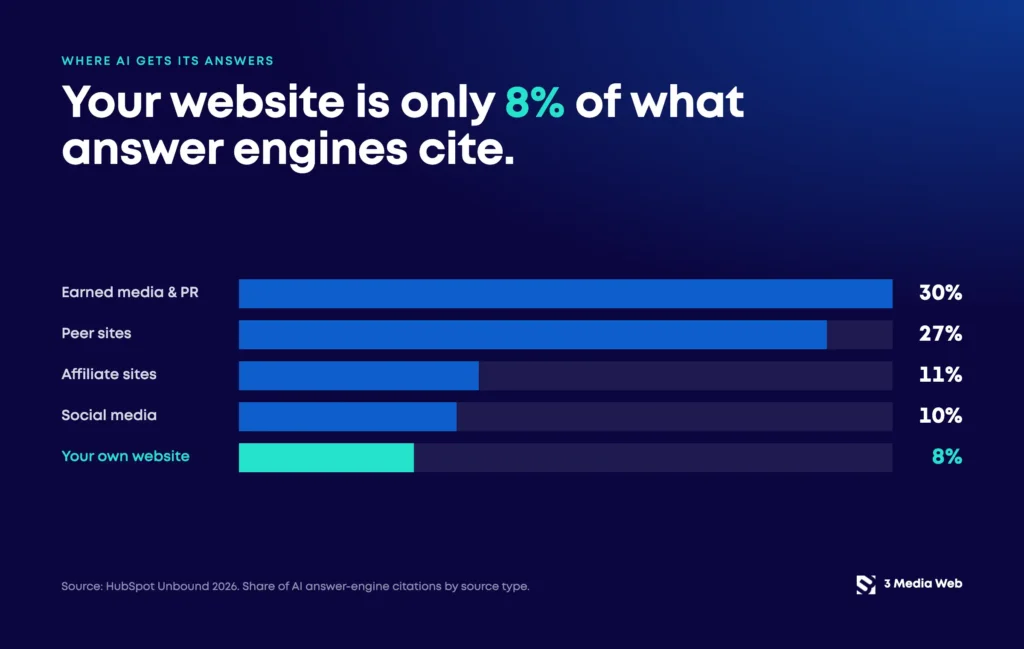
Here’s a stat that should change how you think about AEO: your own website accounts for only about 8% of AI citations. Earned media and PR make up roughly 30%, peer sites 27%, affiliate sites 11%, and social media about 9–10%. Answer engines look for consensus across the web, so the brands that get recommended are the ones that are mentioned, reviewed, and discussed in lots of trusted places.
That’s why speakers kept saying “brand is back” (and so is PR). Being listed in directories, earning reviews on sites like G2 or Trustpilot, landing in “best of” guides, and participating in communities like Reddit all feed the machines that are now making recommendations.
However, this is nothing that groundbreaking. In fact, this is how we’ve always thought about “off-site” SEO elements, like reputation management, NAP consistency, link building, and guest posting. Now we know these are the same things that help feed the answers provided by AI agents.
Matching content to the new buyer journey
HubSpot laid out a helpful framework for what to create at each stage, across both answer engines and social:
| Stage | Answer engines | Social |
|---|---|---|
| Awareness | How-to guides and top-of-funnel content | Short-form video, LinkedIn thought leadership |
| Consideration | Comparison articles, case studies by industry | Review videos, how customers use the product |
| Evaluation | Use-case and persona pages, reviews, trust signals | Product walkthroughs, case study posts |
| Decision | Persona product pages, pricing pages | Social proof, testimonials, retargeting |
KPIs are shifting too. Instead of focusing only on clicks, HubSpot recommends tracking brand visibility (do answer engines know you?), impressions (did people see you?) and share of voice (how do you compare to competitors?).
SEO isn’t dead. It’s the foundation.
As I’ve already mentioned, this should all be quite reassuring for anyone who has spent years on SEO. AEO looks a lot like what good SEO always should have been. Webflow’s Guy Yalif put it nicely when he said your website now has two audiences: people and machines. The fundamentals that help one usually help the other.
However, most sites still aren’t nailing those fundamentals. From Webflow’s study of 2,000 websites:
- 62% have broken internal links.
- 61% have an illogical heading structure (broken H1 → H2 → H3 hierarchy).
- 60% are missing page titles or meta descriptions on a big chunk of their pages.
- 57% aren’t answering the questions their prospects are actually asking.
- 54% have stale content, and 95% of ChatGPT citations point to content updated in the last 10 months.
- 55% hide their topic authority by leaving off author bylines.
Here’s what happened when teams fixed those things:
- Reframing blog headings as questions led to a 13% increase in AI-driven traffic at Webflow.
- Adding a table of contents to blog posts drove 59% more AI-sourced traffic and 23% more SEO traffic in four weeks.
- Adding FAQs and schema to just six product pages produced 57% of Webflow’s new citations over the following two weeks, plus a 24% lift in organic impressions.
- Content with structured data saw a 42% increase in citations. For context, 73% of first-page Google results use schema, but only about 12% of sites have it implemented.
- Citing external experts lifted AI-driven traffic by 14% and search traffic by 8%.
- Refreshing content brought a 42% average increase in SEO visits post-update.
My favorite line on metadata: it reduces the “cost” for an LLM to consume your site. Clear titles, descriptions, alt text, and schema make it easier for machines to understand who you are and what you do. After all these years in digital marketing, I couldn’t help but chuckle that metadata optimization is still talked about as a primary method for not only SEO, but AEO.
Lessons from HubSpot’s AI search lab
HubSpot’s Amanda Kopen shared seven AEO experiments her team ran on hubspot.com, and a few results stood out:
- Glossary pages improved HubSpot’s visibility by 36% when cited, and also ranked for hundreds of traditional keywords.
- Use case x industry pages (specific, real-world scenarios) were crawled 15,000+ times by ChatGPT in 30 days, and 92% of those pages were cited within a few months.
- Prerendering pages cut load time from over 2 seconds to about 70 milliseconds, leading to more AI crawls and 2x OpenAI impressions.
- Rewriting the pricing page in plain, JavaScript-free language improved how accurately AI described HubSpot’s pricing.
The takeaway from her team: in 2026, AEO is about making your brand’s information corroborated, accurate, retrievable, and commerce-focused. And with only about a 20% experiment win rate as their target, the real lesson is to keep testing.
One caution worth repeating: roughly half of new content online is now AI-generated, but primarily AI-generated content isn’t ranking well. Original expertise, unique data, and a real point of view are what get cited.
Your landing pages (and email signatures) are working harder than you think
Flint CEO Michelle Lim opened with a stat that got a few groans from the paid media folks in the room: average cost per click has more than doubled since 2016, from $2.32 to $5.42. Her point was simple. There’s not much room left to squeeze CPCs, but there’s plenty of room to improve conversion rates.
She outlined three ways landing pages lose money:
- Mismatched. Companies with 40+ landing pages generate 12x the leads of those with only one to five, and matching the landing page to the ad roughly doubled performance in one example. Her homework for the week: pull your five best-performing ads and build five pages that match them.
- Missing. One AI prompt now triggers many searches behind the scenes, and each one needs a page that answers it. Your page now has two readers, the human and the AI agent, and you need to convert both.
- Late. Demand shifts daily. Only about 12% of experiments produce a winner, but the winners compound into a 25–40% cumulative annual conversion lift. Her mantra: velocity is the new CRO.
On a lighter (but surprisingly data-backed) note, WiseStamp shared eye-tracking research on email signatures. 95% of people look for contact details at the bottom of an email; a signature increases email viewing time by 58%, and emails with a professional signature saw 23% fewer unsubscribes. Adding a banner bumps viewing time another 18%. It’s a small, often-forgotten piece of brand real estate, and it’s worth a second look.
What’s new in HubSpot
Unsurprisingly, HubSpot used UNBOUND to show off a lot of new AI tools. The big theme was moving marketers from scattered tools and manual work toward connected, AI-assisted campaigns built and measured in one place. Here are the updates I’m most excited about:
- HubSpot AEO. HubSpot now has a built-in AEO tool that tracks brand visibility, share of voice, and citations across answer engines, and recommends what to fix. According to HubSpot, customers who used it saw 20% more AI traffic than those who didn’t, and an average 8% month-over-month improvement in brand visibility.
- Marketing Studio 2.0 and Campaign Agent. Marketing Studio pulls tasks, approvals, and assets into one workspace and adds an Analyze tab that ties campaigns to revenue, spend, and deals. Campaign Agent can take an insight and turn it into a full campaign brief, assets, and an email drip.
- Content Agent. AI-assisted blog posts, landing pages, and LinkedIn content built from your brand voice, ICP, and keyword data, with an eye toward AEO.
- Nurture Agent. One-to-one email personalization based on CRM data. You can lock sections, control what percentage of your audience gets personalized versions, and compare performance against your standard email.
- Agent Hub and the new Workflows builder. A single place to see and manage all your AI agents, plus a new workflow tool that will eventually replace the old one. Breeze can help you build agents and workflows.
- Breeze Assistant upgrades. Scheduled prompts, Breeze Research for longer and deeper analysis, and Breeze Projects for organizing prompts and sharing them with your team.
- New ad integrations. HubSpot now connects to ChatGPT, Microsoft, TikTok, and Reddit ads for audience syncing and lead follow-up.
- For admins. There’s a new resource hub at admins.hubspot.com, a new report builder on the way, and the ability to view raw website event data in Data Management.
Practical HubSpot tips from the breakout sessions
A couple of smaller sessions had some great ideas. No Bounds Digital’s Ben Donahower shared copy-paste workflow recipes, including AI-powered spam detection for form submissions, matching prospects to products, ticket urgency scoring, and even pulling weather data into HubSpot for industries like construction and logistics.
Two tips that I’ll be using for HubSpot clients (and for our own HubSpot account): plan your workflow logic in a separate LLM first to save Breeze credits, and save anything your workflows learn as properties on the CRM record so other teams (and AI) can use it later.
NoirLogic’s Jazmine Moore walked through a lead management setup using HubSpot’s lead object, routing and SLAs. Her example client went from a 4-day average speed to lead to under 2 hours. Her rule of thumb: no lead should die quietly.
The importance of humanity: context, curiosity and connection
For all the talk about agents, some of the best sessions were about people.
On the main stage, HubSpot’s Adam Cuzzort and Databricks’ Tasso Argyros argued that today’s AI models are already smart enough for most tasks. What holds them back is context: your customer data, business goals, call transcripts, and the decisions that usually live in someone’s head. Their advice was to centralize that context early, because every disconnected tool becomes its own data island.
Eric M. Bailey’s session on brain science was a welcome change of pace. He talked about the “illusion of certainty” (the idea that the way we see a problem is the only way it can be seen), the role oxytocin plays in building trust, and why video calls can feel so draining without real eye contact. His challenge to the room was to find joy in not knowing, practice radical curiosity, and remember that your perception isn’t always someone else’s. Good reminders for anyone working with clients, teammates, or, increasingly, AI.
My takeaways (and what 3MW is doing about them)
If you only remember a few things from this recap, make it these:
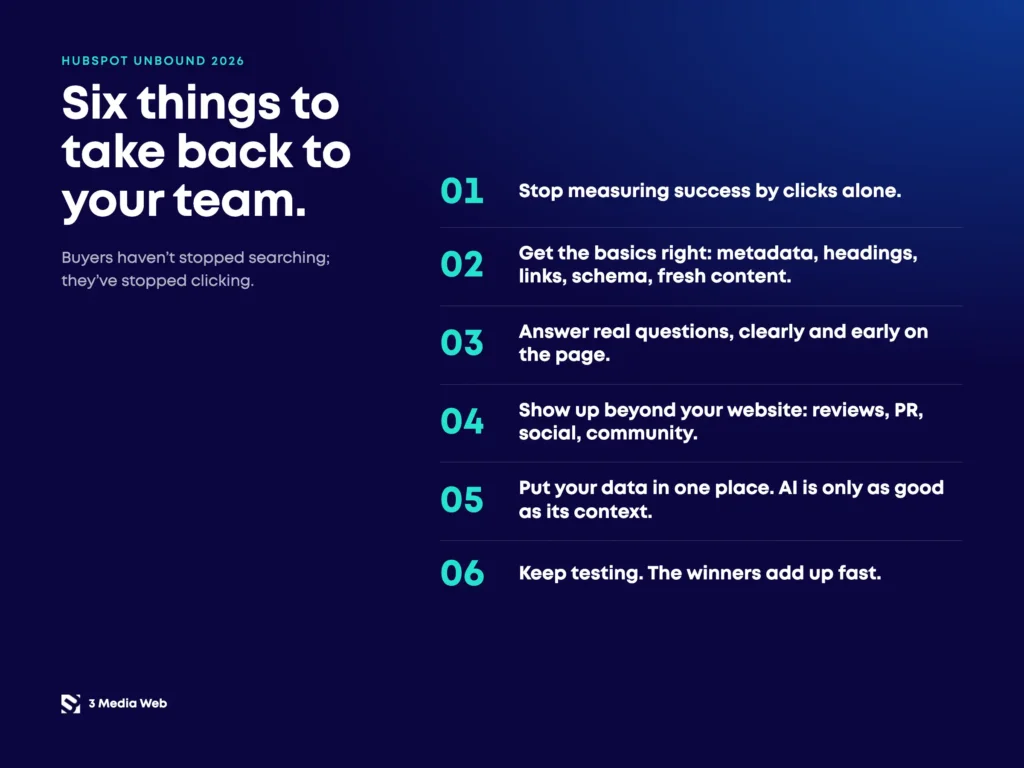
- Stop measuring success by clicks alone. Track brand visibility, share of voice, and citations alongside traffic. While third-party platforms such as HubSpot and SEMrush offer AEO data tracking, you can also see your website’s AI impressions in Google Search Console, and how traffic from AI platforms interacts with your site in Google Analytics.
- Get the basics right. Clean metadata, logical headings, working links, schema, and fresh content help you in Google and in AI answers. If you’ve been following best practices for SEO, you’re already on the right track!
- Answer real questions. Use your sales calls, support tickets, and Search Console data to find what prospects are asking, then answer it clearly and early on the page.
- Show up beyond your website. Reviews, directories, PR, social, and community conversations are where answer engines get most of their information.
- Put your data in one place. AI tools are only as good as the context you give them.
- Keep testing. Most experiments won’t win, but the ones that do add up fast.
At 3 Media Web, we’re already building these ideas into our clients’ digital marketing strategy. If you’re wondering how your brand shows up in ChatGPT, Gemini, or Google’s AI results (or why your organic traffic looks a little different lately), we’d love to talk. Reach out to our team to get started!