AI tools have made it possible for almost anyone to launch a website in an afternoon. But AI-built websites still need someone to check what’s behind the walls: the security, accessibility, SEO, performance, and maintenance work that visitors never see.
What is the plumber’s rule?
There’s an old story about a plumber who had two rates: one for fixing a plumbing problem and another, much higher rate, for fixing a problem after the homeowner tried to repair it themselves.
The reasoning was simple. Sometimes fixing someone else’s attempted solution takes more time, effort, and expertise than solving the original problem would have.
It’s a funny story, but it’s also a surprisingly relevant lesson for businesses launching AI-built websites.
Today, anyone can open ChatGPT, Claude, or another AI platform and ask it to build a website, write code, or create an application. In minutes, they can have something that looks remarkably close to a finished product. And that’s exciting! But there’s a difference between something that looks finished and something that’s actually ready for customers.
AI can help you build it. Expertise makes sure it actually works.
Everyone’s a developer now. Or are they?
Not long ago, creating a website or custom application required a developer, a designer, and often an entire team of specialists.
Today, AI has dramatically lowered the barrier to entry. Business owners can generate landing pages. Marketing teams can prototype applications. Executives can turn ideas into functioning demos without writing a single line of code themselves.
At 3 Media Web, we see real value in clients using AI to explore ideas and bring concepts to life before a project even begins. A working prototype can communicate a vision much more effectively than a lengthy document or a collection of screenshots. But there’s one important distinction: creating a prototype isn’t the same as building a production-ready digital experience.
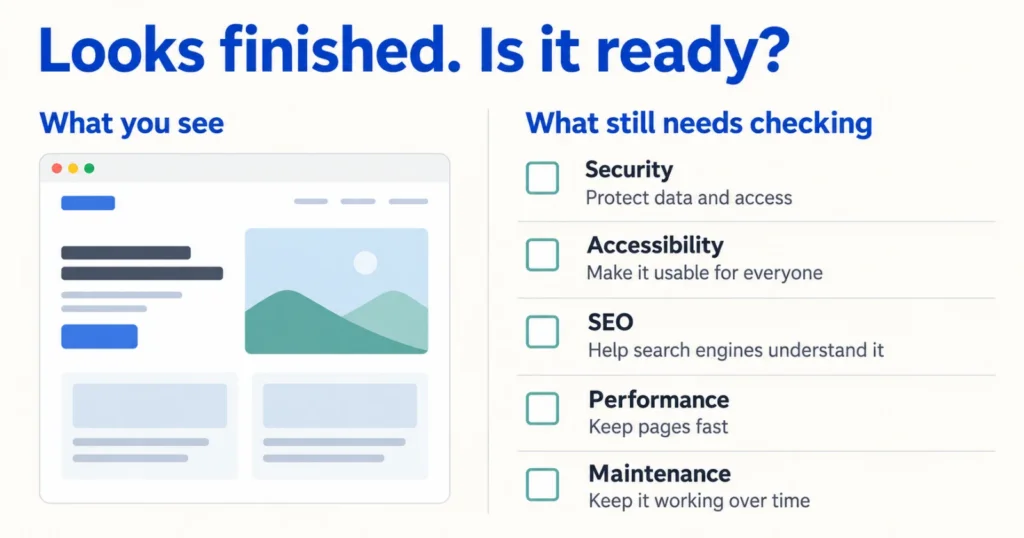
To succeed, a website needs to be secure, accessible, discoverable, fast, maintainable, and aligned with real business goals. Those are the things AI-built websites often miss, even when they look polished on the surface.
The hidden costs of DIY AI-built websites
When businesses take a do-it-yourself approach to AI-built websites or applications, the initial savings can be appealing. But the true cost isn’t always apparent until something stops working, customers encounter problems, or the business needs to make changes. Here are five areas where professional expertise makes a difference:
1. Security: Does your AI-built website protect your business and your customers?
AI can generate functional code, but that doesn’t automatically mean the code follows security best practices. Depending on the project, vulnerabilities might involve authentication, user permissions, data handling, third-party integrations, or outdated dependencies. These issues may remain invisible until they’re exploited or uncovered during a professional review. The OWASP Top 10 outlines some of the most critical web application security risks and is a good place to start when deciding what to check.
2. Accessibility: Can everyone actually use it?
A visually appealing website isn’t necessarily an accessible one. AI-generated interfaces may overlook keyboard navigation, screen reader compatibility, appropriate color contrast, meaningful image descriptions, or accessible forms. These issues can prevent people with disabilities from successfully using your website. The Web Content Accessibility Guidelines (WCAG) provide an established framework for making digital experiences more accessible. Don’t treat accessibility as an optional finishing touch. Build it into every stage of design and development.
3. SEO: Can customers actually find your AI-generated website?
An AI-generated website might look fantastic to a human visitor while creating challenges for search engines. Missing metadata, confusing heading structures, poorly organized content, crawlability problems, and technical performance issues can all affect discoverability. And with AI-powered search becoming increasingly important, businesses need to think about how traditional search engines and AI answer platforms read their content.
Google’s SEO Starter Guide explains the foundational practices that help search engines understand website content. We also explored how these fundamentals connect to AI search in our HubSpot UNBOUND 2026 recap.
4. Performance: Does it work as well as it looks?
A website may look great on a desktop computer but perform poorly on mobile devices, load slowly, or struggle when more users arrive. AI-generated websites can include unnecessary code, inefficient assets, or technical decisions that affect speed and reliability. Google’s Core Web Vitals provide useful measures of real-world loading performance, responsiveness, and visual stability. They also shape how people experience your brand.
5. Maintenance: Who fixes it six months from now?
For AI-built websites, this may be the most overlooked consideration of all. What happens when the business needs a new feature? When an integration changes? When a plugin or dependency needs an update? Or when the person who originally generated the code moves on? Without clear documentation, a maintainable architecture, and an ongoing support plan, seemingly simple updates can become complicated.
That’s the plumber’s second rate: maintaining or repairing a DIY build often costs more than building it did.
AI isn’t the problem. Missing expertise is.
We want businesses to use AI.
AI is changing what’s possible in web design, development, marketing, and digital strategy. It can accelerate research, simplify repetitive tasks, support brainstorming, and help teams move from an idea to a prototype faster than ever. Those are meaningful benefits, but AI doesn’t replace professional judgment.
Experienced designers, developers, strategists, and marketers know which questions to ask beyond the initial prompt. They consider how a website fits into the broader business, how users interact with it, how it protects information, and what happens as the organization grows. They also know when to question, test, refine, or reject an AI-generated answer.
Our approach at 3 Media Web pairs innovation with accountability, and we’ve published it as our Human Expertise & Responsible AI commitment.
There’s a better way to build with AI
The most effective approach to AI web development uses AI and human expertise together, each for what it does best.
Imagine a business owner who has an idea for a new customer portal. Instead of spending weeks trying to explain the concept, they use AI to create a simple working prototype.
They bring that prototype to their digital agency, where experienced professionals can evaluate the concept, identify potential risks, refine the user experience, and develop a secure, scalable solution. The AI-generated prototype becomes a useful starting point rather than a finished product someone has to untangle.
The client can communicate their vision more clearly, and the agency spends less time guessing what the client wants. And the project can move forward with the right technical and strategic foundation.
What should businesses do before launching an AI-built website?
If you’ve been experimenting with AI to build a website, landing page, or application, that’s a great place to start.
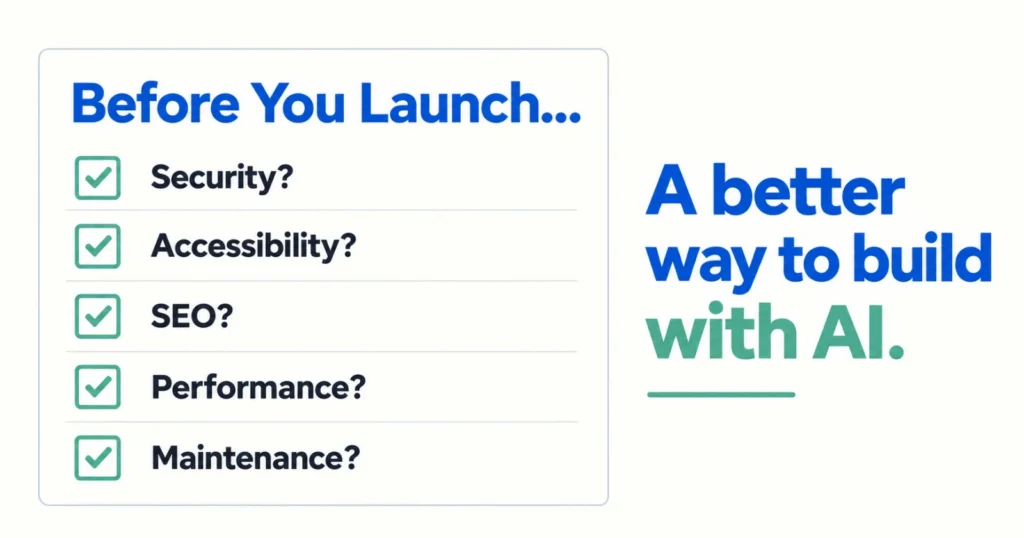
Before putting it in front of customers, however, answer these five questions:
- Has the code been reviewed for security? Are customer information, permissions, and integrations being handled appropriately?
- Has the experience been tested for accessibility? Can people navigate and use the website with different devices and assistive technologies?
- Is the website optimized for search? Can search engines crawl, understand, and index the content effectively?
- Has performance been evaluated? Does the experience work well on mobile devices and under realistic conditions?
- Is there a long-term maintenance plan? Who will support, update, and improve the solution as business needs evolve?
If you can’t confidently answer those questions, your AI experiment is still a good start. Bring in the right expertise before small problems become expensive ones.
Build smarter, not just faster
The plumber’s lesson is knowing when to bring in an expert. That call can save time, money, and frustration, and the same principle applies to AI.
Building a website keeps getting easier and faster, and businesses should take advantage of that. But speed alone doesn’t guarantee quality, and a convincing demo isn’t the same as a secure, accessible, high-performing website.
The best results come from pairing modern tools with people who have the judgment to check the work and answer for it.
At 3 Media Web, we believe in human expertise, responsible AI, and digital solutions built to last.
Already experimenting with AI-generated websites or applications? We’d love to see what you’ve created and help you turn it into something ready for the real world.