Last updated: August 1, 2026
TL;DR: If your campaigns drive traffic but leads stall, your website is usually the bottleneck. Five issues quietly hurt financial services lead generation, and each has a clear fix:
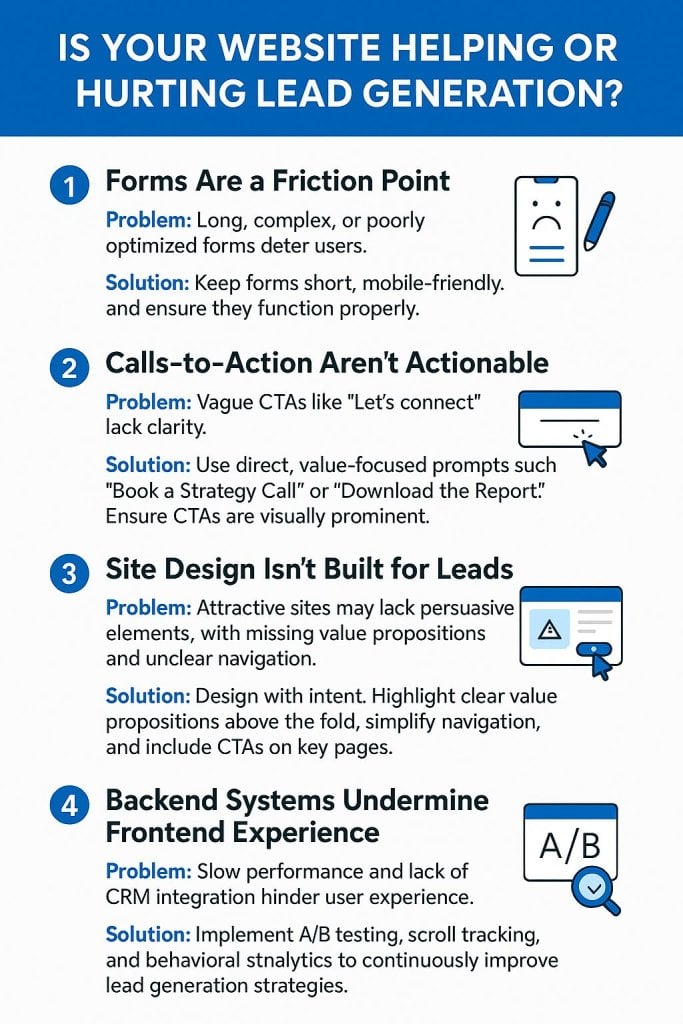
- Forms are too long or clunky: Long, complex, or slow forms create friction. Make them short, mobile-friendly, and backed by smart follow-ups.
- Calls-to-action lack clarity: Vague CTAs like “Let’s connect” don’t inspire action. Replace them with direct, value-focused prompts like “Book a Strategy Call.”
- The site isn’t designed for leads: A polished site can still miss value props, bury CTAs, and confuse navigation. Design with conversion intent.
- Backend systems undermine the funnel: Slow performance, broken CRM sync, and no automation create funnel friction behind the scenes.
- No optimization loop exists: Without A/B testing, scroll tracking, and behavioral analytics, your site never improves. Data is how lead gen compounds.
Keep reading as we break down each issue and actionable solution in detail…
Is Your Website Helping or Hurting Your Lead Generation?
If your campaigns are strong but conversions are weak, your website is the most likely culprit. Many financial marketing leaders invest in the right channels — email campaigns, webinars, paid media management. Their teams generate traffic and do everything they can to attract attention.
But conversions? That’s another story.
The leads aren’t qualified, the forms aren’t getting filled out, and sales is asking why the funnel’s running dry. The most frustrating part: many marketing leaders suspect the website is the problem, but it’s hard to prove, let alone fix, with current in-house resources.
If you’ve ever wondered whether your website is working for your lead gen — or actively working against it — this article will help you get clarity and take action. Strengthening conversion is the core of lead generation as a discipline, and your site is where it starts.
Why Is Your Website the Most Overlooked Part of Lead Gen Strategy?
Your website is overlooked because marketers are trained to optimize campaigns, not the destination those campaigns point to. Financial services marketers are often great at building campaigns, but the website is where most of those efforts either succeed or fail.
In today’s B2B landscape, your site is often the first place prospects evaluate your expertise, your credibility, and your offer. If that experience falls short, leads will stall, no matter how compelling your ads or emails might be.
Lead gen breaks down when:
- Your site isn’t optimized for speed or clarity
- Your forms feel outdated or intrusive
- The user journey isn’t aligned with the funnel stage
- Your CTAs are generic or buried
- Buyers can’t quickly understand why you stand out
Let’s look at the core issues and how to fix them.
1. Your Forms Are a Friction Point
Forms are the most common conversion leak because every extra field gives a busy buyer another reason to quit. Financial services buyers are risk-averse and time-starved. They don’t want to fill out a dozen fields just to request a whitepaper.
Ask yourself:
- Are forms short, scannable, and mobile-friendly?
- Are fields clearly labeled and aligned with the ask?
- Do forms load quickly and actually work?
- Is there a smart follow-up automation behind them?
Pro Tip: Start by auditing forms across your top-performing pages. This is often where quick conversion rate optimization wins live.
2. Your Calls-to-Action Aren’t Actionable
A call-to-action converts when it names a specific, valuable next step — not a vague invitation. “We’re here to help.” “Let’s connect.” These CTAs are friendly, but vague. In financial services, trust is key, but clarity converts.
Strong CTAs for lead gen may include:
- “Get a Free Portfolio Assessment”
- “Download the 2025 Market Readiness Report”
- “Book a 15-Minute Strategy Call”
Each CTA should match the funnel stage and set clear expectations. It’s also essential to make every CTA visually prominent and not buried beneath blocks of copy.
3. Your Site Isn’t Designed for Lead Capture
A site designed for lead capture guides every visitor toward a conversion, while a site designed only to look good leaves that to chance. Your homepage may look polished, but if it wasn’t built with lead generation in mind, you’re leaving money on the table.
Signs your web design and development strategy needs to evolve:
- No clear value prop above the fold
- Navigation is confusing or cluttered
- Key decision pages (e.g., services, resources) don’t have CTAs
- Landing pages lack consistent branding or messaging
Modern lead-gen websites combine form and function: clean layouts, streamlined messaging, and a frictionless path from awareness to inquiry.
4. Your Backend Isn’t Supporting the Funnel
A beautiful front-end means nothing if the backend is a mess, because slow performance and broken integrations leak leads before sales ever sees them. That’s where website support services come in.
For more on this topic, read Why Law Firm CMOs Need AI-Enhanced Web Strategy to Stay Competitive.
Your marketing site should:
- Integrate seamlessly with your CRM
- Quickly route leads to the right reps
- Track behaviors for retargeting and personalization
- Offer fast, secure performance 24/7
Speed is not just a backend nicety — it directly moves revenue. According to Think with Google’s research with SOASTA (published by Google, 2017), as mobile page load time goes from one second to 10 seconds, the probability of a mobile visitor bouncing increases 123%. You can review the full mobile page-speed benchmarks in Think with Google’s report. If your team has to wait on IT to make basic updates, or if you’re unsure where leads are going, that’s a problem worth solving.
5. You’re Not Using Data to Adjust On the Fly
Your website should be a testing ground, because the only way to keep improving lead gen is to learn from real visitor behavior. With the right setup, you can continually optimize for better performance.
Use analytics to:
- A/B test CTAs, headlines, and page layouts
- Measure bounce and scroll depth on top traffic pages
- Refine lead flows based on real behavior
Pair this with insights from SEO and lead generation campaigns to close the loop between content, traffic, and results. When you can show what the website contributes, it becomes far easier to defend budget — a theme we cover in the metrics that prove partnership value to leadership.
What Is Conversion Rate Optimization (CRO)?
Conversion rate optimization (CRO) is the practice of systematically increasing the share of website visitors who take a desired action — filling out a form, booking a call, or downloading a resource — without needing more traffic. For financial services teams, CRO usually means auditing forms, sharpening CTAs, improving page speed, and A/B testing high-intent pages, then letting behavioral data guide the next change.
When Should You Redesign Your Website vs. Optimize It?
Optimize when the fundamentals are sound but specific pages underperform — you can win with form, CTA, and speed fixes in weeks. Redesign when the site fights your brand, buries your value prop, or can’t support conversion tracking and CRM integration no matter how many tweaks you make. If in-house edits require waiting on IT, a structural rebuild usually pays back faster than endless patching.
What Does a High-Converting Financial Website Look Like?
A high-converting financial website loads fast, communicates value instantly, and guides every visitor toward a clear next step. The table below contrasts a site that helps lead gen with one that quietly hurts it across the attributes that matter most.
| Attribute | A site that helps lead gen | A site that hurts lead gen |
|---|---|---|
| Mobile speed | Loads in under 3 seconds on mobile | Slow, bloated pages that drive bounces |
| Value clarity | Explains who you are and what you do, fast | Buyers can’t tell why you stand out |
| Calls-to-action | Multiple, specific, low-friction CTAs | Vague or buried CTAs like “Let’s connect” |
| Funnel alignment | Guides visitors from awareness to action | No clear path; visitors stall and leave |
| Lead handling | Tracks and routes leads automatically | Leads land in a black hole or slow queue |
| Credibility | Looks as credible as your competitors, if not more so | Dated design that undercuts trust |
If your current site misses even a few of these, that could be the root cause of your lead gen frustration. Getting these fundamentals right is also what makes a website worth trusting over the long term — something we explore in building trust in partnerships.
How Can 3 Media Web Help?
We help financial services marketers turn underperforming websites into performance engines, from audit through launch to continuous improvement. At 3 Media Web, our strategic support services are built around lead capture and conversion.
If this challenge sounds familiar, Conversion Testing: How to Benchmark and Improve Your Website is worth a read.
In our work with Hum Capital, a fintech company connecting businesses with investors and lenders through an AI-powered funding platform, we rebuilt a slow, disjointed website into a clean, mobile-optimized experience with streamlined calls to action. The redesign increased website traffic by 39% and improved the conversion rate by 7% immediately following launch — exactly the kind of shift that turns a website from a lead-gen liability into a revenue engine.
We offer:
- Strategic web design and development focused on lead capture and conversion
- Technical website support and performance optimization
- Ongoing conversion rate optimization for high-traffic pages
- Integrated analytics, automation, and retargeting tools
- End-to-end support from audit to launch to continuous improvement
Our clients don’t just get prettier websites — they get measurable results.