Last updated: July 20, 2026
TL;DR:
- No SEO plan = big traffic loss. Skipping an SEO strategy during a redesign often costs you the rankings and visibility you spent years earning.
- Broken redirects tank traffic. Not mapping old URLs to new ones with permanent 301 redirects breaks backlinks and drops you out of search results.
- Poor content mapping erases authority. Removing or moving high-performing pages without a plan throws away the keyword authority behind them.
- Design over function hurts performance. Heavy visuals that ignore speed, mobile, and structure damage both user experience and search rankings.
- No post-launch audit leaves issues live. Failing to re-crawl and fix problems after launch lets ranking-killers sit unresolved.
A website redesign is the perfect moment to clear out the habits quietly dragging down your SEO. It is also the moment those same gains are easiest to lose. Rebuild a site top to bottom and a handful of avoidable mistakes can erase rankings, backlinks, and the organic traffic that took years to build.
This guide pulls the most common website redesign SEO mistakes together with the fixes that prevent them, drawn from the award-winning strategists, developers, and designers at 3 Media Web. Use it as a checklist so qualified traffic from Google and Bing keeps coming after launch day, ideally stronger than before. For the deeper, ongoing work behind these fixes, our SEO strategy team treats a redesign as a chance to grow rankings, not just protect them.
What are the most common SEO mistakes during a website redesign?
The most common website redesign SEO mistakes are missing redirects, careless content and URL changes, performance-killing design choices, and skipping a post-launch audit. Each one quietly bleeds organic traffic, and each one is preventable when you name it before development starts. The table below maps the mistakes our team sees most often to why they hurt and how to avoid them.
| Redesign mistake | Why it hurts your SEO | How to avoid it |
|---|---|---|
| No SEO plan before development | Structure, content, and keywords get rebuilt blind, so rankings drop with no clear cause. | Plan site structure, content, and target keywords before a single page is built. |
| Missing or wrong redirects | Old URLs return 404s, breaking backlinks and dropping pages out of search results. | Map every old URL to its new home with a permanent 301 redirect. |
| Deleting or moving ranked content | Removing high-performing pages throws away the keyword authority behind them. | Inventory top pages first, then retain their content, tags, and keywords. |
| Design that ignores performance | Heavy images, sliders, and animations slow load time and hurt Core Web Vitals. | Optimize images, keep heavy media below the fold, and test on real devices. |
| Forgotten alt text and metadata | Missing alt text and stale meta tags weaken accessibility and on-page signals. | Write descriptive alt text and refresh titles and meta descriptions to match the new design. |
| No post-launch SEO audit | Crawl errors, blocked pages, and missing sitemaps sit unresolved and cap your growth. | Re-crawl the live site, fix what surfaces, and submit fresh sitemaps in Search Console. |
How do you protect SEO when redesigning content and structure?
Protect your SEO by planning structure, content, and keywords before development, redirecting every changed URL, and preserving the pages that already rank. A redesign is the right time to refresh content and information architecture for your audience, but it is also where the deepest SEO damage happens if you move fast and skip the plan.
For a deeper look at this, see Best Practices To Update Website Content During A Redesign.
Our senior strategists put it plainly:
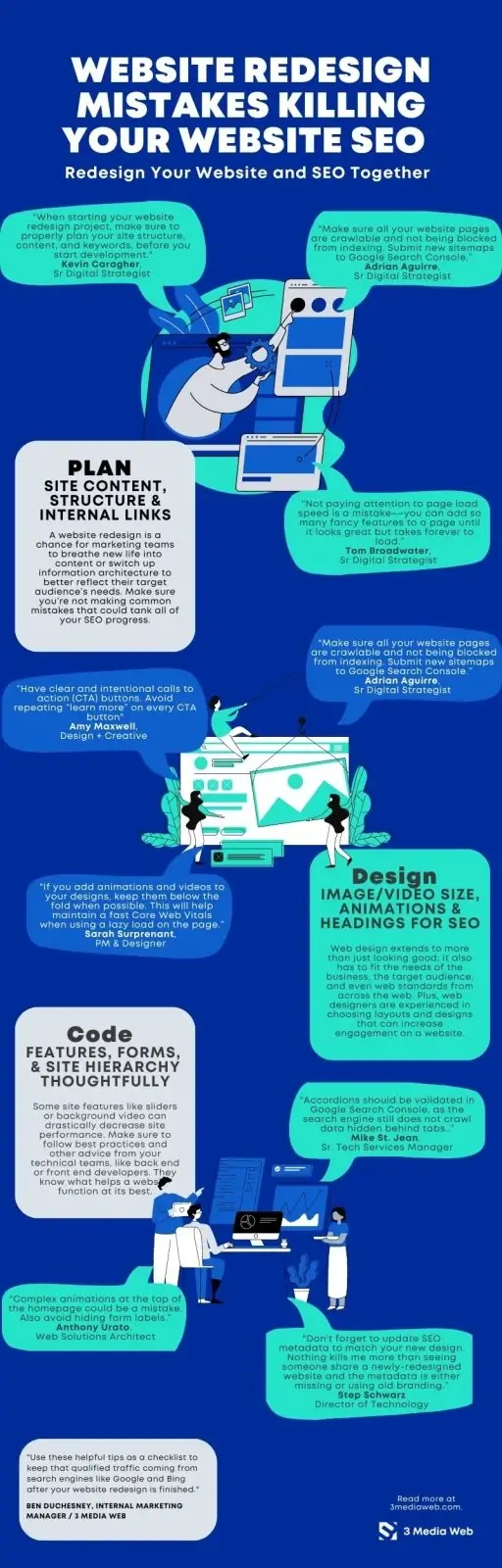
“When starting your website redesign project, properly plan your site structure, content, and keywords before you start development. For any existing content, retain your existing tags and keywords correctly when redesigning. Once your site is ready to launch, QA and test the new site and make sure mobile pages are responsive across devices.” ––Kevin Caragher, Senior Digital Strategist
“Be careful completely redoing your folder structure when redesigning your content. That can really torpedo your SEO performance, especially if you are removing highly ranked content. Make sure to include the proper redirects.” ––Marc Avila, CEO
Redirect every URL you change
A permanent 301 redirect is the single most important step for keeping rankings through a redesign. When you delete a page or change a URL, the old address has to point to its closest new equivalent, or the backlinks and ranking signals attached to it disappear. According to Google Search Central, a permanent server-side redirect is “the best way to ensure that Google Search and people are directed to the correct page,” and it signals the new URL should be treated as the canonical version in search results. Build a full redirect map before launch and test it the day you go live.
What is a 301 redirect?
A 301 redirect is a permanent, server-side instruction that sends both visitors and search engines from an old URL to a new one. The “301” is an HTTP status code meaning “moved permanently.” Unlike a temporary 302, a 301 passes the old page’s ranking signals and backlink value to the new address, which is why it is the correct tool for any URL that changes in a redesign.
Keep the content and keywords that already rank
Inventory your best-performing pages before you touch the folder structure. Pulling up your top organic pages in analytics and Search Console first tells you which content, tags, and keywords must survive the move intact. Renaming files or collapsing a deep folder structure can erase years of authority overnight, so changes to high-value URLs should be deliberate and always paired with a redirect.
Strengthen internal linking while you are in there
A redesign is the best opportunity you will get to connect your most important pages through internal links. Whether or not you add new content, take the time to link related pages together in a way that genuinely helps the reader find the next step. If you want a practical, repeatable approach to the on-page work, our guide to on-page SEO that actually works walks through titles, headings, and internal links in plain language.
Which design and performance decisions affect your SEO health?
Design decisions affect SEO whenever they change page speed, accessibility, or how clearly search engines can read the page. Good design does more than look good: it has to serve the business, the audience, and the technical standards search engines reward. The choices below are where visual ambition most often collides with search performance.
For a closer look at how this plays out, see How to Build a Business Case for a Website Redesign.
Done with SEO built in from the first wireframe, a redesign becomes a growth lever rather than a risk. In our work with global telecom-component manufacturer Maxdao, we rebuilt their site on WordPress with a clean product taxonomy and a keyword-led content structure, and organic traffic rose 48% within the first 90 days after launch. The lesson we see repeated: the redesigns that gain rankings are the ones where structure, speed, and SEO are planned together, not bolted on afterward.
Page speed and Core Web Vitals come first
A slow page is a silent ranking killer, and a redesign is where speed quietly slips. It is easy to keep adding fancy features until a page looks great but takes forever to load. According to Google Search Central, Google “highly recommends site owners achieve good Core Web Vitals for success with Search,” because the metric aligns with what its core ranking systems seek to reward (aim for Largest Contentful Paint within 2.5 seconds). Compress images to next-gen formats, keep animations and background video below the fold, and lazy-load heavy assets to protect First Contentful Paint. When performance is tied to hosting and ongoing upkeep, our hosting, maintenance, and support team keeps those gains from eroding after launch.
Keep accessibility and structure clean
Accessible, well-structured pages are easier for both visitors and search engines to understand. Maintain a clear heading hierarchy so Google knows what each page is about: every page needs at least one H1, and ideally clear H2s beneath it. Declare decorative images as decorative in your CMS so they are not flagged as missing alt text, and write meaningful alt text for every image that conveys information. Treating website accessibility as a baseline rather than a finishing touch protects both your audience and your rankings.
Validate the design patterns that hide content
Some popular design patterns can quietly bury content search engines need to see. Image sliders and background video can drag down performance, and content tucked behind accordions or tabs is not always crawled, so validate it in Search Console. Avoid putting important content or form labels inside pop-ups and hidden elements, and give every call-to-action a clear, specific label instead of repeating “learn more” across the page.
“Be wary of image sliders, as they can negatively impact performance. Accordions and content behind tabs should be validated in Search Console, since the engine still may not crawl data hidden there. Also consider avoiding background videos and not optimizing images to next-gen formats.” ––Mike St. Jean, Sr. Tech Services Manager
“Forgetting to have your SEO metadata match your new design is a big one. Nothing kills me more than seeing a newly redesigned site shared where the sharing info is missing or still uses the old branding.” ––Step Schwarz, Director of Technology
How do you confirm your SEO survived the redesign?
Confirm your SEO survived by re-crawling the live site, checking that every page is indexable, and submitting fresh sitemaps the moment you launch. Launch day is the start of the SEO work, not the end of it. A new design can introduce crawl blocks, broken redirects, and indexing problems that only a post-launch audit will catch.
“Make sure all your website pages are crawlable and not blocked from indexing. Also, submit new sitemaps in Google Search Console after launch.” ––Adrian Aguirre, Senior Digital Strategist
Crawl the new site with an SEO tool, confirm no important pages carry a stray noindex or robots block, and verify your redirect map resolves cleanly. Submit an updated XML sitemap in Search Console so Google re-discovers the new structure quickly. If you want to see your site the way the search engine does, our breakdown of how Google actually sees your website shows what a crawler reads versus what a visitor sees, and where redesigns commonly trip it up.
How long does it take for SEO to recover after a website redesign?
When a redesign is handled well, rankings usually hold steady or dip only briefly before recovering within a few weeks as Google re-crawls and re-indexes the new URLs. Serious drops that linger for months are a symptom of a problem—broken redirects, lost content, or blocked pages—not a normal settling period. The fastest way to shorten any dip is a clean redirect map, preserved high-value pages, and a fresh sitemap submitted on launch day.
Frequently asked questions about website redesign SEO
Will a website redesign hurt my SEO?
A redesign only hurts your SEO when it is done without a plan. The damage comes from missing redirects, deleted ranked pages, and slower performance, not from the new design itself. Map your URLs, preserve high-performing content, and run a post-launch audit, and a redesign can hold or even improve your rankings.
Do I need redirects when I change my URLs?
Yes. Any URL that changes or disappears needs a permanent 301 redirect to its closest new equivalent. Without it, the backlinks and ranking signals tied to the old address are lost and visitors hit 404 pages. Google recommends permanent server-side redirects as the most reliable way to preserve your place in search results.
What is the difference between a 301 and a 302 redirect?
A 301 redirect is permanent and tells search engines to transfer the old page’s ranking signals to the new URL, while a 302 is temporary and signals the original URL will return. For a redesign, almost every changed URL needs a 301—using a 302 by mistake can hold ranking value on the old address and stall your recovery in search results.
How fast should my redesigned website load?
Aim for a Largest Contentful Paint within 2.5 seconds on your most important pages. Google recommends good Core Web Vitals because they align with what its ranking systems reward. The most reliable speed wins are compressing images to next-gen formats, deferring heavy media below the fold, and lazy-loading assets so the page paints quickly.
Should I redesign content and SEO at the same time?
Yes, and a redesign is the ideal time to do both together. Refreshing content, information architecture, and internal links alongside the visual design lets you fix structural SEO issues in one pass. The key is to plan keywords and URLs before development and protect the pages that already rank with redirects.
What should I check right after launching the redesign?
Re-crawl the live site, confirm every important page is indexable, test that your redirects resolve, and submit a fresh XML sitemap in Search Console. Also check that page titles, meta descriptions, and social sharing data reflect the new design. These post-launch checks catch the crawl and indexing issues that quietly cap organic growth.
How 3 Media Web Can Help
A redesign should make your website faster, clearer, and stronger in search, not set your rankings back. At 3 Media Web, we plan and execute redesigns with SEO built in from the first wireframe, guided by our Human and AI approach so expert judgment leads and technology supports it. That includes:
- A full redirect map and content inventory so no ranked page or backlink is lost in the move.
- Ongoing SEO strategy that treats your redesign as a chance to grow organic traffic, not just protect it.
- Performance and accessibility baked into design and development so speed and structure never become an afterthought.
- Proactive strategic support that keeps your site crawlable, fast, and ranking long after launch day.
Protecting and growing your SEO through a redesign is a real project that rewards an expert team. Contact 3 Media Web to plan a redesign that keeps qualified traffic coming from Google and Bing.